
The Paradox of Identity: Humanity as a Moral Condition from Buddhist Philosophy and Existentialist Perspectives
Article Sidebar
Main Article Content
Abstract
This article aims to 1) analyze the perspectives of non-human realms within Buddhist cosmology expressing an existential desire for human rebirth, and 2) critique the paradox in which human beings despite possessing the highest potential for liberation from the cycle of suffering tend toward paths driven by desire and materialism. This inquiry utilizes Western philosophical frameworks and a descriptive philosophical analysis methodology, integrating existentialist ethics and instrumentalism.
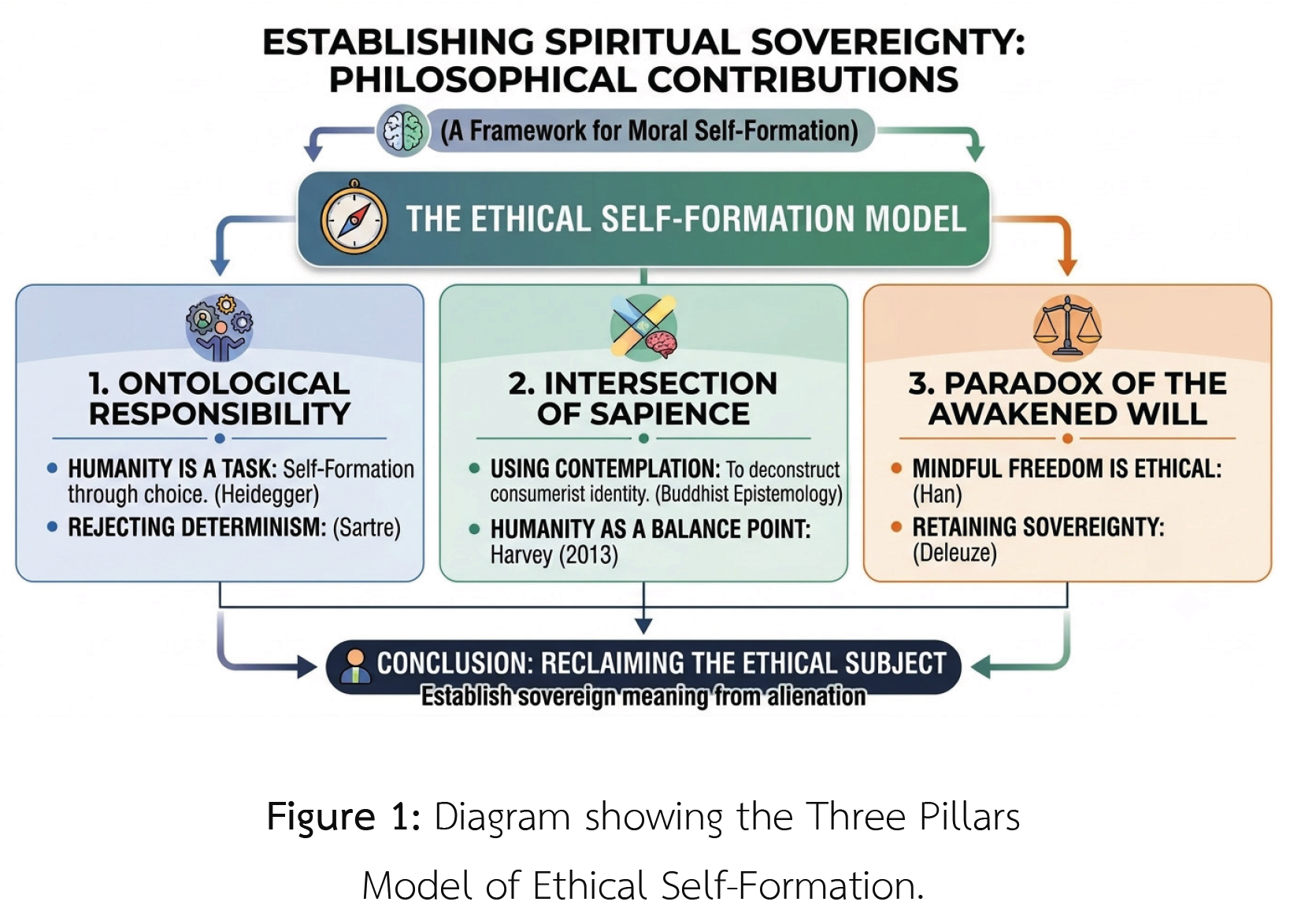
The findings demonstrate that humanity is not merely a static biological category or a sociological construct but a unique ìmoral spaceî situated in the liminality between structural determinism and free will. While other realms remain subjugated to instinctual drives or the extremes of sensory pleasure and pain, the human condition provides a critical equilibrium conducive to transformative reflection and the deconstruction of the illusory self. Through the exercise of reason, contemplation, and mindful ethical action, humanity ceases to be a mere opportunity and is instead recognized as an ìexistential responsibilityî of the highest order.
Ultimately, the central proposition of this article suggests that realizing human potential through the frameworks of freedom and mindful choice is the key to self-elevation within both Buddhist and universal philosophical contexts. This realization serves as an essential pathway for reclaiming true existential meaning in the contemporary world.
Article Details
References
Agamben, G. (1998). Homo Sacer: Sovereign power and bare life (D. Heller-Roazen, Trans.). Stanford University Press.
Aristotle. (2009). The Nicomachean ethics (D. Ross, Trans.). Oxford University Press.
Bourdieu, P. (1990). The logic of practice (R. Nice, Trans.). Stanford University Press.
Deleuze, G. (1992). Postscript on the societies of control. October, 59, 3–7.
Dewey, J. (1938). Experience and education. Macmillan.
Dreyfus, H. L., & Thompson, E. (2007). Mindful inquiry. In Self, no self? Perspectives from analytical, phenomenological, and Indian traditions. Oxford University Press.
Foucault, M. (1977). Discipline and punish: The birth of the prison (A. Sheridan, Trans.). Pantheon.
Foucault, M. (1988). Technologies of the self: A seminar with Michel Foucault (L. H. Martin, H. Gutman, & P. H. Hutton, Eds.). University of Massachusetts Press.
Frankl, V. E. (2006). Man’s search for meaning (I. Lasch, Trans.). Beacon Press. (Original work published 1946).
Gethin, R. (1998). The foundations of Buddhism. Oxford University Press.
Habermas, J. (1984). The theory of communicative action: Reason and the rationalization of society (T. McCarthy, Trans.). Beacon Press.
Han, B.-C. (2015). The transparency society (E. Butler, Trans.). Stanford Briefs.
Harvey, P. (2013). An introduction to Buddhism: Teachings, history and practices (2nd ed.). Cambridge University Press.
Heidegger, M. (1962). Being and time (J. Macquarrie & E. Robinson, Trans.). Harper & Row. (Original work published 1927).
Kant, I. (1997). Groundwork of the metaphysics of morals (M. Gregor, Trans. & Ed.). Cambridge University Press. (Original work published 1785).
Keown, D. (2001). The nature of Buddhist ethics. Palgrave Macmillan.
Keown, D. (2005). Buddhism and ethics. In Buddhist ethics: A very short introduction. Oxford University Press.
Levinas, E. (1969). Totality and infinity: An essay on exteriority (A. Lingis, Trans.). Duquesne University Press.
Mahachulalongkornrajavidyalaya University. (1996). Thai Tripiṭaka (Mahachulalongkornrajavidyalaya Edition).
Mahachulalongkornrajavidyalaya University Press.
Nagel, T. (1971). The absurd. The Journal of Philosophy, 68(20), 716–727.
Phra Brahmagunabhorn (P. A. Payutto). (2012). Buddhadhamma: The expanded and revised edition [In Thai]. Buddhadhamma Foundation.
Phra Phaisan Visalo. (2018). The middle way of life in the digital age [In Thai]. Buddhadasa Indapanno Archives.
Rahula, W. (1978). What the Buddha taught (Revised ed.). Grove Press.
Rawls, J. (1999). A theory of justice (Revised ed.). Belknap Press.
Sartre, J.-P. (2007). Existentialism is a humanism (C. Macomber, Trans.). Yale University Press. (Original work published 1946).
Walpola, R. (2003). The Buddha’s philosophy of mind: An introduction. Buddhist Publication Society.
Williams, P. (2009). Mahayana Buddhism: The doctrinal foundations (2nd ed.). Routledge.
