
Spatial Structure and Psychological Control: A Behavioral and Political Philosophical Analysis in Official Training Centers
Article Sidebar
Main Article Content
Abstract
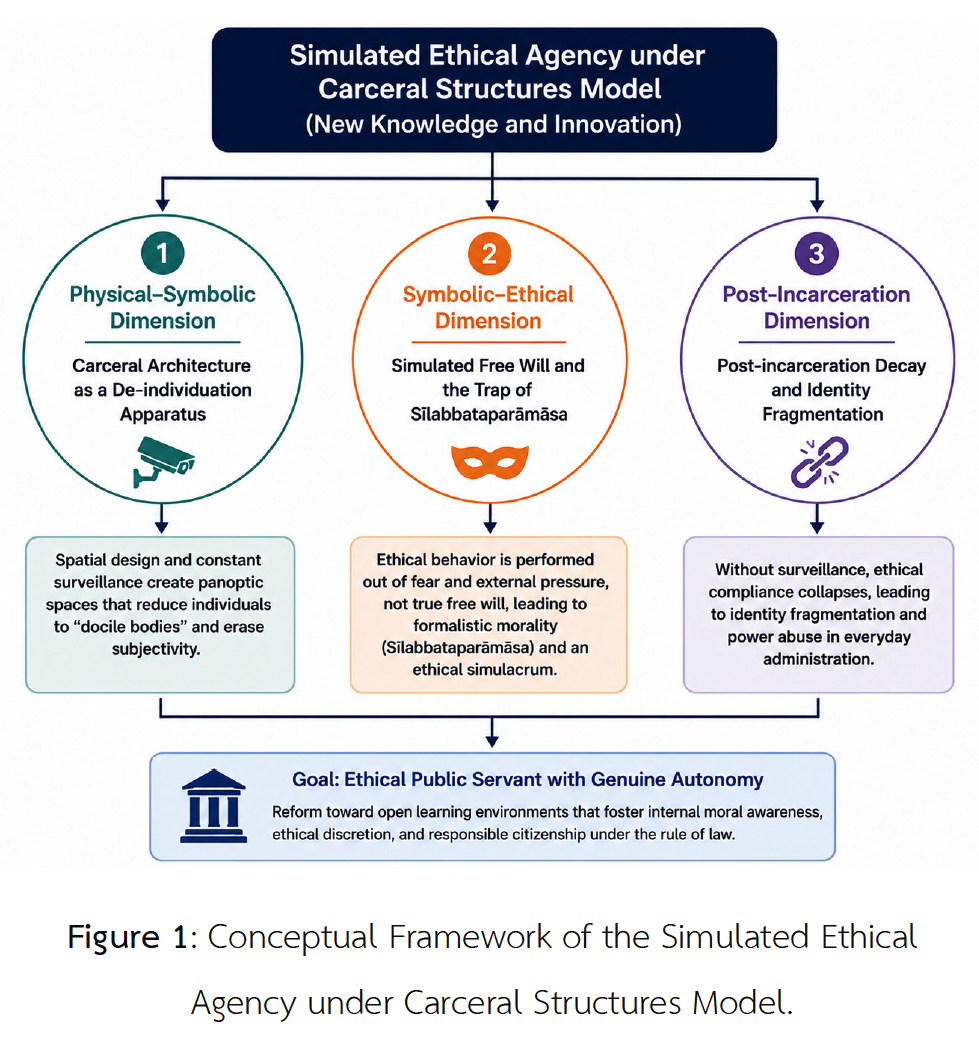
This research aims to: 1) analyze the structural relationship between spatial design and psychological behavioral responses within official training centers; and 2) examine the limitations of free will under closed control systems while developing the concept of simulated ethical agency under carceral structures.
Utilizing a qualitative research methodology compliant with strict ethical standards through phenomenology and encrypted in-depth interviews with ten former trainees to ensure anonymity, the findings reveal that physical architecture functions as a mechanism of total control, establishing panopticism to produce docile bodies. Spatial design combined with coercive scheduling systematically diminishes individual moral agency, leading to a state of simulated free will where ethical conduct is exhibited primarily for professional survival.
This phenomenon represents an academic crisis characterized by the concept of Sīlabbataparāmāsa, or formalistic moral adherence driven by fear of surveillance rather than internal wisdom and awakened will. These discoveries provide strategic policy recommendations for the Office of the Civil Service Commission to advocate for open-learning spaces to reclaim human dignity and cognitive autonomy suppressed by state power technologies. Such a framework serves as a vital pathway for fostering authentic ethical citizens with genuine moral responsibility in the contemporary landscape of public administration.
Article Details
References
Adorno, T. W. (1950). The Authoritarian Personality. Harper & Brothers.
Agamben, G. (1998). Homo sacer: Sovereign power and bare life (D. Heller-Roazen, Trans.). Stanford University Press.
Areesomboon, S. (2022). Spatial politics and institutional architecture: Mapping power in Thai government offices. Journal of Social Architecture, 18(4), 145–160.
Deleuze, G. (1992). Postscript on the societies of control. October, 59, 3-7.
Dewey, J. (1938). Experience and education. Macmillan.
Foucault, M. (1995). Discipline and punish: The birth of the prison (A. Sheridan, Trans.). Vintage Books. (Original work published 1977).
Frankfurt, H. G. (1971). Freedom of the will and the concept of a person. Journal of Philosophy, 68(1), 5-20.
Han, B.-C. (2015). The transparency society (E. Butler, Trans.). Stanford Briefs.
Heidegger, M. (1962). Being and time (J. Macquarrie & E. Robinson, Trans.). Harper & Row. (Original work published 1927).
Heidegger, M. (1977). The question concerning technology, and other essays (W. Lovitt, Trans.). Harper & Row.
Kant, I. (1997). Groundwork of the metaphysics of morals (M. Gregor, Trans. & Ed.). Cambridge University Press. (Original work published 1785).
Maneerat, A. (2024). Constructing the ideal bureaucrat: Training camps, spatial discipline, and ideological conformity. Public Administration Quarterly, 30(2), 201-218.
Phra Brahmagunabhorn (P. A. Payutto). (2012). Buddhadhamma: The expanded and revised edition [In Thai]. Buddhadhamma Foundation.