
Political Ideologies and Ethical Consciousness of Different Generations in Local Administrative Organizations
Article Sidebar
Main Article Content
Abstract
This research article aims to: 1) analyze the disparities in political ideologies and ethical consciousness between older and younger generational cohorts within local administrative organizations; and 2) explore an ethical bridging structure through the concept of transitional ethical epistemology. Utilizing a qualitative research methodology grounded in interpretive inquiry and in-depth interviews with 12 key informants from major local government units undergoing high power transitions, the study uncovers a profound social epistemological fissure between generations. The findings reveal that the older generation structures its ethical consciousness through ontological subjugation to institutional hegemony, prioritizing institutional loyalty, hierarchical order, and the preservation of bureaucratic tradition. Conversely, the younger generation experiences identity alienation from vertical ideologies and seeks to establish systemic truth founded on structural transparency, individual free will, and political equality. This gap indicates that the conflict is not merely chronological but represents a battlefield of disparate cognitive structures of reality.
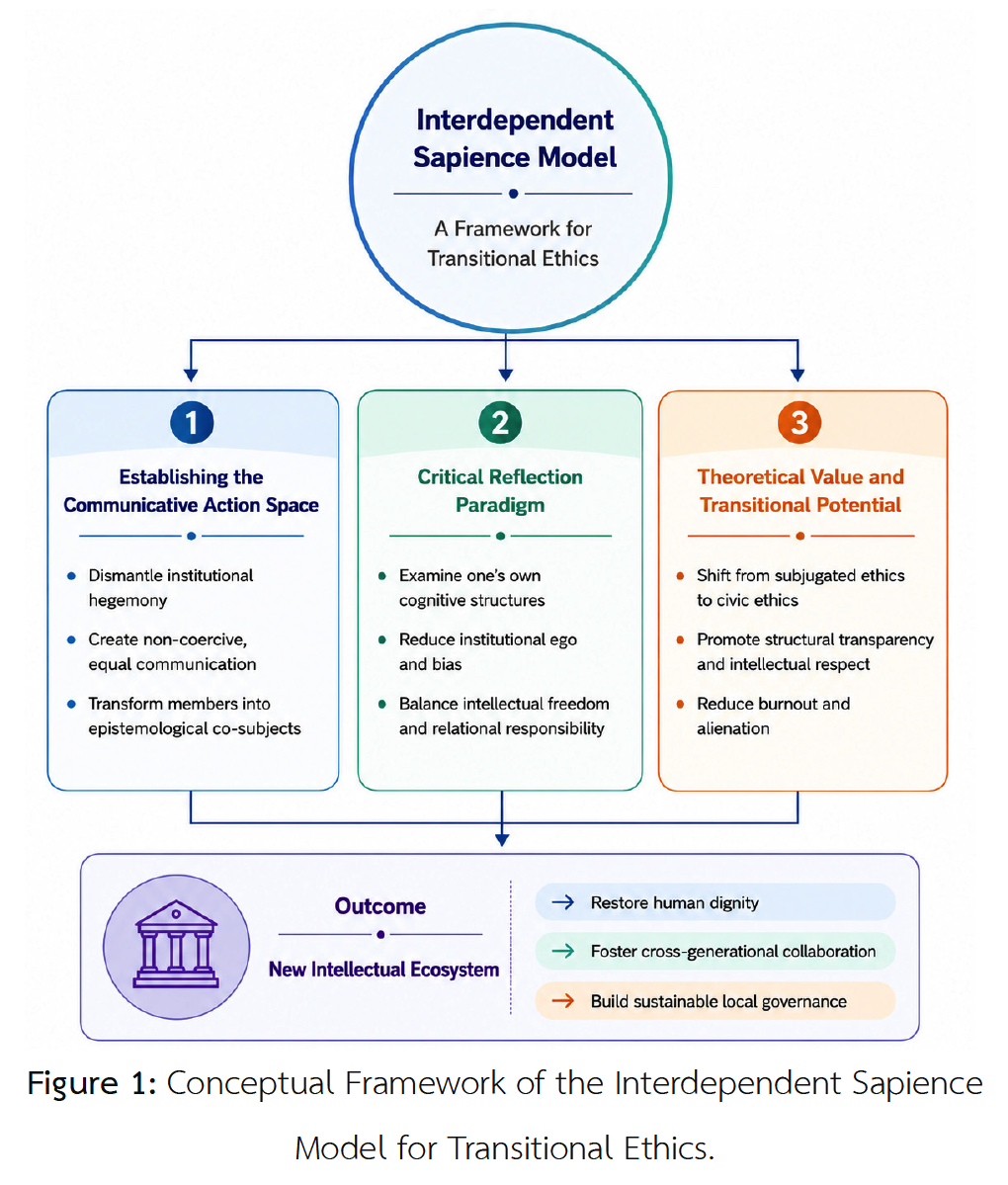
The theoretical contribution of this study proposes the Interdependent Sapience Model as a conceptual framework to facilitate a communicative action space, transcending the stagnation of traditional bureaucracy. By integrating critical reflection and communicative practices to mitigate value-based friction, this model provides a vital pathway for enhancing the efficiency and dignity of public service in the contemporary era of local governance.
Article Details
References
Adorno, T. W., Frenkel-Brunswik, E., Levinson, D. J., & Sanford, R. N. (1950). The authoritarian personality. Harper & Brothers.
Aristotle. (2009). Nicomachean ethics. (D. Ross, Trans.). Oxford University Press.
Bourdieu, P. (1990). The logic of practice. (R. Nice, Trans.). Stanford University Press.
Charoenrungruang, W. (2021). Generational friction in Thai local public administration: Conflict, culture, and structural constraints. Journal of Local Governance, 14(3), 89-104.
Deleuze, G. (1992). Postscript on the societies of control. October, 59, 3-7.
Dewey, J. (1938). Experience and education. Macmillan.
Foucault, M. (1977). Discipline and punish: The birth of the prison. (A. Sheridan, Trans.). Pantheon.
Habermas, J. (1984). The theory of communicative action: Reason and the rationalization of society. (T. McCarthy, Trans.). Beacon Press.
Han, B.-C. (2015). The transparency society. (E. Butler, Trans.). Stanford Briefs.
Kant, I. (1998). Critique of pure reason. (P. Guyer & A. W. Wood, Trans.). Cambridge University Press.
Levinas, E. (1969). Totality and infinity: An essay on exteriority. (A. Lingis, Trans.). Duquesne University Press.
Mannheim, K. (1952). The problem of generations. In P. Kecskemeti (Ed.), Essays on the sociology of knowledge (pp. 276-322). Routledge & Kegan Paul.
Office of the Public Sector Development Commission [OPDC]. (2003). The criteria and methods for good public governance. OPDC Press.
Phra Brahmagunabhorn (P. A. Payutto). (2024). Buddhist ethics for the contemporary world: A critical reflection. Buddhadhamma Foundation.
Rawls, J. (1999). A theory of justice (Revised ed.). Belknap Press.
Raksadee, A. (2023). Digital socialization and the shift in ethical consciousness among new-generation civil servants. Thai Administration Review, 21(1), 45-62.
Ruanpan, C. (2020). Management of community welfare funds for self-reliance in contemporary society. Journal of Humanities and Social Sciences, 11(1), 249-288.
Thai Tripiṭaka (Mahachulalongkornrajavidyalaya Edition). (1996). Mahachulalongkornrajavidyalaya University Press.
