
The Application of Buddhist Dhamma Principles in the Management of the Nam Chum Community Welfare Fund, Sung Men District, Phrae Province: A Philosophical Analysis
Article Sidebar
Main Article Content
Abstract
The objectives of this research are: 1) to study the Buddhist principles applied to community welfare fund management according to Buddhist perspectives; 2) to investigate the contextual conditions, problems, and obstacles in managing the Nam Chum Community Welfare Fund, Sung Men District, Phrae Province; and 3) to analyze the application of Buddhist principles in the administration of the Nam Chum Community Welfare Fund. This qualitative study employed interpretive inquiry, gathering data from 15 key informants through in-depth interviews.
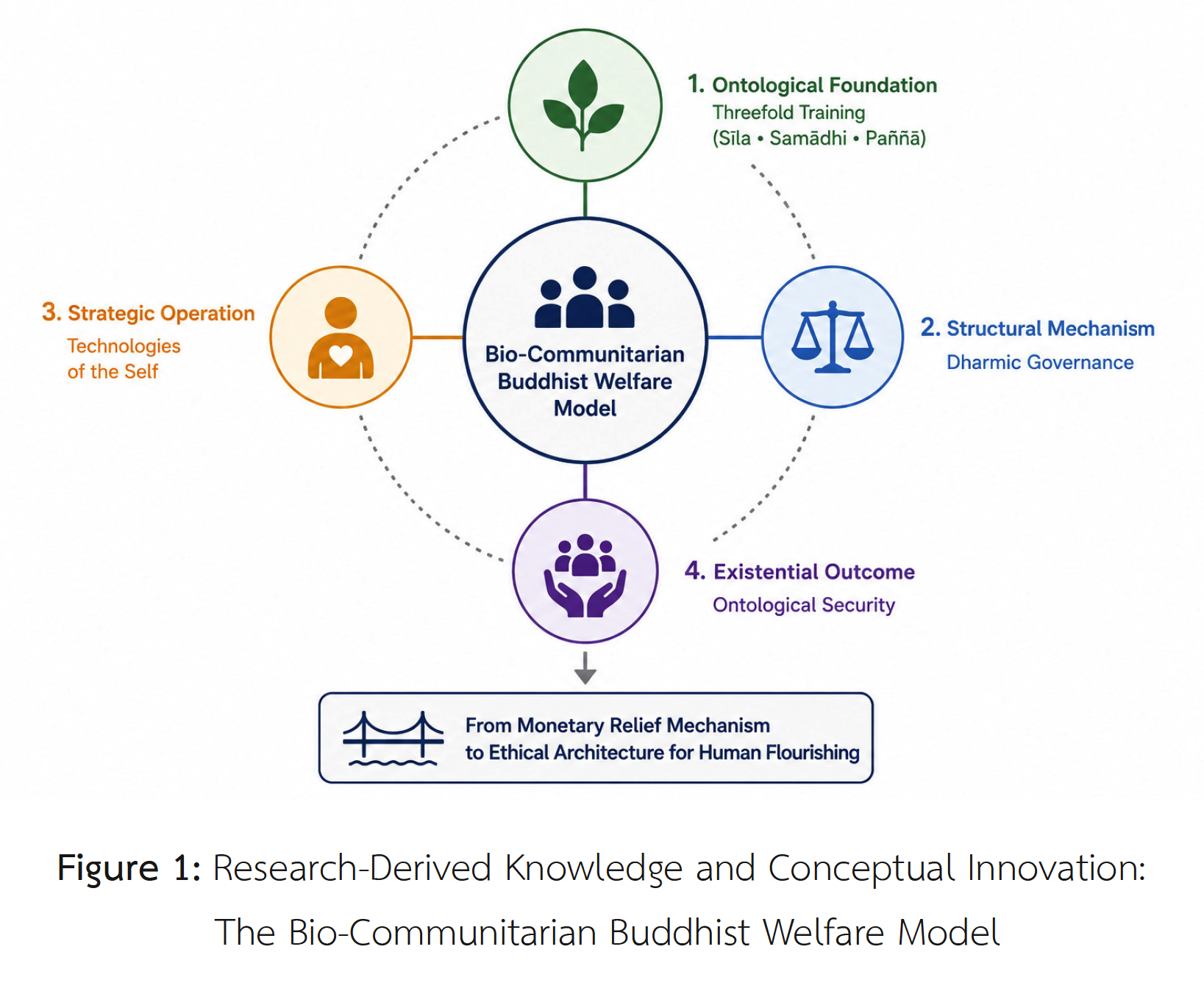
The findings reveal that: (1) the core Buddhist principle applied is the Threefold Training (Tisikkhā), which functions not merely as a private moral code but as a socio-ethical architecture for community regulation; (2) the Nam Chum fund operates within a tension between structural constraints and the pursuit of communitarian sovereignty, where the primary obstacles are identified as epistemological poverty in conceptualizing welfare and administrative alienation; and (3) the strategic application of Dhamma transforms financial assets into ìEthical Capitalî through a framework of Dharmic Governance. This transformation redefines welfare from a mere technical distribution of resources to the establishment of ontological security, empowering the community to safeguard human dignity against the precarity of contemporary economic crises.
Article Details
References
Agamben, G. (1998). Homo sacer: Sovereign power and bare life. Stanford University Press.
Aristotle. (2009). Nicomachean ethics. Oxford University Press.
Bourdieu, P. (1990). The logic of practice. Stanford University Press Community.
Organizations Development Institute [Public Organization]. (2015). Manual for community welfare funds operations. CODI.
Dewey, J. (1938). Experience and education. Macmillan.
Foucault, M. (1977). Discipline and punish: The birth of the prison. Pantheon.
Foucault, M. (1988). Technologies of the self: A seminar with Michel Foucault.
University of Massachusetts Press.
Foucault, M. (1988). Technologies of the self: A seminar with Michel Foucault. University of Massachusetts Press.
Habermas, J. (1984). The theory of communicative action, Vol. 1: Reason and the rationalization of society. Beacon Press.
Han, B.-C. (2015). The transparency society. Stanford Briefs.
Levinas, E. (1969). Totality and infinity. Duquesne University Press.
Mahachulalongkornrajavidyalaya University. (1996). Thai Tripiṭaka (Mahachulalongkornrajavidyalaya Edition). Mahachulalongkornrajavidyalaya University Press.
Narandawamsa, P. N. (2022). Application of the principle of Diṭṭhadhamma-hitattha projects to the management of community welfare funds. Dhammasarn Journal, 1(1), 1-16.
Office of the Public Sector Development Commission. (2003). Principles of good governance for good public administration. OPDC.
Office of the Public Sector Development Commission. (2008). The developmental guidelines for bureaucratic resource management. OPDC.
Patsin, T. (2024). Management of the community welfare fund of Hong Saeng Sub-district, Loeng Nok Tha District, Yasothon Province. Journal of Innovation in Administration and Educational Management, 2(1), 1-14.
Phra Brahmagunabhorn (P. A. Payutto). (2006). The perfect life (11th ed.). Rakkhangthong Press.
Phra Chulaphakkhawat Akkhavaro et al. (2024). The application of Buddhist principles in the administration of Buachet Sub-district administrative organization, Buachet District, Surin Province. Chaiyaphum Review Journal, 7(3), 153-163.
Phrakhru Sangkharak Bunsoem Kittivanno et al. (2018). The application of Buddhist principles for management of Highland Development
Center, Phrae Province. Journal of MCU Lampang, 7(1), 41–50.
Pongsapich, A. (2018). Culture, religion, and ethnicity: An anthropological analysis of Thai society (8th ed.). Chulalongkorn University Press.
Rattanapiean, W. (2019). Social welfare: Concepts and social service provision (2nd ed.). Thammasat University Press.
Rawls, J. (1971). A theory of justice. Harvard University Press.
Ruanpan, C. (2020). Management of community welfare funds for self-reliance in Suphanburi Province. Journal of Humanities and Social Sciences, Ubon Ratchathani University, 11(1), 249-288.
Somdet Phra Buddhaghosacariya (P. A. Payutto). (2019). Buddhism and the development of people and society. Buddhadhamma Foundation.
Uwanno, B. (1999). Building good governance in Thai society. Winyuchon.
