
Beauty and Goodness in Phrommachakra Khon Shadow Performance: Kantian Aesthetics and the Doctrine of Pāramī in Buddhist Philosophy
Article Sidebar
Main Article Content
Abstract
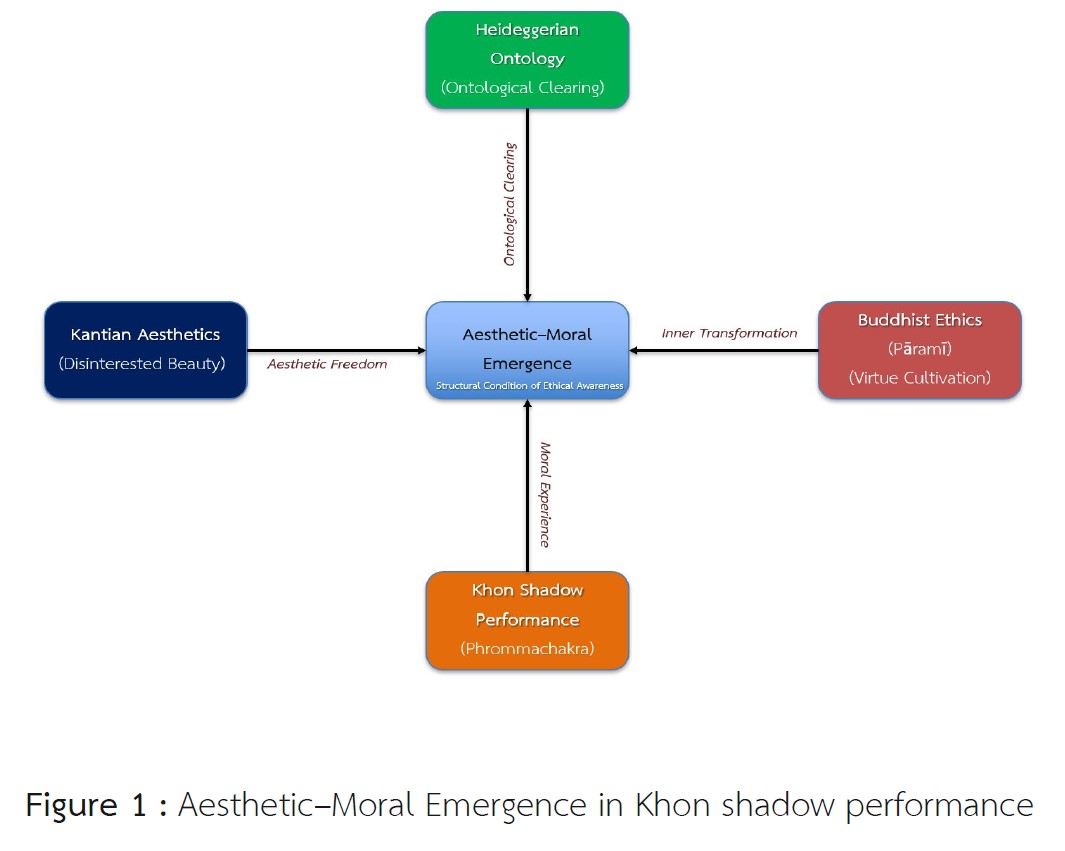
This research article aims to: 1) analyze the concept of disinterested beauty in the aesthetics of Immanuel Kant and compare it with the Buddhist doctrine of pāramī (perfections) in Theravāda philosophy as a framework of moral cultivation; and 2) examine how the Khon shadow performance Phrommachakra reflects the relationship between beauty and goodness.
The study adopts a qualitative approach through philosophical textual analysis, combined with a case study of the Phrommachakra Khon shadow performance as a contemporary aesthetic space.
The findings indicate that although Kantian aesthetics emphasizes beauty as a disinterested experience independent from moral purposes, in the context of performance art rooted in Buddhist Jātaka narratives, aesthetic beauty can function as a condition that allows audiences to freely contemplate moral virtues. In this sense, the Phrommachakra Khon shadow performance demonstrates the possibility of harmonizing beauty and goodness without reducing art to a mere moral instrument. Instead, aesthetic experience becomes a medium through which ethical reflection emerges. This study contributes to the dialogue between Western aesthetics and Buddhist philosophy within the context of contemporary Thai performing arts.
Article Details
References
Allison, H. E. (2001). Kant’s theory of taste: A reading of the Critique of aesthetic judgment. Cambridge University Press.
Bodhi, B. (2005). In the Buddha’s words: An anthology of discourses from the Pali Canon. Wisdom Publications.
Carroll, N. (2001). Beyond aesthetics: Philosophical essays. Cambridge University Press.
Dewey, J. (2005). Art as experience. Perigee Books.
Dreyfus, H. L. (1991). Being-in-the-world: A commentary on Heidegger’s Being and Time, division I. MIT Press.
Guyer, P. (2005). Kant and the claims of taste (2nd ed.). Cambridge University Press.
Harvey, P. (2013). An introduction to Buddhism: Teachings, history and practices (2nd ed.). Cambridge University Press.
Heidegger, M. (1971). Poetry, language, thought (A. Hofstadter, Trans.). Harper & Row.
Kant, I. (2000). Critique of the power of judgment (P. Guyer & E. Matthews, Trans.). Cambridge University Press. (Original work published 1790)
Kant, I. (2012). Groundwork of the metaphysics of morals (M. Gregor & J. Timmermann, Trans.). Cambridge University Press. (Original work published 1785)
Keown, D. (2001). The nature of Buddhist ethics. Palgrave.
Mukdasakunpibān Pitisan. (2020). The creation process of Khon entitled Phrommachak [Doctoral dissertation, Khon Kaen University].
Nussbaum, M. C. (1990). Love’s knowledge: Essays on philosophy and literature. Oxford University Press.
Phra Brahmagunabhorn (P. A. Payutto). (2016). Buddhist economics: A middle way for the market place. Buddhadhamma Foundation.
Schopenhauer, A. (1969). The world as will and representation (E. F. J. Payne, Trans., Vol. 1). Dover Publications. (Original work published 1818)
Shusterman, R. (2000). Pragmatist aesthetics: Living beauty, rethinking art (2nd ed.). Rowman & Littlefield.
