
Moral Leadership of Buddhist Preceptors in the Digital Age: A Buddhist Philosophical Analysis of Power, Governance, and Responsibility
Article Sidebar
Main Article Content
Abstract
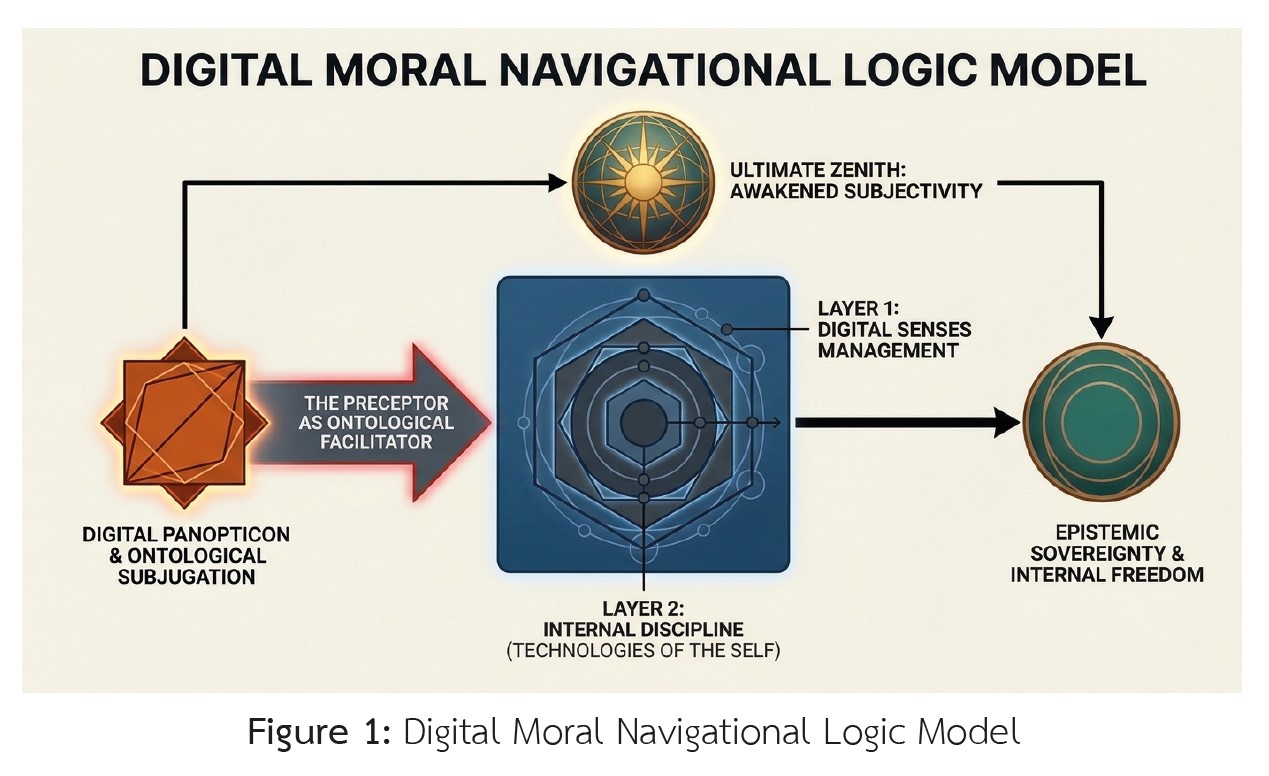
This academic article aims to critique and deconstruct the paradigm surrounding the role of Buddhist preceptors (Upajjhāya) within the digital social context, shifting the focus from traditional administrative descriptions to a rigorous Buddhist philosophical analysis of the mechanisms of self-formation. Amidst the crisis of moral authority and the fluidity of digital identities affecting the ontological state of the monkhood, this study employs the conceptual framework of “Technologies of the Self” to investigate the preceptor’s role as a guardian of the ethical space. The analysis reveals that preceptors do not merely function as gatekeepers screening candidates for the Sangha; rather, they serve as “Ontological Knowledge Managers” facilitating the transition between physical and virtual realms to prevent the cognitive subjugation caused by digital addiction.
The key finding asserts that the strategic application of Monastic Discipline (Vinaya) as a “Digital Operating System” functions as a mechanism for ordering desire through sophisticated mentoring and monitoring processes. This leads to the synthesis of a new theoretical framework: the “Digital Moral Navigational Logic Model.” This intellectual innovation serves as a foundational pillar for establishing “Epistemic Sovereignty” for newly ordained monks, enabling them to maintain ontological stability amidst the overwhelming tides of informational consumerism. Ultimately, the article concludes that the re-establishment of the preceptor’s moral leadership constitutes the formation of a “Cognitive Architecture” that transitions from normative coercion to the creation of conditions for internal freedom. This transformation is essential for preserving the sanctity and sustainability of the monastic institution within a post-human dimension.
Article Details
References
Agamben, G. (1998). Homo sacer: Sovereign power and bare life. Stanford University Press.
Baudrillard, J. (1981). Simulacra and simulation. University of Michigan Press.
Deleuze, G. (1992). Postscript on the societies of control. October, 59, 3–7.
Foucault, M. (1977). Discipline and punish: The birth of the prison. Pantheon Books.
Foucault, M. (1988). Technologies of the self: A seminar with Michel Foucault. University of Massachusetts Press.
Han, B.-C. (2015). The transparency society. Stanford University Press.
Hawking, S. (2019). Brief answers to the big questions. Bear Publishing.
Heidegger, M. (1977). The question concerning technology, and other essays. Harper & Row.
Levinas, E. (1969). Totality and infinity: An essay on exteriority. Duquesne University Press.
Mahachulalongkornrajavidyalaya University. (1996). Thai Tipiṭaka (Mahachulalongkornrajavidyalaya Edition). Mahachulalongkornrajavidyalaya University Press.
Nāgārjuna. (1995). The fundamental wisdom of the middle way: Nāgārjuna’s Mūlamadhyamakakārikā (J. L. Garfield, Trans.). Oxford University Press.
Nishida, K. (1990). An inquiry into the good (M. Abe & C. Ives, Trans.). Yale University Press. (Original work published 1911).
Phra Brahmagunabhorn (P.A. Payutto). (2012). Buddhadhamma: The laws of nature and their benefits to life.
Mahachulalongkornrajavidyalaya University Press.
Promta, S. (2003). Man and religion. Siam Publishing House.
Turner, V. (1969). The ritual process: Structure and anti-structure. Aldine Publishing.
Žižek, S. (2001). On belief. Routledge.
