
Dhammanava: A Semiotic and Ontological Allegory Analysis in Theravada Buddhist Philosophy
Article Sidebar
Main Article Content
Abstract
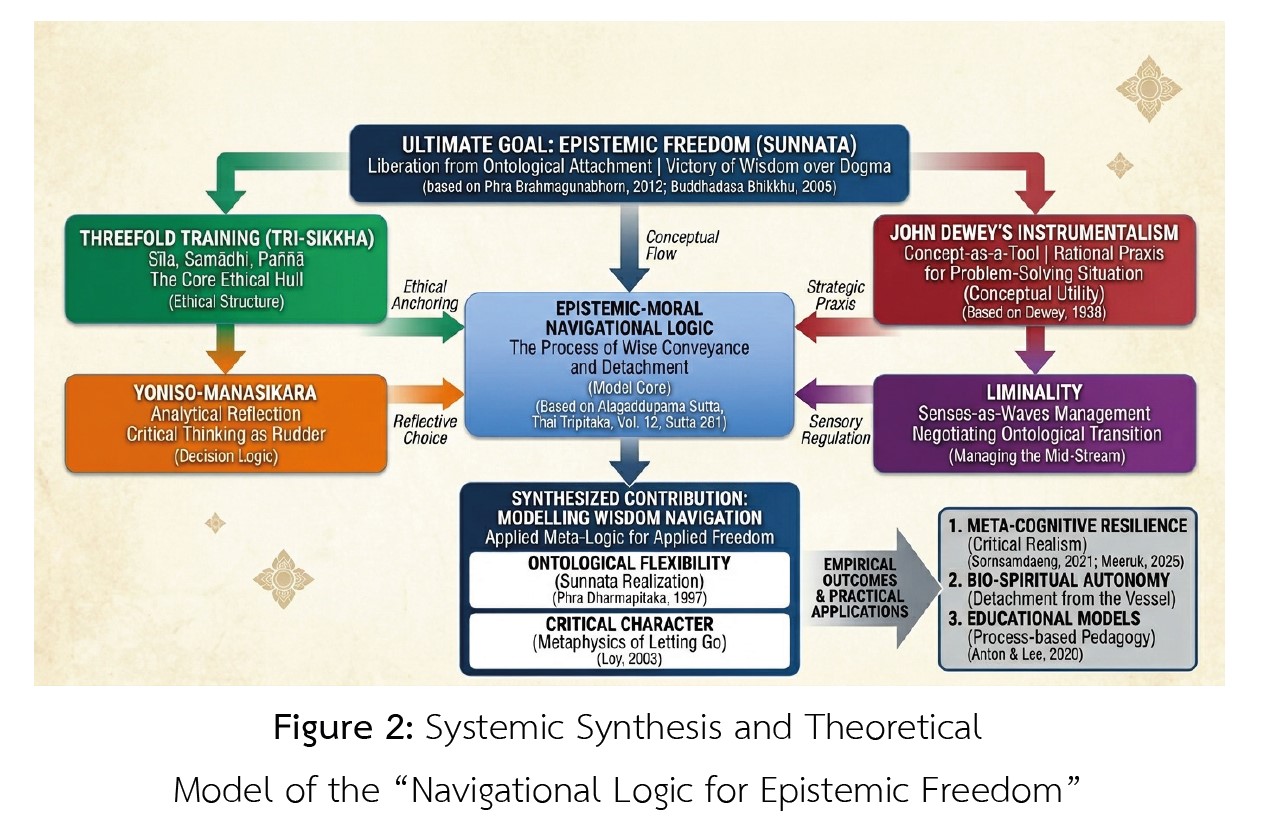
This research article analyzes the concept of "Dhammanava" as an ontological allegory and a semiotic tool within the framework of Theravada Buddhist philosophy. It moves beyond traditional moralistic interpretations towards a critical analysis of conscious transition. The findings reveal that "Dhammanava" functions as a semiotic system representing a temporary and dynamic "Epistemic Instrument," notably illustrated in the Raft Simile. This emphasizes that Dhamma is a methodology rather than an absolute end in itself. From a semiotic perspective, the "Vessel" acts as a structural interface connecting the phenomenal world with the state of absolute reality. The ontological dimension further challenges the existence of the self through the process of instrumental detachment upon reaching the goal. This study synthesizes a new conceptual framework, the "Navigational Logic of Dhamma," demonstrating that the nautical allegory serves as a cognitive mechanism to systematically manage perception and volition during the liminal state of conscious transformation. Consequently, this article elevates Buddhist doctrine from a dimension of faith to a contemporary analytical philosophy.
Article Details
References
Buddhadasa Bhikkhu. (2005). Handbook for Mankind. Buddhadasa Indapanno Archives.
Dewey, J. (1938). Logic: The Theory of Inquiry. Henry Holt and Company.
Guyer, P. (2006). Kant. London: Routledge.
Kant, I. (1998). Critique of pure reason (P. Guyer & A. W. Wood, Trans. & Eds.). Cambridge University Press. (Original work published 1781).
Phra Brahmagunabhorn (P.A. Payutto). (2012). Buddhadhamma: Natural Laws and Values for Life (G.A. Olson, Trans.). Buddhadhamma Foundation.
Phra Dharmapitaka (P.A. Payutto). (1997). Buddhist Solutions for the Twenty-First Century. Buddhadhamma Foundation.
