
The Architecture of Self-Formation: A Buddhist Ethical Analysis of Technologies of the Self in the Context of Parenting
Article Sidebar
Main Article Content
Abstract
This article critiques and deconstructs the fundamental paradigm of child-rearing in contemporary society, shifting the scholarly focus from conventional practical advice or traditionalist morality toward a rigorous Buddhist ethical analysis of “Technologies of the Self.” Amidst the crisis of the ego and ontological rupture occurring within the family institution during cultural transitions.
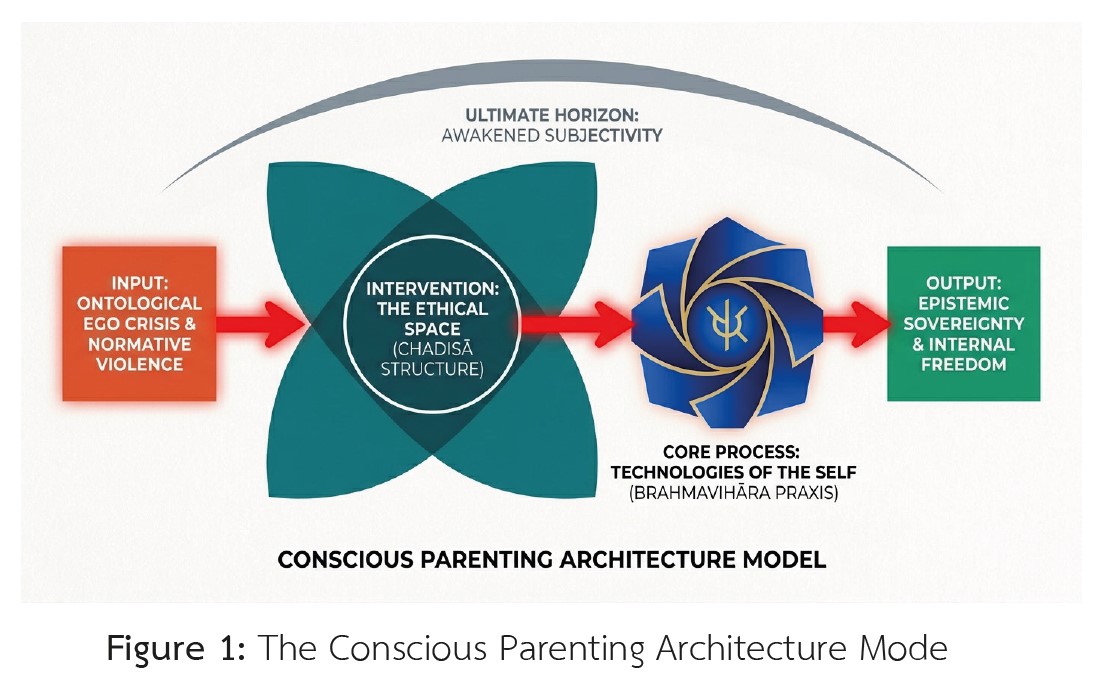
This study employs the framework of Instrumentalism to investigate the mechanisms of desire organization and self-formation within the ethical space. The analysis reveals that parenting is not merely an instinctive mission for biological succession but an expression of a “Consciousness Architecture” designed to establish internal freedom rather than employing normative violence or traditional behavioral control.
The key finding asserts that the strategic application of Chadisā (Six Directions) and Brahmavihāra (Four Sublime States: loving-kindness, compassion, sympathetic joy, and equanimity) functions as a sophisticated ethical praxis for managing the void between attachment and detachment. This mechanism enables individuals, as subjective entities in transition, to navigate the stage of “Ontological Liminality” during adolescence with stability, leading to the synthesis of the “Conscious Parenting Architecture Model.” This model facilitates the transition of the guardian’s status from a producer of identities or life-controller to an ontological facilitator and creator of conditions for epistemic sovereignty. Ultimately, the article emphasizes that comprehensive nurturing represents the triumph of Paññā (wisdom/discernment) over Taṇhā (craving/desire), serving as the foundational pillar for sustainable well-being and authentic ontological freedom within a post-human landscape.
Article Details
References
Dewey, J. (1938). Logic: The theory of inquiry. Henry Holt and Company.
Foucault, M. (1988). Technologies of the self: A seminar with Michel Foucault. University of Massachusetts Press.
Hawking, S. (2019). Brief answers to the big questions. Bear Publishing.
Kant, I. (1998). Critique of pure reason (P. Guyer & A. W. Wood, Eds. & Trans.). Cambridge University Press. (Original work published 1781).
Mahachulalongkornrajavidyalaya University. (1996). Thai Tipiṭaka (Mahachulalongkornrajavidyalaya Edition).
Mahachulalongkornrajavidyalaya University Press.
Phra Brahmagunabhorn (P.A. Payutto). (2012). Buddhadhamma: The laws of nature and their benefits to life. Mahachulalongkornrajavidyalaya University Press.
Phra Dhammakosacariya (Buddhadasa Bhikkhu). (1984). Perfect parents. Somchai Printing.
