
A Buddhist Philosophical Analysis of "Watta Pada VII" as a Mechanism for Ontological Transformation
Article Sidebar
Main Article Content
Abstract
This academic article aims to critique and re-interpret the concept of “Watta Pada VII” (The Seven Practices) through documentary research and philosophical analysis. It shifts from traditional descriptive moralizing toward an analysis of these principles as “Technologies of the Self” and “Ontological Mechanisms.”
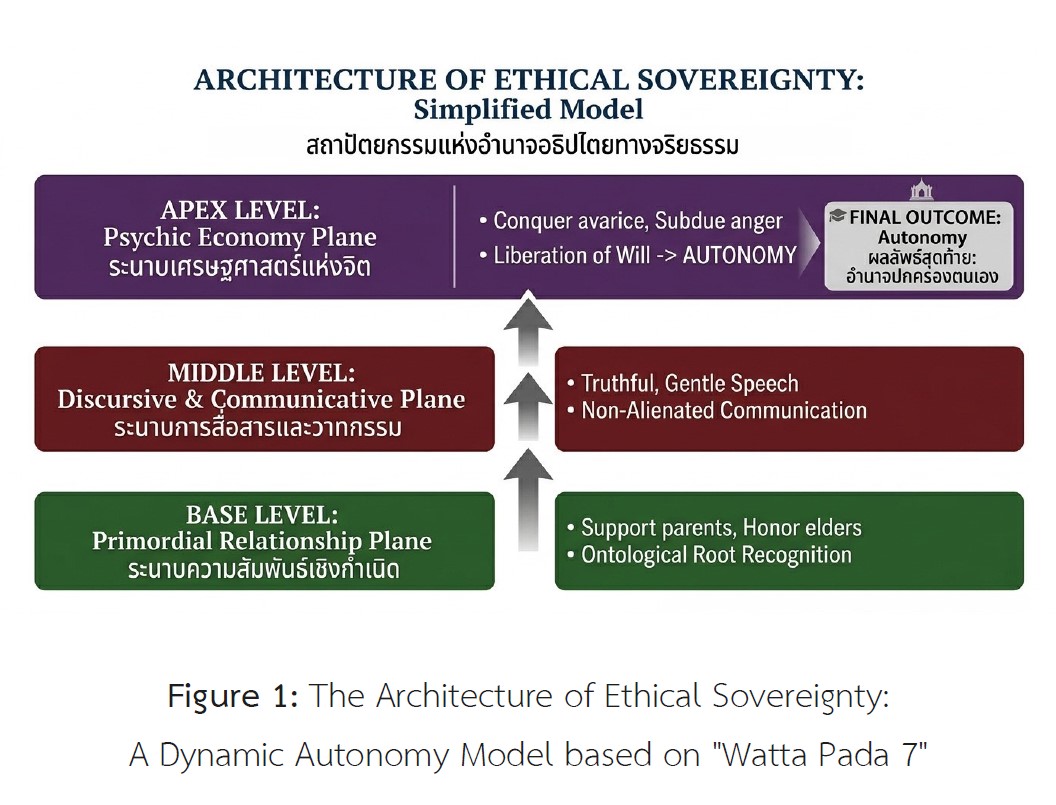
The findings suggest that Watta Pada VII is not merely a set of moral codes for achieving divinity in a superstitious sense, but rather an architectural framework for sensory regulation and the management of the Will. This leads to an ontological transformation from “Magha-manava” (the mundane self) to “King Sakka” (the transcendent self). This article argues that genuine quality of life in Buddhist philosophy is defined by “Autonomy” attained through internal virtue cultivation (Virtue Ethics), serving as a crucial foundation for confronting the crisis of the ego in the contemporary world.
Article Details
References
Aristotle. (2009). The Nicomachean Ethics (D. Ross, Trans.; L. Brown, Ed.). Oxford University Press. (Original work published ca. 340 BCE)
Bourdieu, P. (1990). The logic of practice (R. Nice, Trans.). Stanford University Press.
Chuchai, S. (2011). Quality of life and society development. Rajapruk College.
Dewey, J. (1938). Logic: The theory of inquiry. Henry Holt and Company.
Foucault, M. (1988). Technologies of the self: A seminar with Michel Foucault (L. H. Martin, H. Gutman, & P. H. Hutton, Eds.). University of Massachusetts Press.
Kant, I. (1998). Groundwork of the metaphysics of morals (M. Gregor, Trans. & Ed.). Cambridge University Press. (Original work published 1785)
Levinas, E. (1969). Totality and infinity: An essay on exteriority (A. Lingis, Trans.). Duquesne University Press.
Mahachulalongkornrajavidyalaya University. (1996). Thai Tipiṭaka (Mahachulalongkornrajavidyalaya Edition). Mahachulalongkornrajavidyalaya University Press.
Nakabuppha, K. (1977). Indra in Sanskrit, Pali, and Thai literature [Master’s thesis, Chulalongkorn University]. Chulalongkorn University Digital Repository.
Nietzsche, F. (2005). Thus spoke Zarathustra: A book for all and none (A. Del Caro, Trans.; A. Del Caro & R. B. Pippin, Eds.). Cambridge University Press. (Original work published 1883)
Office of the National Economic and Social Development Council. (2021). The twelfth national economic and social development plan (2017–2021). Office of the Prime Minister. https://www.nesdc.go.th/ewt_w3c/more_news.php?filename=&cid=297
Phra Anan Aphinantho (Phaka). (2020). Practicing the seven virtues for quality of life development. MCU Buriram Academic Journal, 5(2), 147–160.
Phra Brahmagunabhorn (P.A. Payutto). (2012). Dictionary of Buddhist studies. Mahachulalongkornrajavidyalaya University Press.
Phra Charoen Dantachitto. (2017). Developing quality of life according to the seven virtues found in Buddhism. Vasara Paranya Paridassana, 22(2), 73–85.
Phra Rajavaramuni (Prayoon Thammachitto). (2020). Buddhist ethics in the modern world. Mahachulalongkornrajavidyalaya University Press.
Royal Institute of Thailand. (2007). Royal Institute dictionary. Nanmee Book Publishing.
Suphanthasorn, S., & Manoonpichu, N. (1982). Population and quality of life. Department of Health Education, Mahidol University.
The WHOQOL Group. (1995). The World Health Organization Quality of Life assessment (WHOQOL): Position paper from the World Health Organization. Social Science & Medicine, 41(10), 1403–1409. https://doi.org/10.1016/0277-9536(95)00112-K
