
Ontological and Ethical Foundations of Buddhist Volunteerism
Article Sidebar
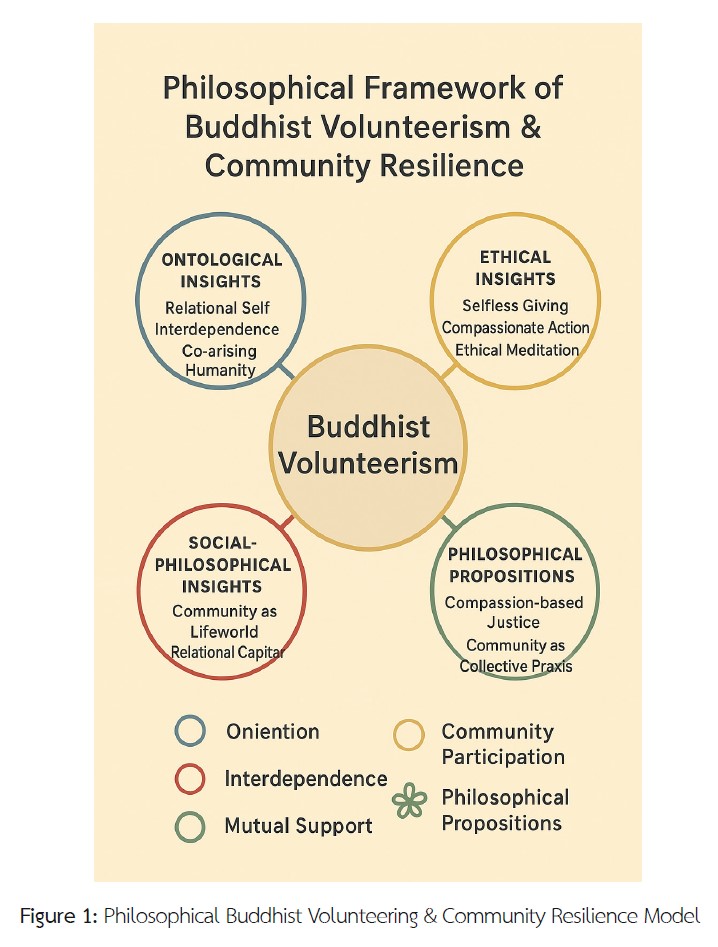
Main Article Content
Abstract
This article explores the transformative power of Buddhist-inspired volunteerism as a philosophical and practical foundation for building resilient and sustainable communities. Drawing upon key Buddhist principles—including the Four Bases of Social Harmony (Saṅgahavatthu), the Four Brahmavihāras, the Threefold Training, and reflective discernment (yonisomanasikāra)—the study argues that community development is not merely a social endeavor but a form of inner cultivation, ethical formation, and collective awakening. The analysis identifies contemporary challenges such as social fragmentation, structural inequality, digital isolation, and shifting communal norms, which increasingly weaken social cohesion. Buddhist volunteerism is interpreted as a generative force that cultivates compassion, trust, and shared meaning, functioning as a “supportive condition” (upanissaya) that strengthens communal relationships. Through a philosophical lens, the article examines how altruistic action rooted in mindfulness and wisdom reshapes the dynamics of care, responsibility, and agency within community life. The findings reveal that sustainable community building, in the Buddhist sense, depends not primarily on material resources but on the ethical and cognitive transformation of individuals who co-create a collective space of mutual flourishing. Ultimately, the article proposes the model of an Awakened Community—a community grounded in compassion, critical insight, and cooperative action—arguing that such a moral-spiritual framework provides a robust pathway for achieving long-term social wellbeing and existential meaning in an era of rapid change.
Article Details
References
Aristotle. (1999). Nicomachean ethics (T. Irwin, Trans.). Hackett Publishing.
Department of Provincial Administration. (2023). Annual report on community and family resilience in Thailand. Ministry of Interior, Thailand.
Habermas, J. (1984). The theory of communicative action: Vol. 1. Reason and the rationalization of society (T. McCarthy, Trans.). Beacon Press.
Harvey, P. (2000). An introduction to Buddhist ethics: Foundations, values and issues. Cambridge University Press.
Mahachulalongkornrajavidyalaya University. (1996). Thai Tipiṭaka (Mahachulalongkornrajavidyalaya Edition). Mahachulalongkornrajavidyalaya University Press.
National Institute of Mental Health. (2018). Loneliness and mental health: National survey report. U.S. Department of Health & Human Services.
Phra Brahmagunabhorn (P. A. Payutto). (2006). Buddhist virtues for social development. Mahachulalongkornrajavidyalaya University Press.
Rawls, J. (1999). A theory of justice (Rev. ed.). Harvard University Press.
Stanford University. (2019). The social disconnection crisis: Digital society and community well-being. Stanford Social Research Center.
