
Interacting with Media: Learning Beyond the Teacher-Centered Paradigm
Article Sidebar
Main Article Content
Abstract
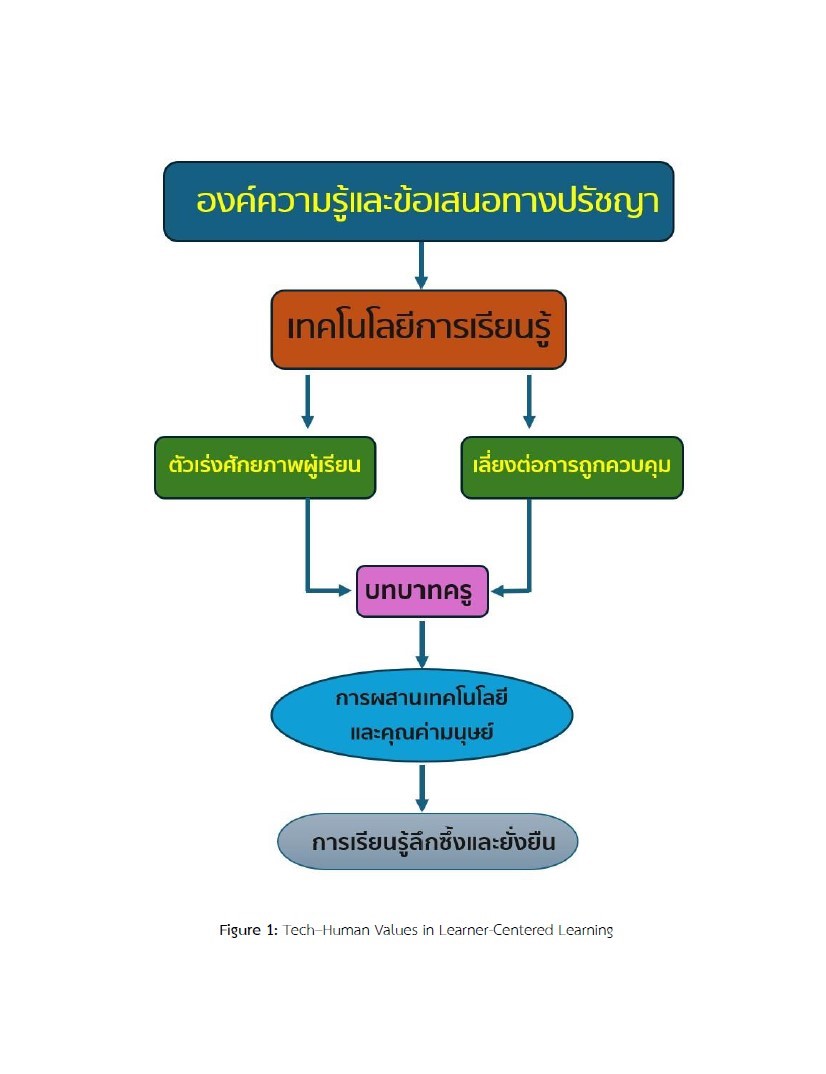
This article aims to (1) analyze the transformation of learning paradigms from teacher-centered to learner-centered approaches, emphasizing the role of interactive media in fostering active engagement, and (2) critique philosophical perspectives concerning the role of technology in learning within the digital era. Drawing upon a case study of interactive media developed for judo education in higher education, the study elucidates how visual, auditory, and real-time responsive elements can enable learners to construct knowledge through participatory and self-directed experiences.
The analysis integrates John Dewey’s philosophy of experiential learning and interaction with the environment, alongside Lev Vygotsky’s concepts of the zone of proximal development and social learning. Both perspectives are situated within the constructivist framework, which views knowledge as actively generated through learners’ interactions with their contexts and peers. Moreover, the discussion engages with philosophical questions regarding learner autonomy, human existence in virtual environments, and the evolving role of teachers as designers of learning experiences rather than transmitters of content.
The philosophical implications of the analysis suggest that a critical and reflective application of interactive media can expand learners’ freedom, cultivate human potential, and open new dimensions for education in the twenty-first century—allowing it to respond more profoundly and sustainably to global transformation.
Article Details
References
Anderson, T. (2003). Modes of interaction in distance education: Recent developments and research questions. In M. Moore & W.
Anderson (Eds.), Handbook of distance education (pp. 129–144). Lawrence Erlbaum Associates.
Biesta, G. (2010). Good education in an age of measurement: Ethics, politics, democracy. Routledge.
Dewey, J. (1938). Experience and education. Macmillan.
Foucault, M. (1977). Discipline and punish: The birth of the prison. Pantheon Books.
Habermas, J. (1984). The theory of communicative action, Vol. 1: Reason and the rationalization of society. Beacon Press.
Heidegger, M. (1962). Being and time. Harper & Row.
Lyotard, J.-F. (1984). The postmodern condition: A report on knowledge. University of Minnesota Press.
Trilling, B., & Fadel, C. (2009). 21st century skills: Learning for life in our times. Jossey-Bass.
Vygotsky, L. S. (1978). Mind in society: The development of higher psychological processes. Harvard University Press.
Wongsa, V. (2013). Development of interactive media on basic knowledge of judo (Master’s thesis, Rangsit University). Rangsit University. https://rsuir-library.rsu.ac.th/bitstream/123456789/1853/1/VIRUNPAT%20WONGSA.pdf
