
The Construction of Cultural Identity in Saud Berk of Lanna
Article Sidebar
Main Article Content
Abstract
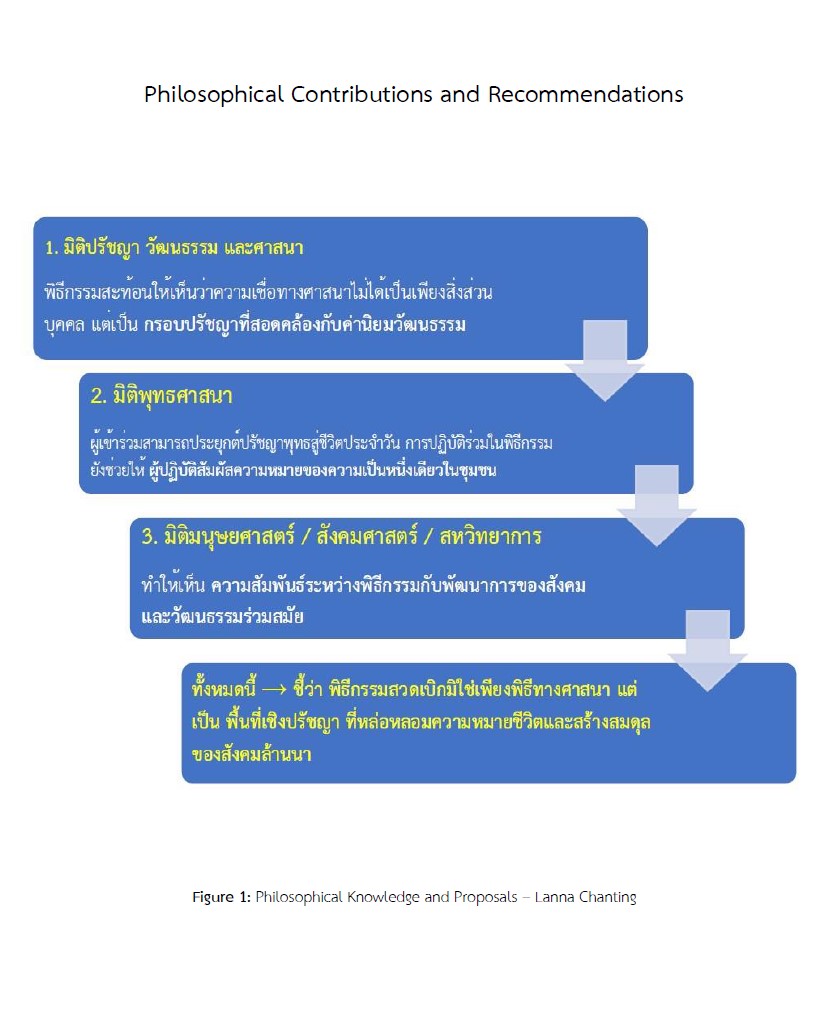
This article examines the Lanna Saud Berk chanting ritual as a process of cultural identity formation. Employing a qualitative approach through literature review, interpretation, and philosophical synthesis, the study explores the meanings and societal roles of the ritual. Findings indicate that Saud Berk contributes to Lanna identity in four dimensions: 1) Lanna Buddhism and philosophical practices 2) Locality and community identity 3) Language and cultural communication 4) Musical art and Lanna singing traditions
The ritual reflects traditional beliefs while adapting to the context of globalization, linking spiritual practices with community life. From the perspective of Buddhist philosophy—including anattā, tilakkhaṇa, paṭiccasamuppāda, and śūnyatā—identity is dynamic, arising from interdependent conditions. Saud Berk thus functions both as a religious practice and a philosophical act, preserving cultural values and connecting with the contemporary search for life’s meaning.
Article Details
References
Apinya, F. (2000). Identity and self-construction in society. Thammasat University Press.
Boonthan, R. (2006). Lanna opening chant rituals. Chiang Mai University Press.
Buckingham, D. (2008). Youth, identity, and digital media. Cambridge, MA: MIT Press.
Chen, G. M. (2014). The impact of globalization on cultural identity. Journal of Global Studies, 12(2), 45-59.
Duanwisets, N. (2021). The chanting-opening ritual and Lanna culture. Chiang Mai University Press.
Fearon, J. D. (1999). What is identity (as we now use the word)? Stanford University, Department of Political Science.
Hall, S. (1989). Cultural identity and diaspora. In J. Rutherford (Ed.), Identity: Community, culture, difference (pp. 222-237). London: Lawrence & Wishart.
Hall, S. (1996). Questions of cultural identity. London: SAGE Publications.
Harvey, P. (2013). An introduction to Buddhism: Teachings, history, and practices (2nd ed.). Cambridge: Cambridge University Press.
Jaitrong, P. (2018). Cultural identity of the four ethnic groups in Sisaket Province. Journal of Cultural Studies, 8(1), 15-32.
Leary, M. R., & Tangney, J. P. (2012). Handbook of self and identity (2nd ed.). New York, NY: Guilford Press.
Phradhammapitaka (P.A. Payutto). (2000a). Buddhist philosophy and identity. Mahachulalongkornrajavidyalaya University.
Phradhammapitaka (P.A. Payutto). (2000b). Anattā: Concepts and interpretations in Buddhism. Mahachulalongkornrajavidyalaya University Press.
Phrapalad Somsak Samahito. (2021). Lanna music and ritual arts. Hariphunchai Temple Publishing.
Ruantun, K. (2018). Promoting Buddhist Lanna cultural identity: A case study of Lampang Province. Journal of Humanities, 12(2), 45-60.
Setthakul, R. (2017). Lanna music and rituals: A study of musical arts in folk culture. Chiang Mai University Press.
Singh, A. (2022). Popular culture and youth identity formation: Case studies from global media. International Journal of Cultural Studies, 25(2), 151-170.
Stets, J. E., & Burke, P. J. (2000). Identity theory and social identity theory. Social Psychology Quarterly, 63(3), 224-237.
Zhang, L. (2019). Cultural identity and cross-cultural education in international schools under China’s Belt and Road Initiative. Asian Education Studies, 4(1), 33-47.
