
A Signal of Klong-duek : The Ethical Value and Existence on I-san Community Way of Life
Article Sidebar
Main Article Content
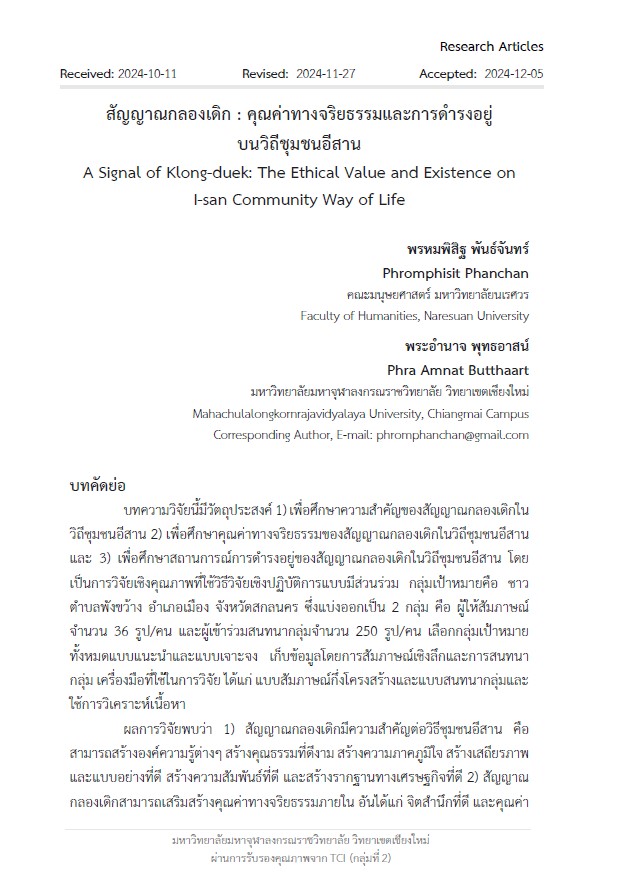
Abstract
This research article contains to 1) study an importance of Klong-duek’ signal, 2) study the ethical values of Klong-duek’ signal, and 3) study the existence situations of Klong-duek’ signal on I-san community way of life widely. This is qualitative research on Participatory Action Research (PAR). The target group is people in Phangkhang sub-district, Muang district, Sakonnakhorn province, divided into 2 groups: 36 persons for interview and 250 persons for focus group that selected by purposive sampling and snowball sampling. Data are collected by in-depth interview and focus group. Main research instruments are the semi structure in-depth interview and schedule for focus group. Content analysis is used to perform this qualitative study.
The results of this study reveal that: 1) The importance of Klong-duek’ signal consists of creation of acknowledgement, morality, worthiness, good stability and paragon, good relationship and good economic basic. 2) A signal of Klong-duek can create the internal ethical value, namely the good conscious mind and the external ethical value, namely the good behaviour or characteristic and the good community for people. And 3) The existence situations of Klong-duek’ signal depend on a Klong-duek beating of monks at Phangkhang sub-district, that has changed a little from the past. For its main cause, that is, there is only one monk in the temple, and perhaps the monk may be old or sick that can not beat the Klong-duek.
Article Details
References
พรหมพิสิฐ พันธ์จันทร์ และคณะ. (2563). การสืบทอดและคุณค่าทางจริยธรรมของชาวอีสานในสัญญาณกลองเพล: กรณีศึกษาตำบลพังขว้าง อำเภอเมือง จังหวัดสกลนคร. วารสารมนุษยศาสตร์และสังคมศาสตร์ มหาวิทยาลัยนครพนม. 10 (1), 55-63.
พระครูศรีธรรมวัฒน์. (2561). ผู้อำนวยการศูนย์เรียนรู้และอนุรักษ์กลองเพล ตำบลพังขว้าง. สัมภาษณ์. 11 สิงหาคม.
พระมรกต อิสฺสโร. (2561). เลขานุการศูนย์เรียนรู้และอนุรักษ์กลองเพล ตำบลพังขว้าง. สัมภาษณ์. 11 สิงหาคม.
พระเอนก อนาวิโล. (2561). เจ้าอาวาสวัดป่าสามัคคีธรรม. สัมภาษณ์. 17 มิถุนายน.
มติชนออนไลน์. (21 มิถุนายน 2559). รู้จักไหม? “ตีกลองแลง” สัญญาณเตือนคนเข้าวัด – แซ่ซ้องถึงเทวดาว่าศาสนายังอยู่. สืบค้นเมื่อ 14 พฤศจิกายน 2567, จาก https://www.matichon.co.th/entertainment/news_182297
มหาจุฬาลงกรณราชวิทยาลัย. (2558). ปรัชญาเบื้องต้น. พิมพ์ครั้งที่ 4. กรุงเทพฯ: มหาจุฬาลงกรณราชวิทยาลัย
ยศ สันตสมบัติ. (2556). มนุษย์กับวัฒนธรรม. พิมพ์ครั้งที่ 4. กรุงเทพฯ: มหาวิทยาลัยธรรมศาสตร์
วิทยา สายสุด. (2536). สื่อสัญญาณพื้นบ้านอีสานในเขตอำเภอหัวตะพาน. วิทยานิพนธ์ ศิลปศาสตรมหาบัณฑิต วิชาเอกไทยศึกษา มหาวิทยาลัยศรีนครินทรวิโรฒ มหาสารคาม.
สวิง บุญเจิม. (ม.ป.ป.). ตำรามรดกอีสาน. อุบลราชธานี: ยงสวัสดิ์การพิมพ์.
สำนักงานคณะกรรมการวัฒนธรรมแห่งชาติ. (2528). ดนตรีพื้นบ้านและศิลปะการแสดงของไทย. กรุงเทพฯ: โรงพิมพ์คุรุสภาลาดพร้าว.
Bignell, J. (1997). Media Semiotics: An Introduction. New York: Manchester University Press.
White, L., 1959. The Evolution of Culture. New York: McGraw-Hill.
