
Ancient Indian Beliefs and Traditions Influencing the Status and Role of Women in Thai Society
Article Sidebar
Main Article Content
Abstract
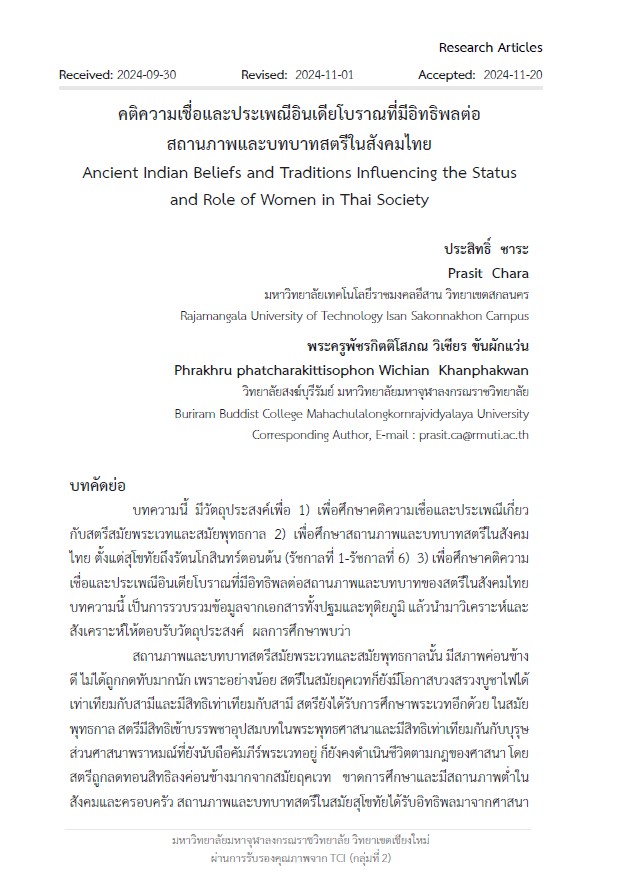
This Article aims to: 1) examine the beliefs and traditions concerning women during the Vedic and Buddhist eras; 2) study the status and roles of women in Thai society from the Sukhothai period to the early Rattanakosin period (reigns of Rama 1 to Rama 6); 3) to analyze the influence of ancient Indian beliefs and traditions on the status and roles of women in Thai society. This study employs documentary research methodology, utilizing both primary and secondary sources, which are subsequently analyzed and synthesized to address the research objectives.
The findings reveal that the status and roles of women during the Vedic and Buddhist eras were relatively favorable, with minimal oppression. In the Rigvedic period, women had the opportunity to perform fire worship rituals on par with their husbands and enjoyed equal rights. Women also had access to Vedic education. During the Buddhist era, women were granted the right to ordain in Buddhism and enjoyed equality with men. In Brahmanical societies that still adhered to the Vedic scriptures, women’s rights were significantly diminished compared to the Rigvedic period, with limited access to education and lower social and familial status. The status and roles of women in the Sukhothai period were directly influenced by Brahmin-Hindu and Buddhist religious beliefs. Consequently, women’s status and roles were predominantly shaped by Brahmin-Hindu traditions, resulting in their oppression through belief systems. This continued into the Ayutthaya period, where women remained under the authority of their husbands. It was not until the middle Rattanakosin period (reign of Rama 6) that women gained greater recognition, access to education, and the freedom to choose their partners without parental coercion. Ancient Indian traditions have had a direct influence on the status and roles of women in Thai society. These customs, rooted in religious beliefs, could not be easily discarded and required gradual, incremental changes over time. In the present day, women have attained rights, freedoms, and equality with men in nearly all aspects of life.
Article Details
References
ปาริชาต นนทกานันท์. (2523). แนวความคิดเกี่ยวกับสตรีในพุทธปรัชญา. วิทยานิพนธ์อักษรศาสตรมหาบัณฑิต. บัณฑิตวิทยาลัย: จุฬาลงกรณ์มหาวิทยาลัย.
เปรม หิมจันทร์. (2521) บทบาทของสตรีอินเดียในวรรณคดีบาลี. วิทยานิพนธ์อักษรศาสตรมหาบัณฑิต. บัณฑิตวิทยาลัย: จุฬาลงกรณ์มหาวิทยาลัย.
พระครูนิพัทธ์กัลยาณวัฒน์ (คะนอง ลายน้ำทอง). (2550). การศึกษาบทบาทสตรีในพระพุทธศาสนา : ศึกษาเฉพาะกรณีบทบาทของสตรีในสังคมไทยปัจจุบัน. วิทยานิพนธ์พุทธศาสตรดุษฎีบัณฑิต. บัณฑิตวิทยาลัย: มหาวิทยาลัยมหาจุฬาลงกรณราชวิทยาลัย.
พระมหากมล ถาวโร (มั่งคำมี). (2550). การศึกษาวิเคราะห์บทบาทของสตรีในพระพุทธศาสนา: ศึกษาเฉพาะกรณีบทบาทของสตรีในสังคมไทยปัจจุบัน. วิทยานิพนธ์พุทธศาสตรดุษฎีบัณฑิต. บัณฑิตวิทยาลัย: มหาวิทยาลัยมหาจุฬาลงกรณราชวิทยาลัย.
