
The The principle of Śūnyatā as a necessary view for attaining Nirvana according to Nāgārjuna's perspective
Article Sidebar
Main Article Content
Abstract
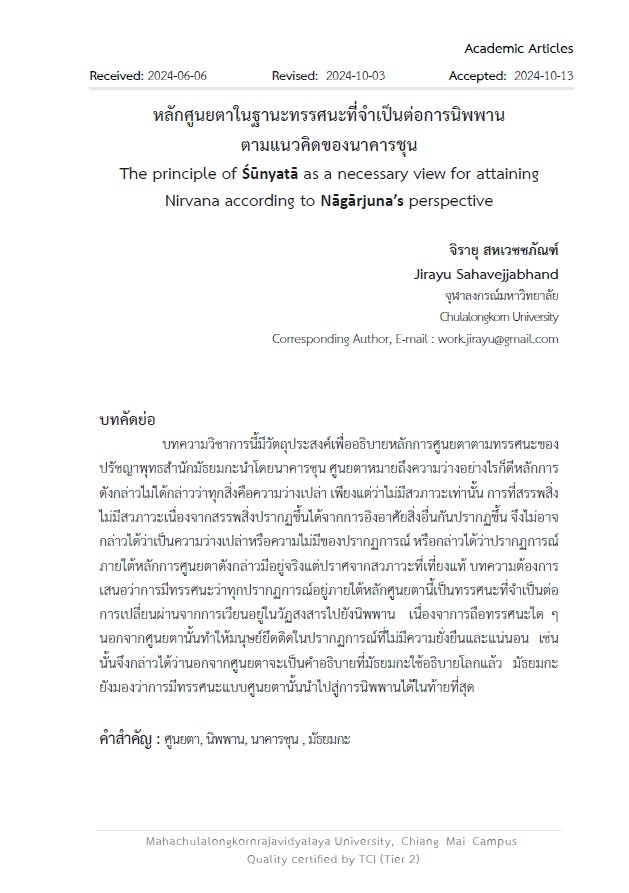
This academic article aims to explain the principle of Śūnyatā from the perspective of the Madhyamaka Buddhist philosophy, led by Nāgārjuna. Śūnyatā means emptiness; however, this principle does not assert that everything is empty, but rather that everything lacks intrinsic nature (Svabhāva). This emptiness refers to the fact that all things lack intrinsic nature because they arise dependently on other things. Therefore, it cannot be said that phenomena are empty or non-existent. It can be said that phenomena exist under the principle of Śūnyatā but without an inherent, eternal nature. The article proposes that the view that all phenomena are under the principle of Śūnyatā is essential for transitioning from Saṃsāra to Nirvana. Holding any view other than Śūnyatā leads humans to cling to phenomena that are neither permanent nor certain. Thus, it can be said that besides being an explanation Madhyamaka uses to describe the world, Śūnyatā is also seen as a view that ultimately leads to Nirvana.
Article Details
References
นาคารชุน. (2565). มูลมัธมกการิกา (โศลกมูลฐานว่าด้วยทางสายกลาง). (โสรัจจ์ หงส์ลดารมภ์, แปล). ประจวบคีรีขันธ์ : มูลนิธิพันดารา.
Jan Christoph Westerhoff. (2010). Nāgārjuna. Stanford Encyclopedia of Philosophy. Retrieved 1 March, 2024, form https://plato.stanford.edu/entries/nagarjuna/
Jay L. Garfield. (1995). The fundamental wisdom of the middle way: Nagarjuna’s Mulamadhyamakakarika. Oxford: Oxford University Press.
K. H Potter. (1991). Presuppositions of India’s philosophies. Deli: Motilal Banarsidass Publishe.
Mark Siderits, และ Shoryu Katsura. (2013). Nagarjuna’s middle way: Mulamadhyamakakarika. Newyork : Simon and Schuster.
Siderits, M., & Katsura, S. (2013). Nagarjuna’s middle way: Mulamadhyamakakarika. Newyork : Simon and Schuster.
