
A Buddhist Contemplative Educational Process Based Desirable Characteristics Development System for Faculty of Education Students in Mahamakut Buddhist University A Buddhist Contemplative Educational Process Based Desirable Characteristics Development System for Faculty of Education Students in Mahamakut Buddhist University
Article Sidebar
Main Article Content
Abstract
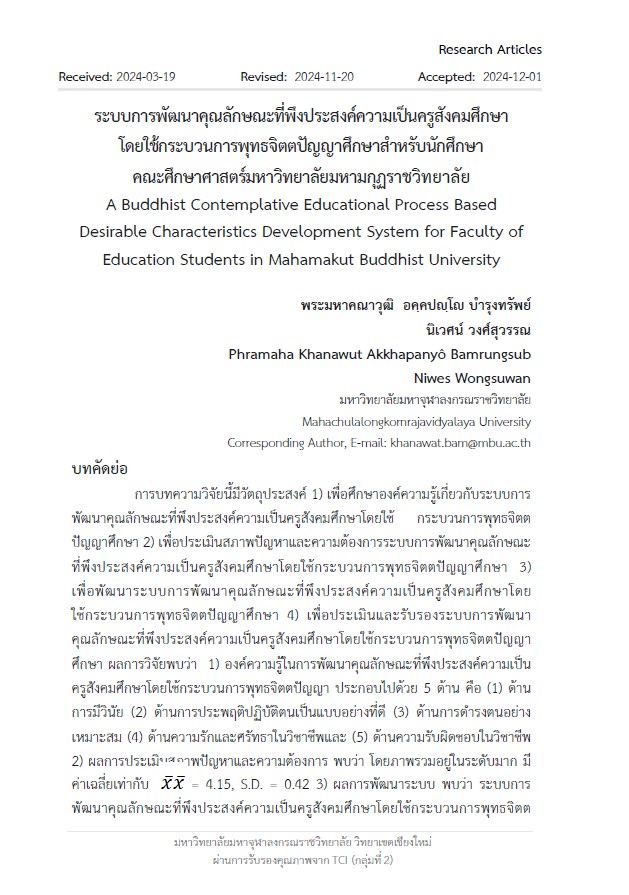
This research article contains to 1) To investigate knowledge about the system for establishing desired traits for social studies instructors utilizing the Buddhist Contemplative Education Process. 2) Evaluate the challenges and demands of a system for creating desirable attributes in social studies instructors through the Buddhist Contemplative Education process. 3) Create a mechanism for fostering desired attributes in social studies teachers through the process. Buddhist contemplative education. 4) To assess and certify a system for creating desirable traits in social studies teachers through the Buddhist Contemplative Education process. The study’s findings revealed that. 1) The corpus of information for establishing the desired attributes of a social studies teacher utilizing the Buddhist mindfulness approach includes five areas: (1) discipline (2) conduct and self-conduct as a role model. Good (3) in terms of self-care. (4) in terms of love and faith in the profession and (5) in terms of professional responsibilities. 2) The assessment of problems and needs revealed that they were generally at a high level. The mean value is = 4.15, with a standard deviation of 0.42 3) The results of the system development discovered that the system for developing desirable characteristics for social studies teachers using the Buddhist contemplative education process developed in five areas is the development of desirable characteristics that are appropriate and beneficial to students in the teaching of contemplative education. These are the attributes that society need in terms of morals, ethics, values, conscience, and the ability to live together with others. 4) Results of the system evaluation and certification. A committee of ten experts/people determined that the established model was appropriate, feasible, and able to be employed. and is effective in structuring students’ teaching and learning experiences.
Article Details
References
กรมการฝึกหัดครู..(2515)..มาตรการพื้นฐานบางประการสำหรับการสร้างครูที่ดี. กรุงเทพมหานคร: โรงพิมพ์คุรุสภา.
กระทรวงศึกษาธิการ. (2560). แผนการศึกษาแห่งชาติ พ.ศ. 2560 - 2579. กรุงเทพมหานคร: พริกหวานกราฟฟิค.
พระพรหมคุณาภรณ์ (ป.อ. ปยุตฺโต). (2551). ข้อคิดเพื่อการศึกษา. กรุงเทพมานคร: ศูนย์สื่อและสิ่งพิมพ์แก้วเจ้าจอม มหาวิทยาลัยราชภัฏสวนสุนันทา.
ไพฑูรย์ สินลารัตน์. (2559). คิดเพื่อครู (คำบรรยายระหว่างดำรงตำแหน่งประธานกรรมการครุสภา). กรุงเทพมหานคร: โรงพิมพ์แห่งจุฬาลงกรณ์มหาวิทยาลัย.
ราชกิจจานุเบกษา. (2563). ข้อบังคับคุรุสภาว่าด้วยจรรยาบรรณของวิชาชีพ พ.ศ. 2556. ราชกิจจานุเบกษา, 130 (ตอนพิเศษ), [72].
Kathryn Byrnes. (2009). Portraits of contemplative teaching: A third way.United States : University of Colorado.
Nozawa, A. (2004). Contemplative practices in teacher education. Journal of Inservice Education. 30 (2), 193 - 207.
Roeser, R. W., & Peck, S. C. (2009). An education in awareness: Self, motivation, and self-regulated learning in contemplative perspective. Educational Psychologist. 44 (2), 119 - 136.
