
A CriticalStudy of Buddhist Ethicsas Presentedinthe Milinda Panha
Article Sidebar
Main Article Content
Abstract
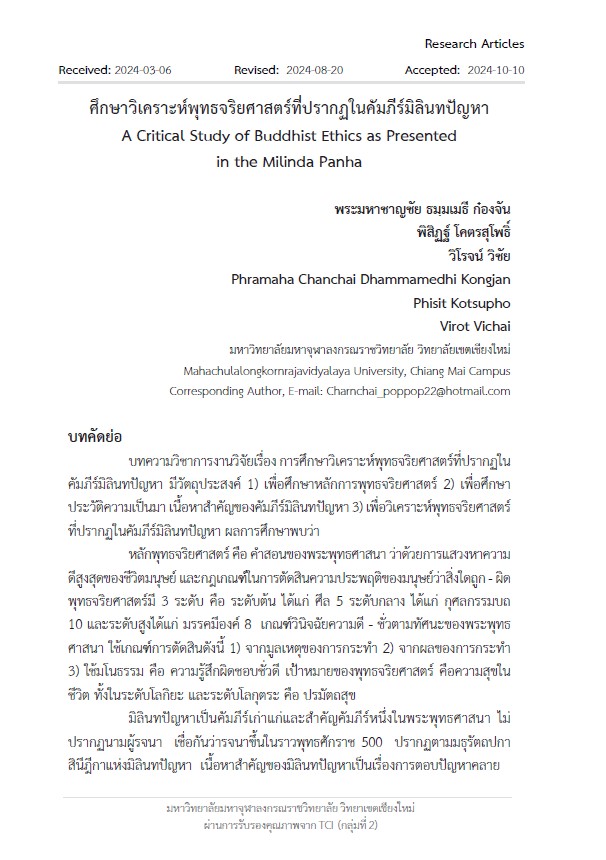
The thesis titled “A Critical Study of Buddhist Ethics as Presented in the Milinda Pañhã Scripture" aims: 1) to study the principles of Buddhist ethics, 2) to examine the historical background and essential content of the Milinda Pañhã scripture and 3) to analyze the Buddhist ethics found in the Milinda Pañhã scripture. The research’s findings were founded as follows:
The principles of Buddhist ethics entail the moral teachings of the Buddhism concerning the pursuit of the highest good in human life and the criteria for judging human conduct being as right or wrong, good or bad. Buddhist ethics are divided into three levels namely: the elementary level, consisting of the Five Precepts; the intermediate level, consisting of the Ten Virtues of Merit Making; and the advanced level, consisting of the Eightfold Path. The criteria for determining goodness or badness, according to the Buddhist perspectives are as follows: 1) on the motive of the action, 2) on the consequence of the action, 3) on the introspection. The goal of Buddhist ethics is the happiness in life, both on the mundane or supra-mundane levels which is the ultimate happiness.
The Milinda Pañhã, an ancient and significant scripture in Buddhism, does not reveal its author’s name. Having believed that it has been composed around the 500 B.E. It also appeared in Madhurasapakasinitika. The main contents of the Milinda Pañhã revolved around resolving various doubts in different doctrines by the Elder Naga Sena towards the King Milinda.
On analyzing Buddhist ethics as presented in the Milinda Pañhã, researchers have identified two characteristics namely : 1) Traditional Characteristics: These are the fundamental principles of natural truth according to the teachings of Buddhism.
2) Contemporary Characteristics: These can apply Buddhist teachings to explain current societal issues.
Article Details
References
พระมหาวิสิษฐ์ ปญฺาวฑฺฒโน (กฤษวี). (2545). การศึกษาเชิงวิเคราะห์เรื่องอุปมากถาในมิลินทปัญหา. วิทยานิพนธ์พุทธศาสตรมหาบัณฑิต. บัณฑิตวิทยาลัย:
มหาวิทยาลัยมหาจุฬาลงกรณราชวิทยาลัย.
พระมหาปพน กตสาโร (แสงย้อย). (2561) . การวิเคราะห์อภิปรัชญาที่ปรากฏในสารัตถะแห่งคัมภีร์มิลินทปัญหา. ดุษฎีนิพนธ์พุทธศาสตรดุษฎีบัณฑิต. บัณฑิตวิทยาลัย: มหาวิทยาลัยมหาจุฬาลงกรณราชวิทยาลัย.
พระครูปลัดธันรบ โชติวํโส (วงศ์ษา). (2563). เกณฑ์ตัดสินทางพุทธจริยศาสตร์ที่มีต่อการใช้ปัญญาประดิษฐ์. วิทยานิพนธ์พุทธศาสตรมหาบัณฑิต. บัณฑิตวิทยาลัย: มหาวิทยาลัยมหาจุฬาลงกรณราชวิทยาลัย.
พระพรหมคุณาภรณ์ (ป.อ. ปยุตฺโต). (2555). พุทธธรรม ฉบับปรับขยาย. พิมพ์ครั้งที่ 35. กรุงเทพมหานคร: สำนักพิมพ์ผลิธัมม์.
มหาจุฬาลงกรณราชวิทยาลัย. (2539). พระไตรปิฎกภาษาไทย ฉบับมหาจุฬาลงกรณราชวิทยาลัย. กรุงเทพมหานคร : โรงพิมพ์มหาจุฬาลงกรณราชวิทยาลัย.
วิชชุ เวชชาชีวะ. (2543). ปัญญาพระนาคเสน. พิมพ์ครั้งที่ 1. กรุงเทพมหานคร: อักษรสยามการพิมพ์.
แสวง แสนบุตร. (2556). การอธิบายอริยสัจ 4 ในคัมภีร์พระพุทธศาสนา. สารนิพนธ์พุทธศาสตรดุษฎีบัณฑิต. บัณฑิตวิทยาลัย: มหาวิทยาลัยมหาจุฬาลงกรณราช
วิทยาลัย
สินชัย วงษ์จํานงค์. (2548). การศึกษาคติภพของคฤหัสถ์ผู้เป็นพระอริยบุคคลในพระพุทธศาสนา. วิทยานิพนธ์พุทธศาสตรมหาบัณฑิต. บัณฑิตวิทยาลัย: มหาวิทยาลัยมหาจุฬาลงกรณราชวิทยาลัย.
