The Roles of Chief District Officer (CDO) in propelling Poverty Eradication and Sustainable Human Development
Article Sidebar
Main Article Content
Abstract
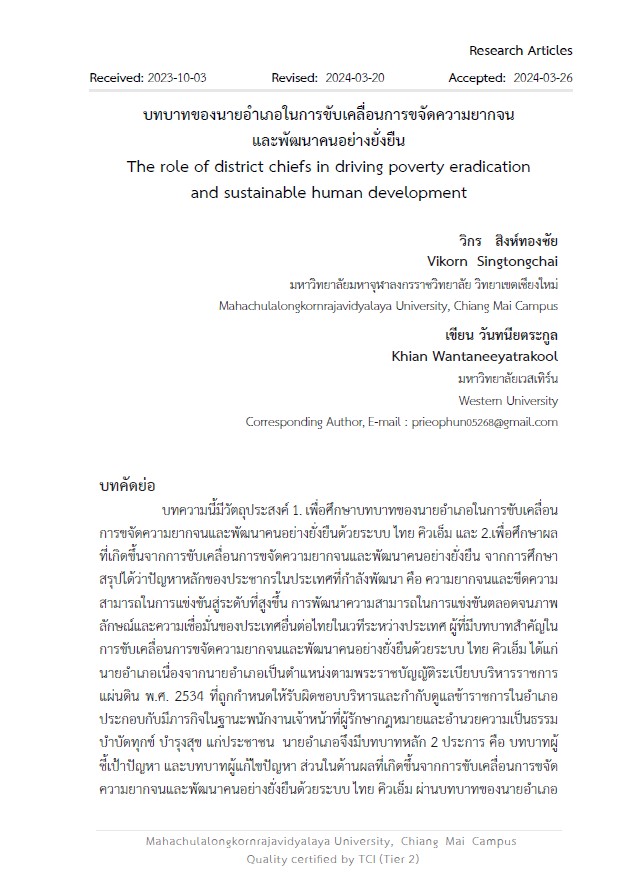
This paper had two main objectives, namely (1) to study the roles of Chief District Officer (CDO) in propelling the poverty eradication and sustainable human development through the usage of Thai QM system, and (2) to study the results of such propellant using Thai QM system. The study illustrated that Chief District Officers are key actors in driving the poverty eradication and sustainable human development by using Thai QM system. From the study, it can be concluded that the main problems of people in developing countries, including Thailand, are poverty and competitive capabilities. To solve such problems in current world context, it is important to focus on poverty eradication and development of Thai people’s wellbeing, improvement of competitive competencies, as well as reinforcement of image and trustworthiness of Thailand in international setting. In addition, this aspect has connection to the United Nations’ Sustainable Development Goals (SDGS), which had been positively affirmed by the general assembly in 2015. The key actor in propelling poverty eradication and sustainable human development through Thai QM system is the Chief District Officer (CDO). This is because the positions of CDOs are assigned in accordance with the State Administration Act 1991 (B.E.2534), which stated that CDOs are responsible for administrative tasks and monitoring of district officers. Moreover, CDOs are responsible as regulators/law enforcers to uphold justice, alleviate suffering, enhance happiness for the people. In this regard, CDOs have two main roles: CDOs as problem locators, and CDOs as problem solvers. The result of CDOs’ propellant of poverty eradication and sustainable human development through Thai QM system were reflected in five dimensions, namely (1) Health Dimension, (2) Wellbeing Dimension, (3) Education Dimension, (4) Income Dimension, and (5) Accessibility to Public Services Dimension. The outcome stated that 629,588 out of 653,524 struggling households, accounted for 96.34 percent, had received help. In this number, 48,523 struggling households were in the monitoring stage, while the problems of another 1,045 struggling households were deemed unsolvable. In this regard, it can be concluded that poverty had been significantly addressed and sustainable human development had been achieved, both of which aligned with the United Nations’ sustainable development goals.
Article Details
References
กรมการปกครอง กระทรวงมหาดไทย. (2560). คู่มือเพื่อสนับสนุนการปฏิบัติราชการของนายอำเภอ. กรุงเทพมหานคร : โรงพิมพ์อาสารักษาดินแดน.
_____________-. ( 2 มกราคม 2560). คู่มือสนับสนุนการปฏิบัติราชการของนายอำเภอ กรมการปกครอง กระทรวงมหาดไทย. สืบค้นเมื่อ 25 มกราคม 2567, จาก ttps://multi.dopa.go.th/tspd/tpad/work_manual/read8
กระทรวงมหาดไทย. (1 มีนาคม 2565). รายงานผลการดำเนินงานตามภารกิจสำคัญของกระทรวงมหาดไทย ปีงบประมาณ พ.ศ. 2565. สืบค้นเมื่อ 25 มกราคม 2567, จาก https://www2.buengkan.go.th/ebook/detail/7
ปรัชญาของเศรษฐกิจพอเพียง . ( 5 มีนาคม 2565). คู่มือการดำเนินงานการขจัดความยากจนและพัฒนาคนทุกช่วงวัยอย่างยั่งยืนตามหลักปรัชญาของเศรษฐกิจพอเพียง. สืบค้นเมื่อ 26 มกราคม 2567, จาก https//mahasarakham.cdd&oq=https/mahasarakham.cdd&gs_lcrp=EgZjaHJvbWUyBggAEEUYOTIGCAEQRRg60gEKODU1OTFqMGoxN
สำนักงานสภาพัฒนาการเศรษฐกิจและสังคมแห่งชาติ. (2 มีนาคม 2566). แนวทางขับเคลื่อนการขจัดความยากจนและพัฒนาคนทุกช่วงวัย บนฐานข้อมูลเชิงประจักษ์ปีงบประมาณ พ.ศ. 2566. สืบค้นเมื่อ 25 มกราคม 2567, จาก http://nscr.nesdc.go.th/wp-content/uploads/2023/05/pelcd_TPMAP _presentation.pdf
สำนักงานคณะกรรมการกฤษฎีกา . (1 ตุลาคม 2534 ). พระราชบัญญัติระเบียบบริหารราชการแผ่นดิน พ.ศ. 2534. สืบค้นเมื่อ 25 มกราคม 2567, จากhttps//www.obtnongpan.&oq=https/www.obtnongpan.&gs _lcrp=EgZjaHJvbWUyBggAEEUY OTIGCAEQRRg60gEKNzcwNDlqMGoxNag
วัชรเดช เกียรติชานน.(2564). การพัฒนาบทบาทของนายอำเภอในทศวรรษหน้า.วารสารสังคมศาสตร์และมานุษยวิทยาเชิงพุทธ. 6 (2), 443 - 456.
สมศักดิ์ จังตระกุล. (2554). การจัดการความขัดแย้งโดยนายอำเภอของประชาชนในประเทศไทย. หลักสูตรปรัชญาดุษฎีบัณฑิต, สาขาวิชาการจัดการภาครัฐและเอกชน : มหาวิทยาลัยคริสเตียน.
