
ความย้อนแย้งแห่งอัตลักษณ์: มนุษย์ในฐานะภาวะทางจริยธรรม จากมุมมองพุทธปรัชญาและอัตถิภาวนิยม
Article Sidebar
Main Article Content
บทคัดย่อ
บทความนี้มีวัตถุประสงค์เพื่อ 1) วิเคราะห์ทัศนะของภพภูมิอื่นตามคติจักรวาลวิทยาตามทัศนะทางพุทธปรัชญา ที่แสดงความปรารถนาอยากเกิดเป็นมนุษย์ และ 2) วิพากษ์ความย้อนแย้งของมนุษย์ในฐานะผู้อมีศักยภาพสูงสุดในการหลุดพ้นจากวัฏสงสาร แต่กลับเลือกเส้นทางแห่งกิเลส ความทะยานอยาก และวัตถุนิยม ซึ่งใช้กรอบแนวคิดทางปรัชญาตะวันตก และระเบียบวิธีวิจัยเชิงพรรณนาวิเคราะห์ทางปรัชญาโดยการบูรณาการจริยศาสตร์อัตถิภาวนิยมและเครื่องมือนิยม
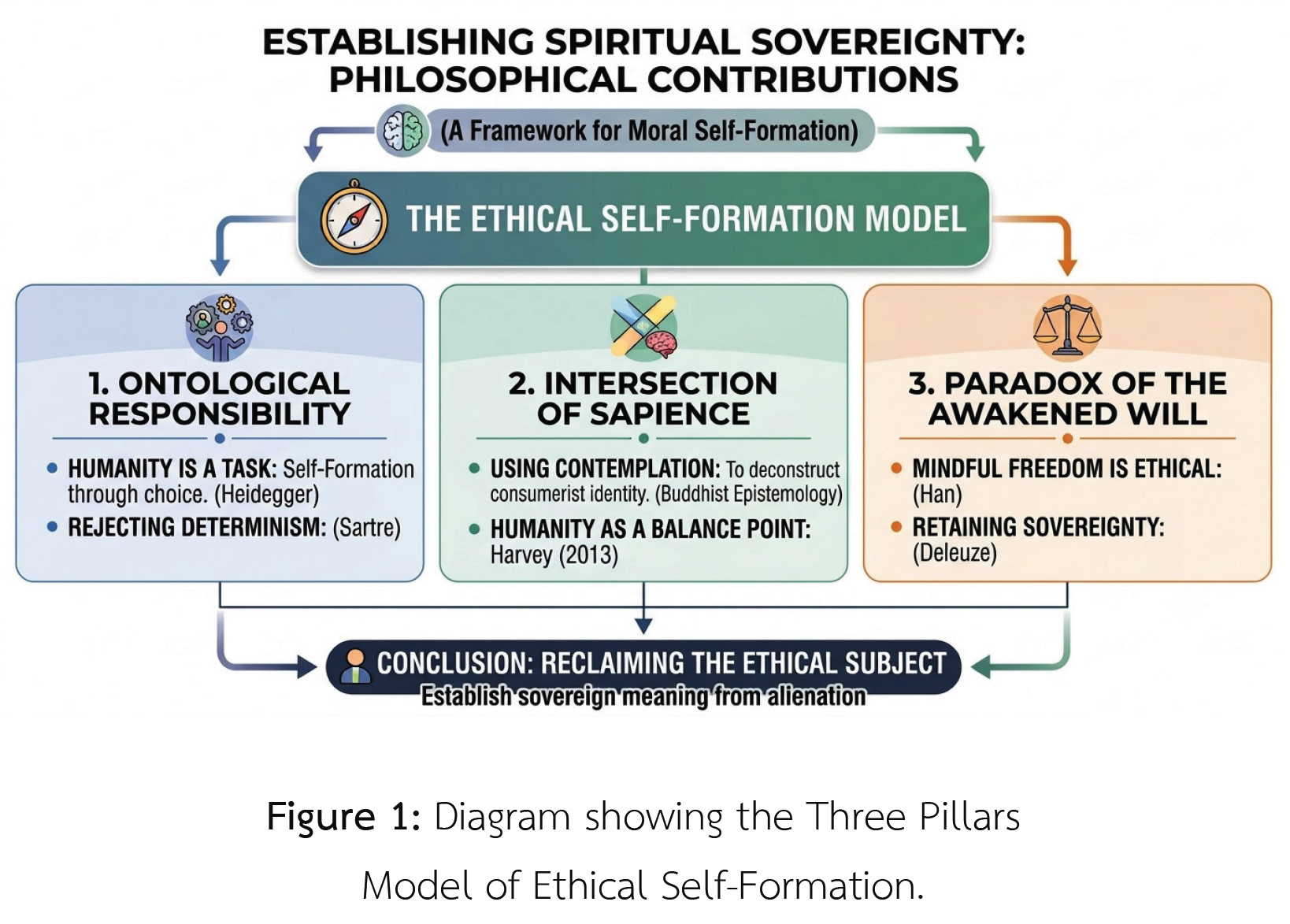
ผลการวิจัยพบว่า ความเป็นมนุษย์มิใช่สถานะทางชีวภาพที่หยุดนิ่งหรือนิยามด้วยสังคมวิทยาเพียงระนาบเดียว แต่คือพื้นที่ทางจริยธรรมที่ดำรงอยู่ในสภาวะรอยต่อระหว่างความจำยอมเชิงโครงสร้างและเจตจำนงเสรี ในขณะที่ภพภูมิอื่นถูกจำกัดด้วยภาวะสยบยอมต่อสัญชาตญาณหรือแรงขับทางกามสุขและทุกขเวทนาที่ล้นเกิน มนุษย์กลับดำรงอยู่ในจุดสมดุลเชิงวิพากษ์ที่เอื้อต่อการใช้โยนิโสมนสิการเพื่อรื้อสร้างอัตลักษณ์และก้าวพ้นมายาการของตัวตน ด้วยความสามารถในการใช้เหตุผล การไตร่ตรอง และการกระทำที่มีจริยธรรมอย่างมีสติ เหตุนี้ ความเป็นมนุษย์จึงมิใช่เพียงโอกาส แต่เป็น ìภาวะที่ต้องรับผิดชอบî ในระดับสูงสุด
Article Details
เอกสารอ้างอิง
Agamben, G. (1998). Homo Sacer: Sovereign power and bare life (D. Heller-Roazen, Trans.). Stanford University Press.
Aristotle. (2009). The Nicomachean ethics (D. Ross, Trans.). Oxford University Press.
Bourdieu, P. (1990). The logic of practice (R. Nice, Trans.). Stanford University Press.
Deleuze, G. (1992). Postscript on the societies of control. October, 59, 3–7.
Dewey, J. (1938). Experience and education. Macmillan.
Dreyfus, H. L., & Thompson, E. (2007). Mindful inquiry. In Self, no self? Perspectives from analytical, phenomenological, and Indian traditions. Oxford University Press.
Foucault, M. (1977). Discipline and punish: The birth of the prison (A. Sheridan, Trans.). Pantheon.
Foucault, M. (1988). Technologies of the self: A seminar with Michel Foucault (L. H. Martin, H. Gutman, & P. H. Hutton, Eds.). University of Massachusetts Press.
Frankl, V. E. (2006). Man’s search for meaning (I. Lasch, Trans.). Beacon Press. (Original work published 1946).
Gethin, R. (1998). The foundations of Buddhism. Oxford University Press.
Habermas, J. (1984). The theory of communicative action: Reason and the rationalization of society (T. McCarthy, Trans.). Beacon Press.
Han, B.-C. (2015). The transparency society (E. Butler, Trans.). Stanford Briefs.
Harvey, P. (2013). An introduction to Buddhism: Teachings, history and practices (2nd ed.). Cambridge University Press.
Heidegger, M. (1962). Being and time (J. Macquarrie & E. Robinson, Trans.). Harper & Row. (Original work published 1927).
Kant, I. (1997). Groundwork of the metaphysics of morals (M. Gregor, Trans. & Ed.). Cambridge University Press. (Original work published 1785).
Keown, D. (2001). The nature of Buddhist ethics. Palgrave Macmillan.
Keown, D. (2005). Buddhism and ethics. In Buddhist ethics: A very short introduction. Oxford University Press.
Levinas, E. (1969). Totality and infinity: An essay on exteriority (A. Lingis, Trans.). Duquesne University Press.
Mahachulalongkornrajavidyalaya University. (1996). Thai Tripiṭaka (Mahachulalongkornrajavidyalaya Edition).
Mahachulalongkornrajavidyalaya University Press.
Nagel, T. (1971). The absurd. The Journal of Philosophy, 68(20), 716–727.
Phra Brahmagunabhorn (P. A. Payutto). (2012). Buddhadhamma: The expanded and revised edition [In Thai]. Buddhadhamma Foundation.
Phra Phaisan Visalo. (2018). The middle way of life in the digital age [In Thai]. Buddhadasa Indapanno Archives.
Rahula, W. (1978). What the Buddha taught (Revised ed.). Grove Press.
Rawls, J. (1999). A theory of justice (Revised ed.). Belknap Press.
Sartre, J.-P. (2007). Existentialism is a humanism (C. Macomber, Trans.). Yale University Press. (Original work published 1946).
Walpola, R. (2003). The Buddha’s philosophy of mind: An introduction. Buddhist Publication Society.
Williams, P. (2009). Mahayana Buddhism: The doctrinal foundations (2nd ed.). Routledge.
