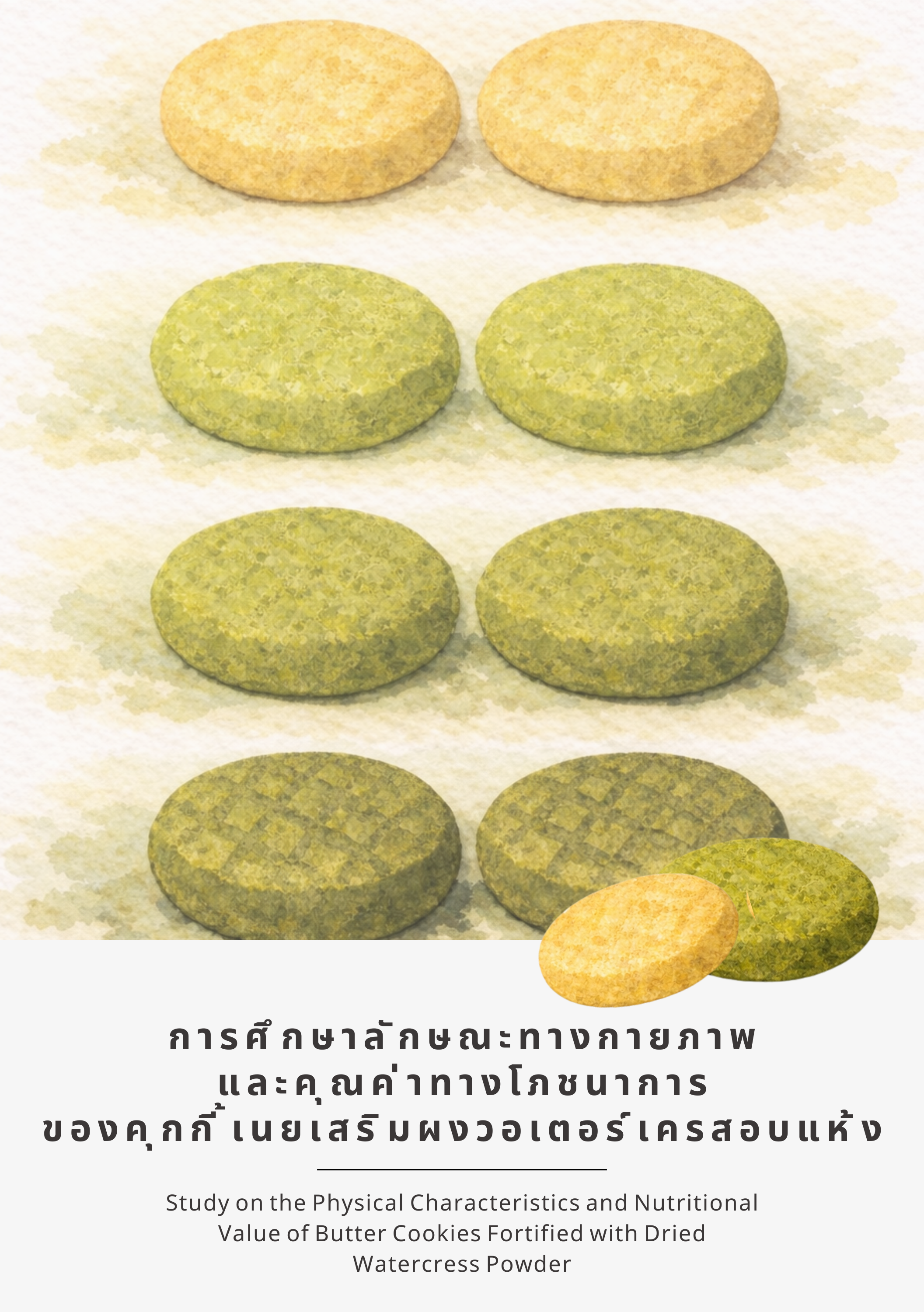
Study on the Physical Characteristics and Nutritional Value of Butter Cookies Fortified with Dried Watercress Powder
Article Sidebar
Main Article Content
Abstract
This research aimed to investigate the physical characteristics and nutritional value of butter cookies fortified with dried watercress powder. Six formulations were developed with watercress powder added at 0%, 5%, 10%, 15%, 20%, and 25% of the flour weight. The experiment was conducted using a control butter cookie recipe, into which the dried watercress powder was incorporated. The cookies were analyzed for lightness (L), color values (a and b*), hardness, and spread. Nutritional values were determined using the INMUCAL-Nutrients V.4.0 software. The results showed that the addition of watercress powder led to a darker green appearance of the cookies. The L value decreased, the a value shifted from positive to negative indicating a green hue, and the b* value also decreased with increasing levels of watercress powder. The hardness of the cookies significantly increased as the amount of watercress powder increased. Cookie spread decreased, with a significant reduction in diameter and an increase in thickness. Nutritional analysis revealed that the fortified cookies contained progressively higher amounts of protein, dietary fiber, calcium, iron,and vitamin A.Fortifying butter cookies with dried watercress powder can enhance their nutritional value and provide a healthier alternative for consumers seeking functional food options.
Article Details
References
สถาบันโภชนาการ มหาวิทยาลัยมหิดล. (2563). โปรแกรม INMUCAL-Nutrients เวอร์ชัน 4.0, (อัดสำเนา), มหาวิทยาลัยมหิดล.
ปัทมาภรณ์ เจริญนนท์, จุฑาวรรณ นวลจันทร์คง, กุสุมาศ ตันไชย และศกุนตาล์ มานะกล้า. (2566). คุณสมบัติทางเคมีกายภาพและคุณค่าทางโภชนาการ ของผลิตภัณฑ์คุกกี้โดยใช้แป้งบักวีทและแป้งควินัว. วารสารวัฒนธรรมอาหารไทย, 5(2), 39-50.
อาริยา จินดาวิภูษิต, วรลักษณ์ ปัญญาธิติพงศ์ และวไลภรณ์ สุทธา. (2567). การพัฒนาผลิตภัณฑ์คุกกี้เนยสดเสริมกากกาแฟ. วารสารคหกรรมศาสตร์และวัฒนธรรมอย่างยั่งยืน, 6(2), 32-45.
Butt, M. S., Tahir-Nadeem, M., Khan, M. K. I., & Shabir, R. (2016). Oat: Unique among the cereals. European Journal of Nutrition, 47(2), 68-79. https://doi.org/10.1007/s00394-008-0698-7
Gill, C. I. R., Haldar, S., Boyd, L. A., Bennett, R., Whiteford, J., Butler, M. & Rowland, I. R. (2007). Watercress supplementation in diet reduces lymphocyte DNA damage and alters blood antioxidant status in healthy adults. The American Journal of Clinical Nutrition, 85(2), 504–510. https://doi.org/10.1093/ajcn/85.2.504
Gómez, M., Ronda, F., Blanco, C. A., Caballero, P. A. & Apesteguía, A. (2012). Effect of dietary fiber on dough rheology and bread quality. Food Science and Technology International, 18(3), 241-249. https://doi.org/10.1007/s00217-002-0632-9
Guil-Guerrero, J. L., Martínez-Guirado, C., Rebolloso-Fuentes, M. M. & Carrique-Pérez, A. (2006). Nutrient composition and antioxidant activity of 10 pepper (Capsicum annuum) varieties. European Food Research and Technology, 224, 1-9. https://doi.org/10.1007/s00217-006-0281-5
Healthline. (2018, August 6). 10 impressive health benefits of watercress. https://www.healthline.com/nutrition/watercress-benefits
Lee, Y. M., Shin, H. S. & Lee, J. H. (2017). Quality Characteristics and Antioxidant Properties of Cookies Supplemented with Taraxacum coreanum Powder. Journal of the Korean Society of Food Science and Nutrition, 46(2), 273-278.
Sudha, M. L., Baskaran, V. & Leelavathi, K. (2007). Apple pomace as a source of dietary fiber and polyphenols and its effect on the rheological characteristics and cake making. Food Chemistry, 104(2), 686–692. https://doi.org/10.1016/j.foodchem.2006.12.016
The Watercress Company. (n.d.). Nutritional composition of watercress. Retrieved May 28, 2025, from https://www.thewatercresscompany.com/nutritional-composition-of-watercress
U.S. Department of Agriculture. (2020). FoodData Central. https://fdc.nal.usda.gov/
WebMD. (n.d.). Health benefits of watercress. https://www.webmd.com/diet/health-benefits-watercress
