Development of Vegetarian Recipes from Konjac Products Incorporating Thai Culinary Identity
Article Sidebar
Main Article Content
Abstract
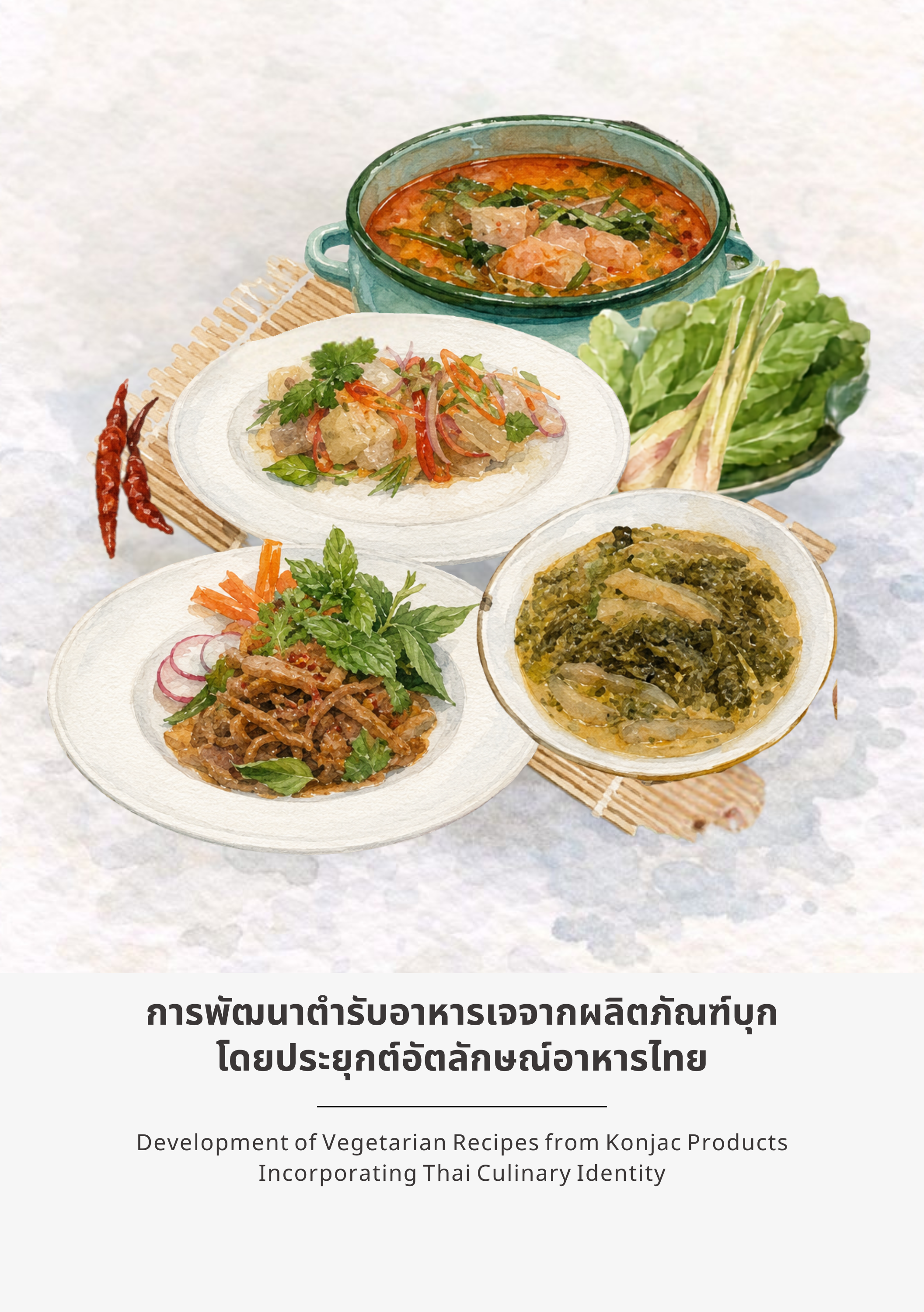
This research aimed to study the demand for vegetarian recipes made from konjac products, to develop vegetarian recipes using processed konjac products, and to examine their nutritional values and consumer acceptance. The research methodology consisted of three phases. Phase 1 involved selecting food items based on the classification criteria of Thai cuisine and surveying consumer demand for vegetarian food. Phase 2 focused on the experimental development process, beginning with the selection of ingredients and raw materials, measuring and weighing components, and preparing materials, equipment, and cooking procedures according to specified time and temperature conditions. Phase 3 involved the analysis of nutritional values and the evaluation of consumer acceptance. The results of the development revealed eight vegetarian recipes made from konjac products, including curry dishes, spicy salads (yam), larb, stir-fried dishes, and dipping sauces. The eight developed recipes were: Konjac with Senna siamea curry, Konjac red curry, Mixed konjac spicy salad, Konjac larb, Four-style stir-fried konjac, Spicy stir-fried konjac, Stir-fried chili paste with konjac, and Konjac coconut dip. Among these, Konjac red curry provided the highest energy at 125 kilocalories, while the Mixed konjac spicy salad provided the lowest energy at 60 kilocalories. In terms of consumer acceptance, the Mixed konjac spicy salad received the highest overall preference score at the highest level (8.45±0.69).
Article Details
References
ชรินรัตน์ จริงจิตร และเสาวลักษณ์ เชื้อคำ. (2566). อาหารไทยจงเจริญ. แสงแดด.
เปลี่ยน ภาสกรวงศ์. (2564). ตำราแม่ครัวหัวป่าก์. (พิมพ์ครั้งที่ 10). สถาพรบุ๊คส์.
พิมพ์วิชญ์ โภคาสุวิบุลย์. (2562). อาหารไทยยอดนิยม. เพชรประกาย.
ยุทธ ไกยวรรณ์. (2559). การวางแผนการทดลองสำหรับการวิจัย. จุฬาลงกรณ์มหาวิทยาลัย.
แสงแข สพันธุพงศ์ และจอมขวัญ สุวรรณรักษ์. (2567). ตำรับอาหารของกลุ่มชาติพันธุ์ไทยรามัญบนพื้นฐานความดั้งเดิม. วารสารมนุษยศาสตร์และสังคมศาสตร์ มหาวิทยาลัยราชภัฏพิบูลสงคราม, 18(2), 663-678.
อภิญญา มานะโรจน์ และสุวรรณา ชัยชนะ. (2561). อาหารไทยเบื้องต้น. แม่บ้าน.
Betagro. (2023, Mar 28). Betagro launches 'Meatly!' premium plant-based ready-to-eat series Kick off with spicy, delicious, healthy Thai fares Advocate new generation to create sustainable food culture. https://shorturl.asia/3w4Bb
Gordon, R. (2019). Quick and Delicious 100 recipes to cook in 30 minutes or less. Great Britain.
Guo, L., Yokoyama. W., Chen. L., Liu. F., Chen. M. & Zhon. F. (2021). Characterization and physicochemical properties analysis of konjac glucomannan: Implications for structure-properties relationships. Food Hydrocolloids, 120, 106818. https://doi.org/10.1016/j.foodhyd.2021.106818
Punyaratabandhu, L. (2018). Simple Thai Food. https://leelapunyaratabandhu.com/simple-thai-food/
Ran, X., Lou, X., Zheng, H., Gu, Q. & Yang, H. (2022). Improving the texture and rheological qualities of a plant-based fishball analogue by using konjac glucomannan to enhance crosslinks with soy protein. Innovative Food Science & Emerging Technologies, 75, 102910. https://doi.org/10.1016/j.ifset.2021.102910
USDA Foreign Agricultural Service. (2021). Plant-based food and beverage market in Thailand. https://shorturl.asia/LVMgO
Widjanarko, S. B., Affandi, M. & Wahyuli, Z. (2022). A review on konjac glucomannan and hydrolysed konjac glucomannan. Food Research, 6(5), 425-433.
