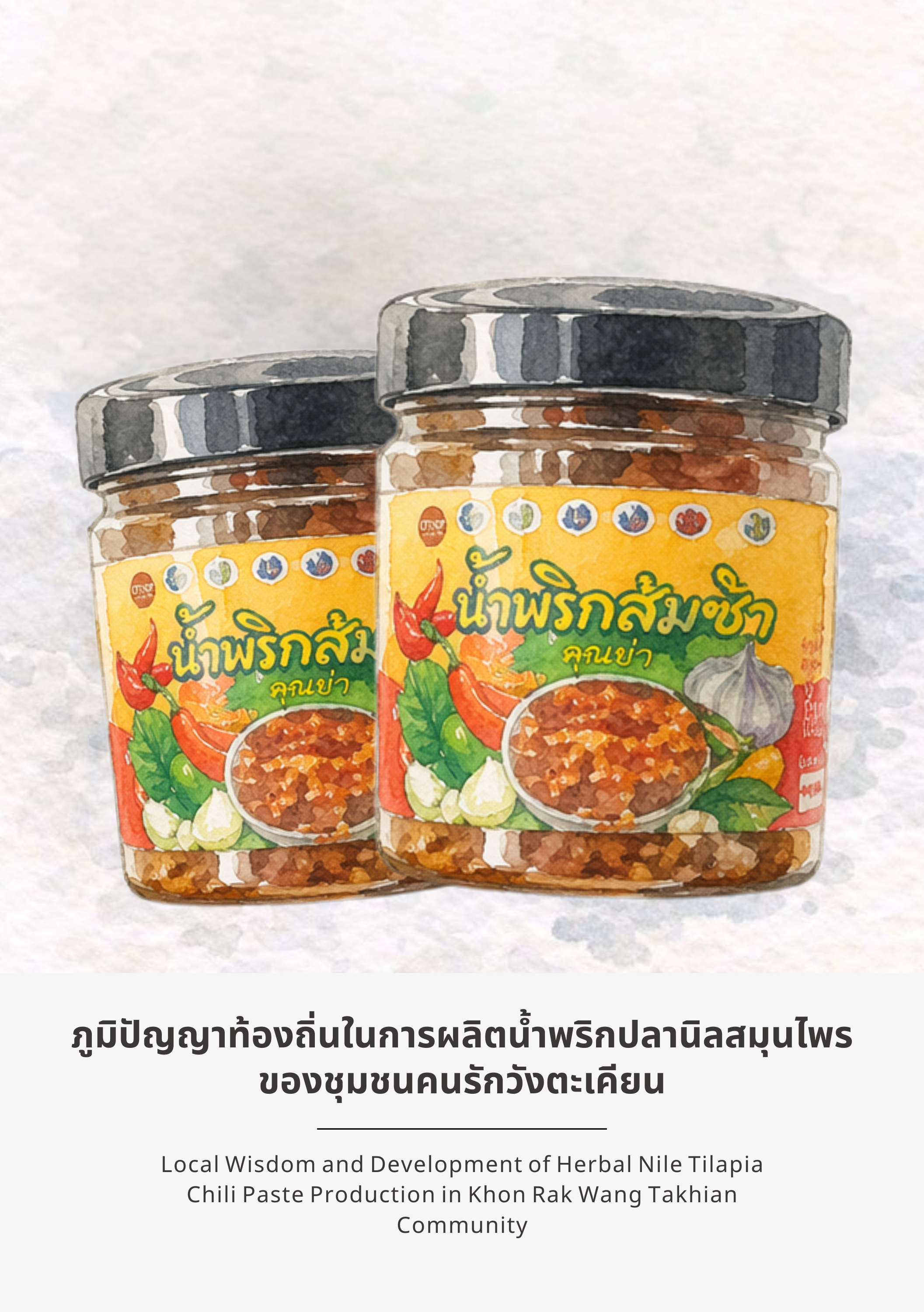
Local Wisdom and Development of Herbal Nile Tilapia Chili Paste Production in Khon Rak Wang Takhian Community
Article Sidebar
Main Article Content
Abstract
The local wisdom of chili paste production is closely interrelated with the community's way of life and livelihood. However, the reliance on personal expertise without a standardized recipe negatively affects product consistency. This qualitative research, employing a phenomenological approach, aims to investigate the socio-cultural context associated with the local wisdom of herbal tilapia chili paste production, explore the traditional knowledge and manufacturing process, and propose guidelines for product development by integrating local wisdom with management concepts and process innovations. The key informants comprised ten individuals, including members of the Wang Takhian Lover Community Enterprise and consumers. Data were collected through in-depth interviews using semi-structured guidelines and analyzed via thematic analysis. The findings reveal that: 1) the community context consists of five main themes: history and identity, natural resources, occupations, collective organization, and the transmission of wisdom, wherein chili paste production serves as a method to process surplus agricultural produce to create added value; 2) the production process involves six stages: equipment preparation, fish meat preparation, frying, seasoning, cooling, and packaging; and 3) the product development guidelines entail four approaches: establishing a standardized recipe to elevate product quality, selecting optimal raw materials to ensure desired taste and nutritional value, utilizing high-quality cooking methods to preserve the unique herbal characteristics, and standardizing the production process for commercial viability. Consequently, the study recommends a systematic integration of local wisdom and modern innovation throughout the production process.
Article Details
References
จักรินทร์ ตรีอินทอง และปิยะฉัตร วิริยะอำไพวงศ์. (2566). การพัฒนาผลิตภัณฑ์น้ำพริกปลานิลเค็ม. วารสารเกษตรพระวรุณ, 20(2), 151-159.
จิระประภา คำราช, ฐิฏิกานต์ สุริยะสาร, กาญจนา คุมา และเบญจวรรณ เลาลลิต. (2568). การเพิ่มมูลค่าของผลิตภัณฑ์น้ำพริกลาบเพื่อสร้างความได้เปรียบในการแข่งขันของกลุ่มวิสาหกิจชุมชนน้ำพริกลาบบ้านน้ำจำ ตำบลวอแก้ว อำเภอห้างฉัตร จังหวัดลำปาง. วารสารการพัฒนาชุมชนและคุณภาพชีวิต, 13(2), 196-205.
ชเนตตี พิพัฒนางกูร, นงนาท นพคุณ, ประพันธ์ แก้วคำ, Chen, Y., จีระรัตน์ โพธิกระจ่าง, Bin,Q. และอรพรรณ สุวภาพ. (2568). การพัฒนากลุ่มอาชีพน้ำพริกเห็ดสู่วิสาหกิจชุมชนโดยการมีส่วนร่วมของชุมชน: กรณีศึกษาชุมชนพูนทรัพย์ เขตสายไหม กรุงเทพมหานคร. วารสารมนุษยศาสตร์และสังคมศาสตร์ร่มพฤกษ์, 43(2), 221-236.
ชินีเพ็ญ มะลิสุวรรณ และมีนา ระเด่นอาหมัด. (2564). การสื่อสารวัฒนธรรมอาหารพื้นบ้านชายแดนใต้ของไทย. วารสารปัญญาภิวัฒน์, 13(2), 177-189.
นุชเนตร ตาเย๊ะ, จริยา สุขจันทรา, คืนจันทร์ ณ นคร และรุสนี กาแมแล. (2565). การพัฒนาผลิตภัณฑ์น้ำพริกปลาส้มปลานิล. วารสารวิทยาศาสตร์และเทคโนโลยี มรย., 7(3), 1-8.
นันธวัช นุนารถ. (2560). ภูมิปัญญาท้องถิ่น คุณค่าแห่งวิถีชีวิต วัฒนธรรม เพื่อการศึกษาที่ยั่งยืน. วารสารวิชาการและวิจัยสังคมศาสตร์, 12(34), 17-26.
บุษกร เชี่ยวจินดากานต์. (2561). เทคนิคการวิจัยเชิงคุณภาพแบบกรณีศึกษา. วารสารศิลปศาสตร์ปริทัศน์. 13(25), 103-118.
ประไพพิมพ์ สุธีวสินนนท์ และประสพชัย พสุนนท์. (2559). กลยุทธ์การเลือกตัวอย่างสำหรับการวิจัยเชิงคุณภาพ. วารสารปาริชาต มหาวิทยาลัยทักษิณ. 29(2), 31-48.
พิเชษฐ เนตรสว่าง และฉัตรชัย นิยะบุญ. (2565). การสืบทอดภูมิปัญญาในการทำขนมไทย (ทองหยอด ฝอยทอง และเม็ดขนุน) เพื่อพัฒนาเป็นธุรกิจ ของกลุ่มแม่บ้าน ชุมชนบ้านจีน ตำบลวัดยม อำเภอบางบาล จังหวัดพระนครศรีอยุธยา. วารสารวิชาการอยุธยาศึกษา, 14(1), 87-101.
วีรยุทธ เปลี่ยนสำโรง, ศิวพร ยิ้มแต้, จารุวรรณ เนตรบุตร, กนกวรรณ เตียศิริ และจุฑามาศ พีรพัชระ. (2568). ภูมิปัญญาการทำน้ำพริกปลาส้มคั่วสมุนไพร การพัฒนาผลิตภัณฑ์เพื่อความยั่งยืนของชุมชน. วารสารคหกรรมศาสตร์และวัฒนธรรมอย่างยั่งยืน, 7(1), 134-147.
สิริน ฉกามานนท์. (2563). แนวทางการสืบสานคุณค่าและอัตลักษณ์ร่วมทางวัฒนธรรม: น้ำพริกแห่งอุษาคเนย์. วารสารกระแสวัฒนธรรม, 23(43), 34-45.
Braun, V. & Clarke, V. (2006). Using thematic analysis in psychology. Qualitative Research in Psychology, 3(2), 77-101. https://doi.org/10.1191/1478088706qp063oa
Heotis, E. (2020). Phenomenological research methods: Extensions of Husserl and Heidegger. International Journal of School and Cognitive Psychology, 7(2), 221-231.
Langdridge, D. (2007). Phenomenological Psychology: Theory, Research and Method. Pearson Education.
Nastasi, B. K. & Schensul, S. L. (2005). Contributions of qualitative research to the validity of intervention research, Journal of School Psychology, 43(3), 177-195. https://doi.org/10.1016/j.jsp.2005.04.003
Trott, P. (2021). Innovation management and new product development (7th ed.). Pearson.
