Effects of Using Bitter Orange Juice and Peel Supplementation in Crispy Jelly on Physical Qualities and Consumer Acceptance
Article Sidebar
Main Article Content
Abstract
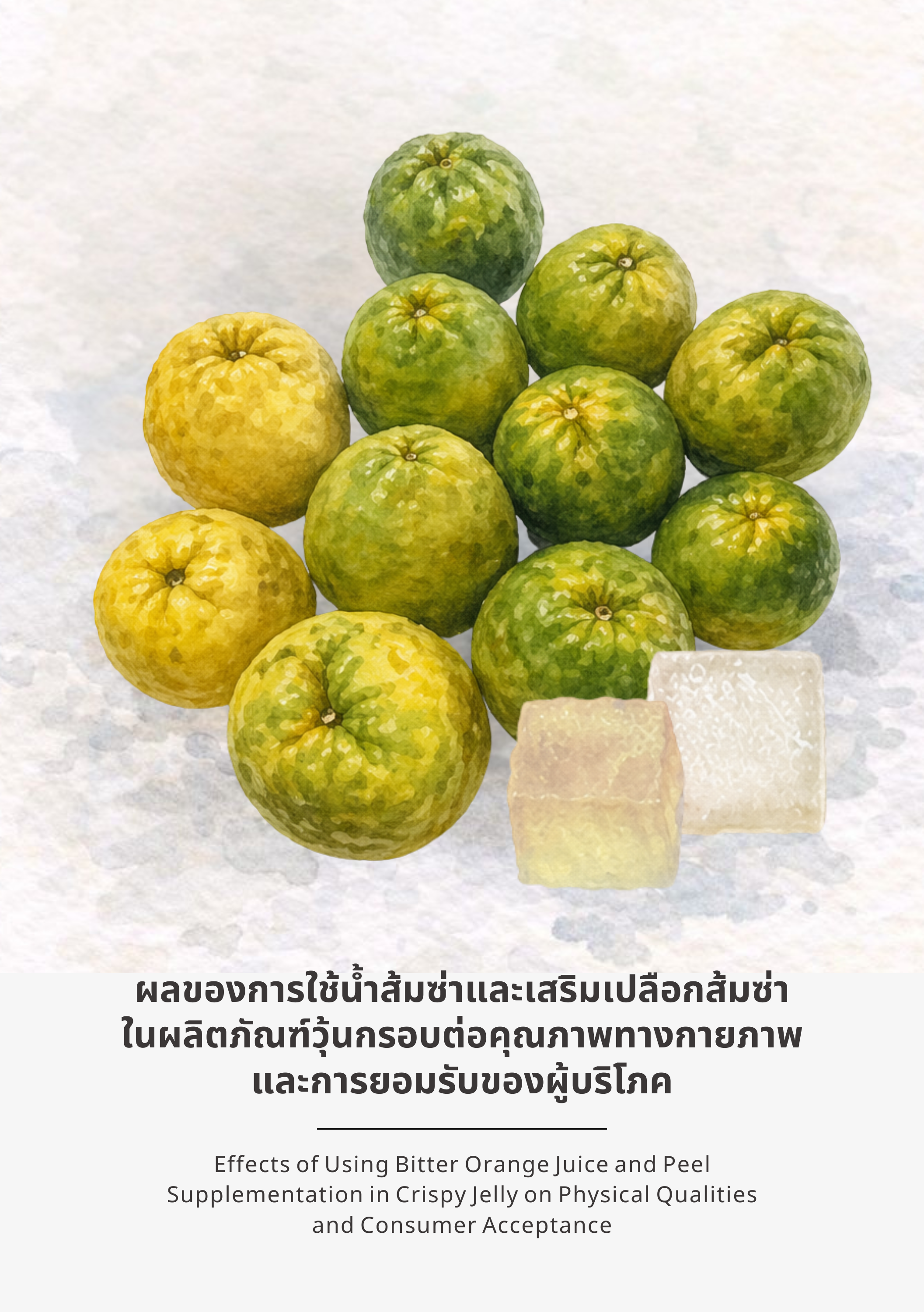
This study aimed to develop crispy jelly (Wun Krob) using bitter orange (Som Sa) by investigating the appropriate amount of bitter orange juice and bitter orange peel to optimize the sensory evaluation and physical qualities of the product. The optimal amount of bitter orange was investigated by substituting water at 10%, 20%, and 30% levels, respectively. The sensory evaluation revealed that the crispy jelly formulation with the 70:30 water:bitter orange juice ratio had the highest flavor attribute, which was statistically significant (p≤0.05). Subsequently, a study on bitter orange peel supplementation at 0.5%, 1%, and 1.5%, based on ingredient weight, The bitter orange peel 0.5% supplementation had the highest scores for appearance, flavor, taste, texture and overall liking. The developed product exhibited the lightness (L*), redness (a*), and yellowness (b*) values of 28.11, –1.16, and 5.48, respectively, reflecting a natural yellowish-green characteristic. It had a moisture content of 6.85% and a water activity (aw) of 0.77. Consumer acceptance evaluation revealed that the average liking scores for appearance, color, flavor, taste, texture, and overall liking were 8.72, 7.80, 7.74, 7.72, 8.06, and 8.20, respectively. These findings highlight the potential of Som Sa, a distinctive Thai local crop, for value-added processing into innovative Thai desserts.
Article Details
References
ณฐิฒา รอดขวัญ และวรรณี จิรภาคย์กุล. (2559, 2-9 กุมภาพันธ์). สารประกอบเชิงซ้อนแบบอินคลูชันของสารให้กลิ่นสำคัญของใบมะกรูดด้วยสตาร์ชถั่วเขียวและการปลดปล่อยที่ค่าพีเอชต่างกัน [เอกสารนำเสนอ]. การประชุมทางวิชาการของมหาวิทยาลัย เกษตรศาสตร์ ครั้งที่ 54. มหาวิทยาลัยเกษตรศาสตร์ กรุงเทพฯ, ประเทศไทย.
ธิดารัตน์ นทวงศ์ และปรียาภรณ์ คลังสิริ. (2558). วุ้นกรอบมะละกอ. [ปัญหาพิเศษศิลปศาสตรบัณฑิต ไม่ได้ตีพิมพ์]. มหาวิทยาลัยราชภัฏนครปฐม.
นรินทร์ เจริญพันธ์. (2561). การพัฒนาผลิตภัณฑ์วุ้นกรอบจากลำไยตกเกรด. วารสารวิทยาศาสตร์และเทคโนโลยี, 26(5), 834-845.
วรรณวรางค์ วัชรานานันท์, ธงชัย พุฒทองศิริ และกิตติพงษ์ ห่วงรักษ์. (2563). สารให้กลิ่นในเปลือกส้มซ่าจากการสกัดด้วยวิธีต่างกัน. วารสารเกษตรพระจอมเกล้า, 38(1), 16-23.
วัฒนา อัจฉริยะโพธา, สินีนาถ สุขทนารักษ์ และเบญจางค์ อัจฉริยะโพธา. (2564). การศึกษาเบื้องต้นของสารต้านอนุมูลอิสระในน้ำคั้นผลส้มซ่าที่ปลูกแบบไร้สารพิษในพื้นที่ ต.คลองห้า อ.คลองหลวง จ.ปทุมธานี. วารสารวิทยาศาสตร์เกษตร, 52(1)(พิเศษ), 205-208.
ศรัณยา เพ่งผล, ณัฐชา ชื่นเนียม และวิลาวัลย์ คำปวน. (2564). ผลของสารเคลือบผิวไขผึ้งต่อคุณภาพของส้มซ่าระหว่างการขนส่งแบบจำลอง. วารสารวิทยาศาสตร์เกษตร, 52(2)(พิเศษ), 102-106.
สินีนาถ สุขทนารักษ์, เบญจางค์, อัจฉริยะโพธา และวัฒนา อัจฉริยะโพธา. (2566). การพัฒนาผลิตภัณฑ์เม็ดเจลน้ำส้มซ่าทรงกลม. วารสารวิจัย มหาวิทยาลัยเทคโนโลยีราชมงคล ตะวันออก, 16(2), 66-74.
สุปราณี แพรศิริ. (2552). ขนมไทย. เอ็มไอเอส.
อบเชย วงศ์ทอง และขนิษฐา พูนผลกุล. (2559). หลักการประกอบอาหาร (พิมพ์ครั้งที่ 13). สำนักพิมพ์มหาวิทยาลัยเกษตรศาสตร์.
อินท์ธีมา หิรัญอัครวงศ์. (2557). การพัฒนาผลิตภัณฑ์วุ้นกรอบจากน้ำตาลสด. [วิทยานิพนธ์ปริญญามหาบัณฑิต ไม่ได้ตีพิมพ์]. มหาวิทยาลัยเทคโนโลยีราชมงคลพระนคร.
โอเพ่นไรซ์. (ม.ป.ป.). วุ้นกรอบ. https://th.openrice.com/th/recipe/วุ้นกรอบ/2028
AOAC. (2000). Official Methods of Analysis (17th ed). Association of Official Analytical Chemists.
Jeffries, K. A., Fan, Z., Mattia, M., Stover, E., Baldwin, E., Manthey, J. A., Breksa, A., Bai, J. & Plotto, A. (2025). Flavonoid contributors to bitterness in juice from Citrus and Citrus hybrids with/without Poncirus trifoliata in their pedigree. Food chemistry: X, 26, 102289. https://doi.org/10.1016/j.fochx.2025.102289
Konno, A., Misaki, M., Toda, J., Wada, T. & Yasumatsu, K. (1982). Bitterness Reduction of Naringin and Limonin by β-Cyclodextrin. Agricultural and Biological Chemistry, 46(9), 2203-2208. https://doi.org/10.1271/bbb1961.46.2203
Maksoud, S., Abdel-Massih, R. M., Rajha, H. N., Louka, N., Chemat, F., Barba, F. J. & Debs, E. (2021). Citrus aurantium L. Active Constituents, Biological Effects and Extraction Methods. An Updated Review. Molecules, 26(19), 5832. https://doi.org/10.3390/molecules26195832.
Masyita, A., Mustika Sari, R., Dwi Astuti, A., Yasir, B., Rahma Rumata, N., Emran, T. B., Nainu, F. & Simal-Gandara, J. (2022). Terpenes and terpenoids as main bioactive compounds of essential oils, their roles in human health and potential application as natural food preservatives. Food chemistry: X, 13, 100217. https://doi.org/10.1016/j.fochx.2022.100217
Munir, H., Yaqoob, S., Awan, K. A., Imtiaz, A., Naveed, H., Ahmad, N., Naeem, M., Sultan, W. & Ma, Y. (2024). Unveiling the Chemistry of Citrus Peel: Insights into Nutraceutical Potential and Therapeutic Applications. Foods (Basel, Switzerland), 13(11), 1681. https://doi.org/10.3390/foods13111681.
Stone, H. & Sidel, J. L. (1993). Sensory Evaluation (2nd ed.). Academic Press, Inc.
Wang, R., & Hartel, R. W. (2022). Citric acid and heating on gelatin hydrolysis and gelation in confectionery gels. Food Hydrocolloids, 129, 107642. https://doi.org/https://doi.org/10.1016/j.foodhyd.2022.107642.
