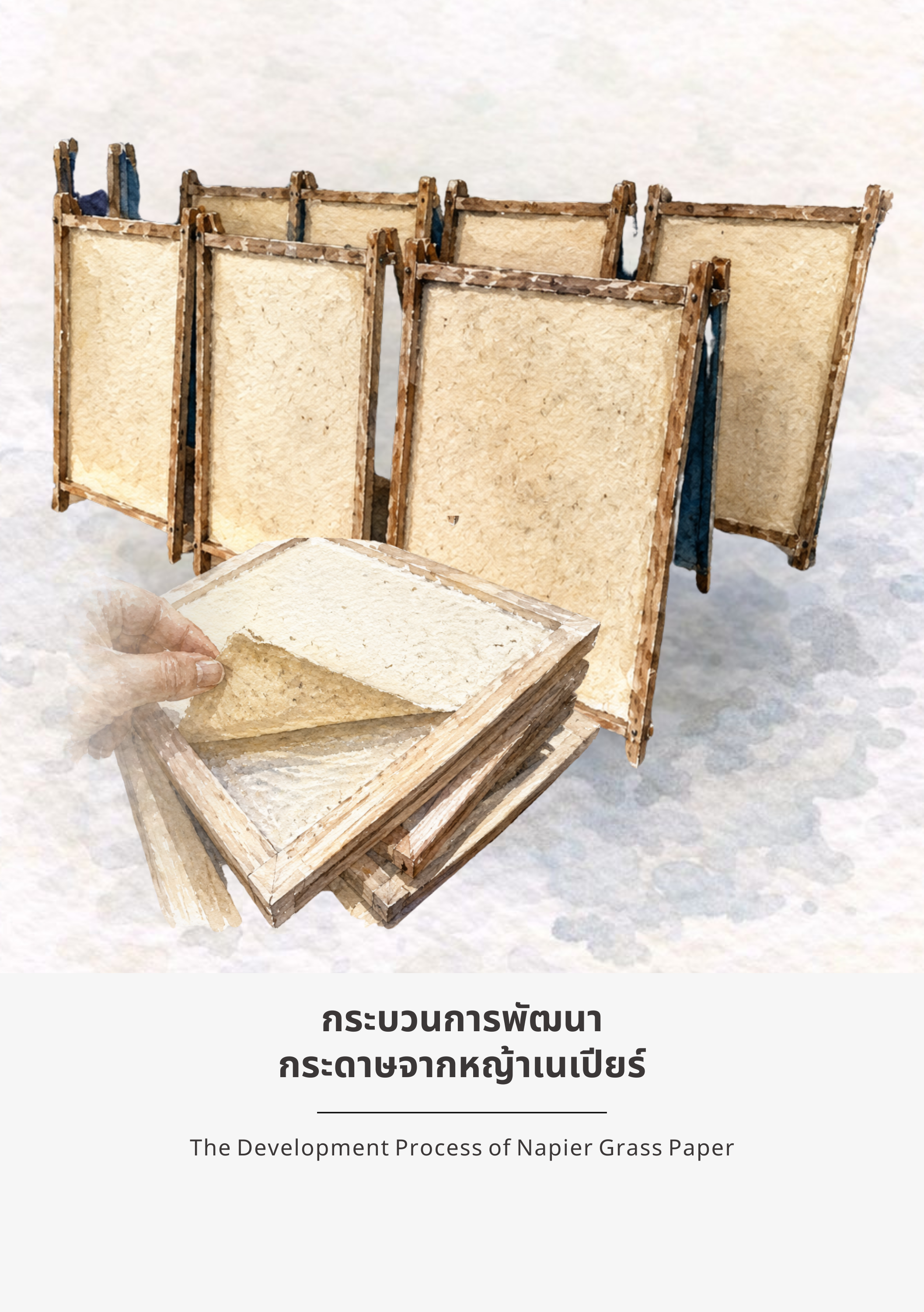
The Development Process of Napier Grass Paper
Article Sidebar
Main Article Content
Abstract
This research aimed to 1) investigate approaches for utilizing Napier grass, 2) study the production process and physical quality of Napier grass paper, and 3) evaluate user satisfaction with Napier grass paper. The research instruments included interview forms, experimental record forms, and a satisfaction assessment form for Napier grass paper. The sample groups consisted of Napier grass growers, handicraft experts, and paper users. The findings revealed that Napier grass, an agricultural waste material, could be developed into plant fiber paper products in accordance with the Thai Community Product Standard (TCPS 41/2017). The production process comprised six stages: 1) raw material preparation, 2) pulp cooking with an alkaline solution, 3) pulp washing, 4) pulp blending, 5) paper sheet formation, and 6) drying. The resulting paper exhibited natural coloration, toughness, strength, and good flexibility. Product quality testing, conducted by the Environmental and Product Testing Center of Chiang Rai Rajabhat University according to TCPS 41/2017 standards, indicated that all five samples of Napier grass paper met the required criteria. The paper demonstrated fine workmanship, absence of tears or contaminants, a moisture content of 8.65% in compliance with the standard, and dimensions of 50×70 centimeters according to the specified requirements. User satisfaction with Napier grass paper was rated at a high level (x̅=4.32, SD 0.56). In conclusion, Napier grass, as an agricultural waste material, can be effectively developed into plant fiber paper for further application in creative product development under the concept of the circular economy.
Article Details
References
กรมปศุสัตว์ กระทรวงเกษตรและสหกรณ์. (2545). หญ้าเนเปียร์. โรงพิมพ์ชุมนุมสหกรณ์การเกษตรแห่งประเทศไทย จำกัด.
บุญชม ศรีสะอาด. (2560). การวิจัยเบื้องต้น. (พิมพ์ครั้งที่ 10). สุวีริยาสาส์น.
สำนักงานส่งเสริมและสนับสนุนวิชาการ 9. (2567, มีนายน). PM2.5 ภัยไร้เสียงสถานการณ์ฝุ่นควัน PM2.5 ภาคเหนือนืตอนบน. https://drive.google.com/file/d/1o70kKOZ8AlRohVFBF_QCyjy7uBsyODBE/view
สำนักพัฒนาอุตสาหกรรมชุมชน. (2650). มาตรฐานผลิตภัณฑ์ชุมชน กระดาษเส้นใยพืช (มผช. 41/2560). กรมส่งเสริมอุตสาหกรรม.
วีระ โชติธรรมาภรณ์. (2566). การผลิตกระดาษหัตถกรรมจากเยื่อใบสับปะรด เยื่อฟางข้าว และ เยื่อกาบกล้วยและการเคลือบด้วยสารไคโตซาน. วารสารก้าวทันโลกวิทยาศาสตร์, 23(1), R1-R12.
อุดมเดชา พลเยี่ยม และนิภาพร ปัญญา (2566). กระดาษจากเศษเหลือทิ้งของป่านศรนารายณ์สำหรับงานหัตถกรรม. วารสารวิทยาศาสตร์และเทคโนโลยี มหาวิทยาลัยสุโขทัยธรรมาธิราช, 3(1), 1-12.
Abd El-Sayed, E. S., El-Sakhawy, M. & El-Sakhawy, M. A.-M. (2020). Non-wood fibers as raw material for pulp and paper industry. Nordic Pulp & Paper Research Journal, 35(2), 215-230. https://doi.org/10.1515/npprj-2019-0064
Geissdoerfer, M., Savaget, P., Bocken, N. M. P. & Hultink, E. J. (2017). The Circular Economy – A new sustainability paradigm?, 143(6), 757-768. https://doi.org/10.1016/j.jclepro.2016.12.048
Hubbe, M. A. & Bowden, C. (2009). Handmade paper: A review of its history, craft, and science. BioResources, 4(4), 1736-1792. DOI:10.15376/biores.4.4.1736-1792
Hurter, R. W. (2001). Nonwood Plant Fiber Characteristics. file:///C:/Users/User/Downloads/Nonwood_Plant_Fiber_Characteristics.pdf
Jiménez, L., Serrano, L., Rodríguez, A. & Sánchez, R. (2009). Soda-anthraquinone pulping of palm oil empty fruit bunches and beating of the resulting pulp. Bioresource Technology, 100(3), 1262-1267. https://doi.org/10.1016/j.biortech.2008.08.013
Lee, C. L., Chin, K. L., H’ng, P. S., Hafizuddin, M. S. & Khoo, P. S. (2022). Valorisation of Underutilized Grass Fibre (Stem) as a Potential Material for Paper Production. Polymers, 14(23), 5203. https://doi.org/10.3390/polym14235203
Mbeche, S. M. & Omara, T. (2020). Effects of alkali treatment on the mechanical and thermal properties of sisal/cattail polyester commingled composites. PeerJ Materials Science, 2(e5). https://doi.org/10.7717/peerj-matsci.5
Rowell, R. M. (2012). Handbook of wood chemistry and wood composites (2nd ed.). CRC Press. https://doi.org/10.1201/b12487
Sridach, W. (2010). The environmentally benign pulping process of non-wood fibers. Suranaree Journal of Science and Technology, 17(2), 105-123.
Worku, L. A., Bachheti, A., Bachheti, R. K., Rodrigues Reis, C. E. & Chandel, A. K. (2023). Agricultural Residues as Raw Materials for Pulp and Paper Production: Overview and Applications on Membrane Fabrication. Membranes, 13(2), 228. https://doi.org/10.3390/membranes13020228
