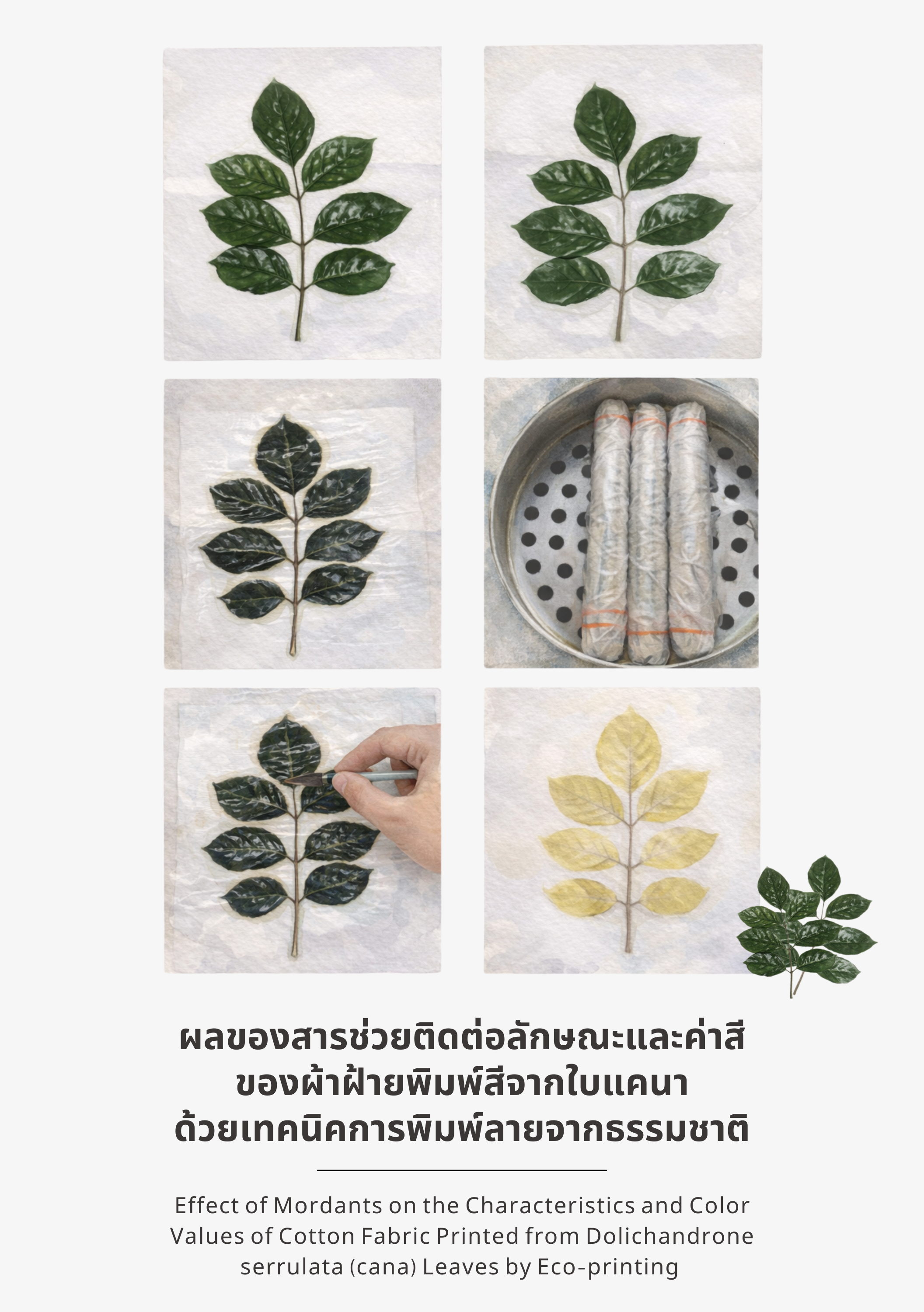
Effect of Mordants on the Characteristics and Color Values of Cotton Fabric Printed from Dolichandrone serrulata (cana) Leaves by Eco-printing
Article Sidebar
Main Article Content
Abstract
This research aimed to investigate the effects of mordants on the characteristics and color values of cotton fabric printed from Dolichandrone serrulata (cana) leaves by the eco-printing technique. The experimental factors were 3 types of mordant, which were rust water, limewater, and acetic acid, and concentration of mordant solutions at 3 levels, which were 4% 6% and 8%. The data were analyzed using two-way analysis of variance (Two-way ANOVA), and the mean color values were compared using the least significant difference (LSD) test. The results revealed that the cotton fabrics printed using rust water, limewater, and acetic acid as mordants exhibited grayish green-yellowish green, yellowish brown, and yellowish green colors, respectively. The cotton fabrics printed using rust water as a mordant showed the clearest leaf patterns. The cotton fabrics printed with mordants at concentrations of 4% 6% and 8% had average L* a* b* C* and h in the range of 74.20 to 80.77 -2.87 to -7.69 17.04 to 50.13, 17.60 to 50.47, and 94.80 to 105.75, respectively. The type, concentration, and interaction between type and concentration of mordants had significant effects on the L* a* b* C* and h values (p£0.05).
Article Details
References
เกชา ลาวงษา, สุจาริณี สังข์วรรณะ และวีระศักดิ์ ศรีลารัตน์. (2565). การศึกษาการย้อมสีใบตะขบด้วยฝางเพื่องานพิมพ์สีธรรมชาติด้วยเทคนิคการถ่ายโอนสีสู่ผ้าฝ้าย. วารสารวิจัยและพัฒนา วไลยอลงกรณ์ ในพระบรมราชูปถัมภ์, 17(3), 87-96.
ขจีจรัส ภิรมย์ธรรมศิริ. (ม.ป.ป.). เอกสารคำสอนรายวิชาการออกแบบลวดลายผ้า, (อัดสำเนา), คณะเกษตร, มหาวิทยาลัยเกษตรศาสตร์.
ดารณี ขันเพ็ชร และวิรัน วิสุทธิธาดา. (2558). อิทธิพลของสารมอร์แดนท์ต่อสมบัติการย้อมเส้นด้ายฝ้ายด้วยสีธรรมชาติที่สกัดจากใบสัก. วารสารวิชาการและวิจัย มทร.พระนคร ฉบับพิเศษ การประชุมวิชาการมหาวิทยาลัยเทคโนโลยีราชมงคล ครั้งที่ 5, 357-363.
ณัฐธิดา ภู่จีบ. (2566). การศึกษาความแตกต่างของการติดสีสำหรับพืชแต่ละชนิด ผ่านการทดลองมอร์แดนท์ธรรมชาติด้วยเทคนิค Eco-printing. วารสารศิลป์ พีระศรี, 11(1), 1-18.
พัทวัฒน์ สีขาว, หนึ่งฤทัย เนื้อไม้หอม, นฤมล พรมลา, นุสรินทร์ สุคนธภักดี, ครรชิต ณ วิเชียร เสาวลักษณ์ อยู่เพชร และอรัญญา จุติวิบูลย์สุข. (2565). การศึกษาเฉดสีและความคงทนของการย้อมสีธรรมชาติจากใบมะยงชิดบนเส้นใยไหมและฝ้าย. PSRU Journal of Science and Technology, 7(2), 89-102.
ระบบฐานข้อมูลเกษตรดิจิทัล. (2564, มิถุนายน 7). แคนา Dolichandrone serrulate (Wall. ex DC.) Seem. https://data.addrun.org/plant/archives/d2027-dolichandrone-serrulata-wall-ex-dc-seem.
วราภรณ์ บันเล็งลอย, กัญญาณัฐ ทรวงถูก และพรพิริยา ลาดหนองขุ่น. (2565). การออกแบบเสื้อผ้าจากผ้าพิมพ์ลวดลายด้วยพืชพรรณไม้. วารสารเทคโนโลยีคหกรรมศาสตร์และนวัตกรรม, 1(1), 32-42.
วีระศักดิ์ ศรีลารัตน์, สุจาริณี สังข์วรรณะ, ภัทรภร พุฒพันธ์, ธิติรัตน์ วงษ์กาฬสินธุ์, ณรัชพรนิธิบุญ และธนัง ชาญกิจชัญโญ. (2565). การพิมพ์สีธรรมชาติจากใบเพกาด้วยเทคนิคการถ่ายโอนสีสู่ผ้าฝ้าย. วารสารวิจัยและพัฒนา วไลยอลงกรณ์ ในพระบรมราชูปถัมภ์ สาขาวิทยาศาสตร์และเทคโนโลยี, 17(1), 45-55.
ศศิประภา รัตนดิลก ณ ภูเก็ต และกิตติกานต์ ทัฬหิกรณ์. (2568). ผลของน้ำยาปรับผ้านุ่มจากน้ำหมักชีวภาพสับปะรดต่อความเหนียวและการขจัดคราบเปื้อนบนสิ่งทอ. วารสารวิชาการและวิจัย มทร.พระนคร สาขาวิทยาศาสตร์และเทคโนโลยี, 19(2), 76-86.
Bechtold, T. & Mussak, R. (2009). Handbook of natural colorants. John Wiley & Sons Ltd,
Benli, H. (2024). Bio-mordants: a review. Environmental Science and Pollution Research, 31(14), 20714–20771. https://doi.org/10.1007/s11356-024-32174-8
Jabar, J. M., Adedayo, T. E. & Odusote, Y. A. (2021). Green, eco-friendly and sustainable alternative in dyeing cotton fabric using aqueous extract Mucuna slonaei F dye: effects of metal salts pre-mordanting on color strength and fastness properties. Current Research in Green and Sustainable Chemistry, 4, 100151. https://doi.org/10.1016/j.crgsc.2021.100151
Samanta, A. K. & Agarwal, P. (2009). Application of natural dyes on textiles. Indian Journal of Fibre & Textile Research, 34(4), 384-399.
Santiago, D., Cunha, J. & Cabral, I. (2023). Chromatic and medicinal properties of six natural textile dyes: A review of eucalyptus, weld, madder, annatto, indigo and woad. Heliyon, 9(11), e22013. https://doi.org/10.1016/j.heliyon.2023.e22013.
Wahyuningsih, S. E., Kusumastuti, A., Krisnawati, M., Paramita, O., Yuniar, M. & Furi, M. R. (2022). Quality of motif, colors and fastness of Sekar Ayu ecoprint products in terms of mordant type, natural dyes, and types of leaves on silk fabrics. IOP Conference Series: Earth and Environmental Science, 969, 012043. https://doi.org/10.1088/1755-1315/969/1/012043.
Yuliana, T. & Bahari, N. (2023). The development and analysis of eco-print and screen printing combination using natural dyes. Fibres and Textiles, 30(2), 51-55.
