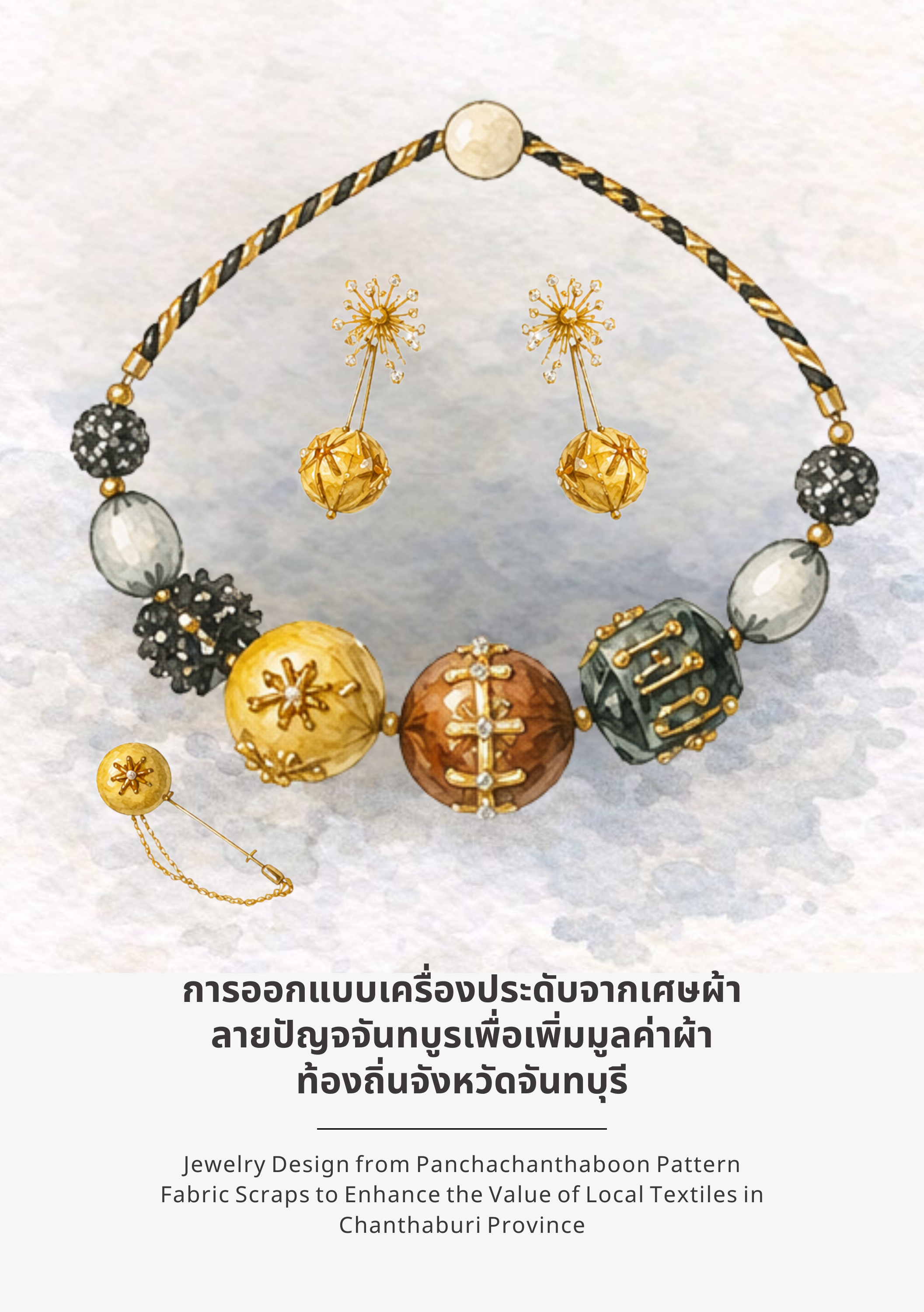
Jewelry Design from Panchachanthaboon Pattern Fabric Scraps to Enhance the Value of Local Textiles in Chanthaburi Province
Article Sidebar
Main Article Content
Abstract
This study aimed to 1) investigate the context and needs of the Ban Sab Tar Ri Weaving Center Community Enterprise in Chanthaburi Province and 2) design jewelry from Panchachanthaboon-patterned fabric scraps. It was mixed-methods research. The sample group consisted of 3 groups: (1) 4 members of the Ban Sab Tar Ri Weaving Center Community Enterprise, (2) 97 jewelry consumers, and (3) 3 jewelry design experts. The statistics used to analyze the data were percentage, mean, and standard deviation. The research results indicated that 1) the community needed to develop jewelry from fabric scraps using sewing and embroidery techniques, and according to the consumer survey, the majority were female, aged 26–35 years (27.84%) and 36–45 years (27.84%), and were most interested in buying earrings, followed by necklaces and brooches, and 2) the jewelry design relied on fashion trends of 2025 where a circular fabric form is shaped in conjunction with bead embroidery. The expert evaluation suggested that design 1 was the most suitable for production, with an average evaluation score of 4.67 (SD = 0.49). The highest-evaluated aspect was the compatibility of the jewelry design with the Panchachanthaboon-patterned fabric, with an average score of 5.00 (SD = 5.00), followed by aesthetics and comfort of wearing, with an average score of 4.67 (SD = 0.45). The results indicated that utilizing fabric scraps to produce jewelry could add value to leftover materials from the production process.
Article Details
References
กัญญาภัค แก้วขาว. (2565). การขึ้นรูปเศษวัสดุเหลือใช้จากงานหัตถกรรมหนังตะลุงเพื่อการออกแบบเครื่องประดับภายใต้แนวคิดการพัฒนาเศษวัสดุอย่างสร้างสรรค์. วารสารสวนสุนันทาวิชาการและวิจัย, 16(2), 1–14.
กิตติพงศ์ เกียรติวิภาค. (2560). พัฒนาด้านการออกแบบผลิตภัณฑ์โดยใช้กรอบแนวคิดการออกแบบหัตถอุตสาหกรรม. วารสารศิลปกรรมศาสตร์ มหาวิทยาลัยขอนแก่น, 9(2), 343-363.
ปานฉัตท์ อินทร์คง. (2559). การออกแบบผลิตภัณฑ์วัฒนธรรม: แนวคิดรูปแบบและการวิเคราะห์. อันลิมิต พริ้นติ้ง.
ภัทรบดี พิมพ์กิ, ภัทรา ศรีสุโข, วรฉัตร อังคะหิรัญ, พนม จงกล และกรกนก สนิทการ (2566). การสร้างสรรค์เครื่องประดับดีไอวาย เพื่อสะท้อนอัตลักษณ์ชุมชนเหมืองพลอยจังหวัดจันทบุรี. วารสารสังคมศาสตร์และวัฒนธรรม, 7(2), 391-407.
ภัทรา ศรีสุโข, ณภัค แสงจันทร์ และพนม จงกล (2564). การออกแบบและพัฒนารูปแบบเครื่องประดับเพื่อหาแนวทางเพิ่มมูลค่าผลิตภัณฑ์ผ้าไหมย้อมสีธรรมชาติจากใบขลู่. วารสารชุมชนวิจัย, 15(3), 70-79.
รจนา จันทราสา. (2558). การออกแบบผลิตภัณฑ์หัตถกรรมหญ้าแฝก. สำนักพิมพ์แห่งจุฬาลงกรณ์มหาวิทยาลัย.
ราชา ธงภักดิ์ และเพ็ญสิริ ชาตินิยม. (2565). การออกแบบผลิตภัณฑ์สร้างสรรค์จากสภาวะการเปลี่ยนแปลงของสิ่งแวดล้อม. วารสารสหวิทยาการสังคมศาสตร์และการสื่อสาร,5(3), 190-230.
วรฐ ทรัพย์ศรีสัญจัย และวิรุฬห์ วุฒิฤทธากุล. (2565). การพัฒนาผลิตภัณฑ์แฟชั่นอับไซเคิลกรณีศึกษากลุ่มผลิตภัณฑ์จากเศษผ้า อำเภอวัฒนานคร จังหวัดสระแก้ว. วารสารสถาบันวัฒนธรรมและศิลปะ, 23(2), 106-119.
สำนักงานจังหวัดจันทบุรี. (2566) เรื่องราวเกี่ยวกับผ้าของเมืองจันทบุรีในสมัยรัชกาลที่ 5. https://www.chanthaburi.go.th/files/com_news/2022-07_7247b346555b3aa.pdf
สำนักงานพัฒนาวิทยาศาสตร์และเทคโนโลยีแห่งชาติ. (2566, มีนาคม 20). จ.จันทบุรีต่อยอดลายผ้าประจำจังหวัดสู่ลายเสื่อกกจันทบูร. https://www.bcg.in.th /news/chanthaburi-fabric-pattern-reed-mat-chanthaboon/.
สำนักงานส่งเสริมเศรษฐกิจสร้างสรรค์. (2565, เมษายน 10). หัตถกรรมท้องถิ่นเชียงใหม่ปรับตัวตามเทรนด์โลกชนะใจผู้บริโภค. https://www.cea.or.th/th/single-research/chiangmai-crafts
สิน พันธุ์พินิจ. (2554). เทคนิคการวิจัยทางสังคมศาสตร์ (พิมพ์ครั้งที่ 2). วิทยพัฒน์.
Berthon, M. (2022). The Creative Resource Guide Crafts in Asia: Pathways to Sustainability. https://asef.org/wp-content/uploads/2022/08/ASEF-Culture360_Crafts-in-Asia_Pathways-to-Sustainability_FINAL.pdf
Luca, P. D. (2024). The Jewellery Trendbook 2025+. Forecast Fiera di Vicenza.
Quist, Z. (2024). Guide To Sustainable Product Design (2024 Update). https://ecochain.com/blog/guide-to-sustainable-product-design/
