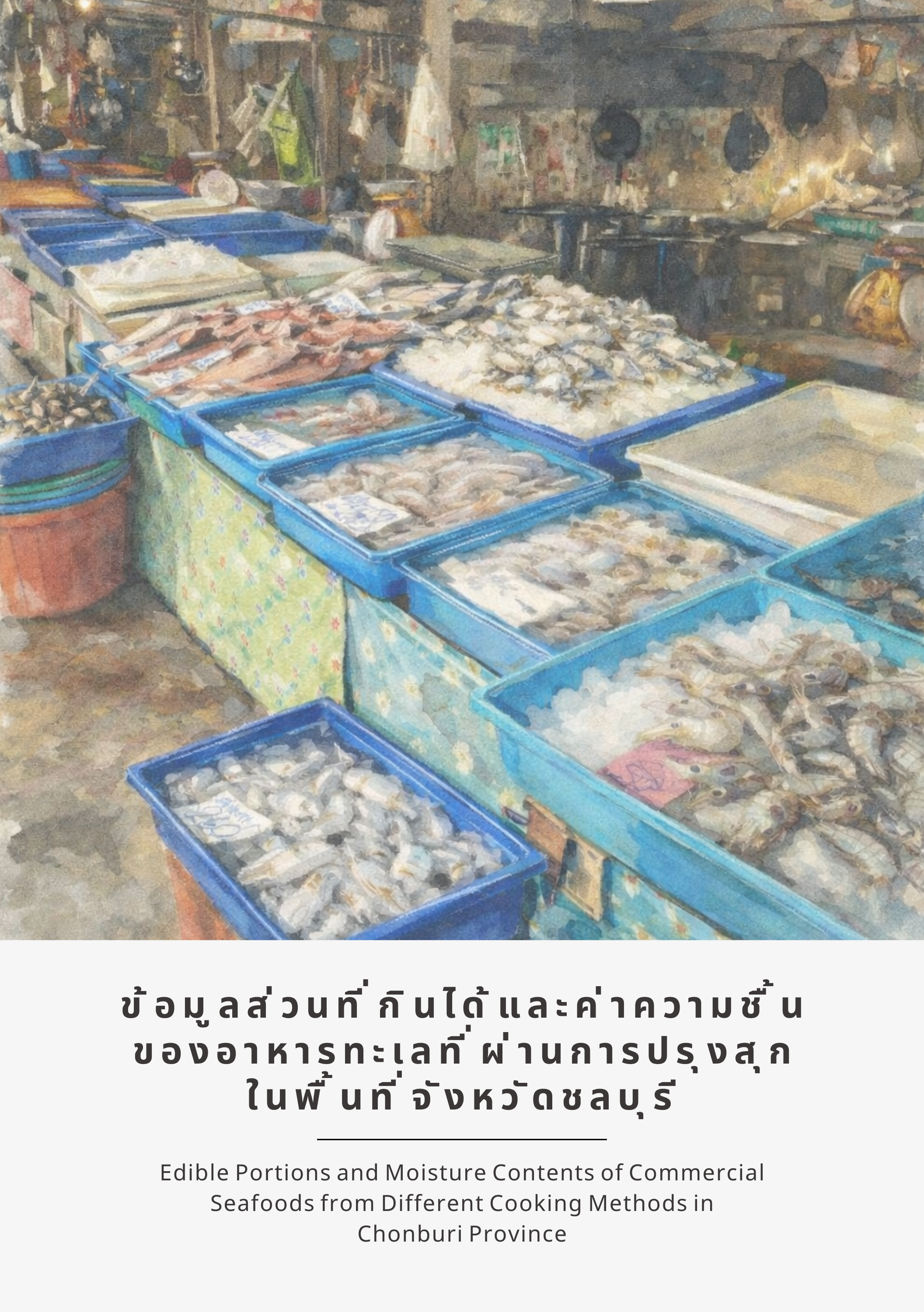
Edible Portions and Moisture Contents of Commercial Seafoods from Different Cooking Methods in Chonburi Province
Article Sidebar
Main Article Content
Abstract
This study aimed to evaluate the edible portion and changes in moisture content of 20 types of seafood after cooking by boiling, frying, and grilling. Freeze-drying was used to determine moisture content post-cooking, determined by weight recorded ant it’s changing. The results showed a variation in edible portions across species. High edible yields were found in bigfin reef squid (ร้อยละ 92.73%), razor clams (88.39%), and cuttlefish (84.11%), whereas low yields were observed in horseshoe crab (10.01%), blood cockles (16.69%), and squid (14.73%). After cooking, the percentage of moisture content generally decreased, with frying resulting in the most moisture loss and the highest solid weight. Boiled samples retained more moisture, particularly in species like mud crab (84.21%) and squid (83.67%). Grilling produced moderate moisture loss, falling between boiling and frying. The findings contribute valuable insights into the selection and use of seafood ingredients, especially in terms of edible yield and cooking method suitability. These findings can support better planning in menu development and cost-effective food processing in the culinary and food industry. Understanding how different seafood respond to cooking methods enhances the efficiency of raw material usage and promotes the development of value-added seafood products aligned with consumer needs and industry standards.
Article Details
References
Asokapandian, S., Swamy, G. J., & Hajjul, H. (2020). Deep fat frying of foods: A critical review on process and product parameters. Critical reviews in food science and nutrition, 60(20), 3400-3413.
Benton, D. (2015). Portion size: what we know and what we need to know. Critical reviews in food science and nutrition, 55(7), 988-1004.
Clement, J., Alenčikienė, G., Riipi, I., Starkutė, U., Čepytė, K., Buraitytė, A., Zabulionė, A., & Šalaševičienė, A. (2023). Exploring Causes and Potential Solutions for Food Waste among Young Consumers. Foods, 12(13), 2570.
Ding, Y., Yang, Y., Li, F., Shao, Y., Sun, Z., Zhong, C., Fan, P., Li, Z., Zhang, M., Li, X., Jiang, T., Song, C., Chen, D., Peng, X., Yin, L., She, Y., & Wang, Z. (2021). Development and validation of a photographic atlas of food portions for accurate quantification of dietary intakes in China. Journal of human nutrition and dietetics: the official journal of the British Dietetic Association, 34(3), 604-615.
Elieh Ali Komi, D., Sharma, L., & Dela Cruz, C. S. (2018). Chitin and Its Effects on Inflammatory and Immune Responses. Clinical reviews in allergy & immunology, 54(2), 213-223.
Hu, X., Tian, Z., Li, X., Wang, S., Pei, H., Sun, H., & Zhang, Z. (2020). Green, Simple, and Effective Process for the Comprehensive Utilization of Shrimp Shell Waste. ACS omega, 5(30), 19227–19235.
Iqbal, A., Zan, F., Liu, X., & Chen, G. (2023). Net zero greenhouse emissions and energy recovery from food waste: manifestation from modelling a city-wide food waste management plan. Water research, 244, 120481.
Jamali, M. A., Wang, Z., Zhu, Y., & Zhang, Y. (2022). Novel Water-Oil Mixed Frying: Fried Oil Quality and the Formation of Heterocyclic Amines and Trans Fatty Acids in Fried Duck. Foods, 11(5), 626.
Lévesque, J., Perreault, V., & Mikhaylin, S. (2024). Eco-efficiency as a prioritization tool in the reduction of food waste in restaurants. The Science of the total environment, 927, 171515.
Manjunatha, S. S., Ravi, N., Negi, P. S., Raju, P. S., & Bawa, A. S. (2014). Kinetics of moisture loss and oil uptake during deep fat frying of Gethi (Dioscorea kamoonensis Kunth) strips. Journal of food science and technology, 51(11), 3061-3071.
Pimsannil, K., Palamae, S., Fan, X., Zhao, Q., Zhang, B., & Benjakul, S. (2024). Edible portions of precooked blue swimming crab: Chemical composition and effect of chitooligosaccharide conjugate and high-pressure processing on microbial inactivation. Food chemistry: X, 25, 102070.
Xie, Y., Xu, J., Yang, R., Alshammari, J., Zhu, M. J., Sablani, S., & Tang, J. (2021). Moisture Content of Bacterial Cells Determines Thermal Resistance of Salmonella enterica Serotype Enteritidis PT 30. Applied and environmental microbiology, 87(3), e02194-20.
You, L., Zhang, Y., Ma, Y., Wang, Y., & Wei, Z. (2025). Effect of Boiling Time on the Color, Water, Protein Secondary Structure, and Volatile Compounds of Beef. Foods, 14(8), 1372.
