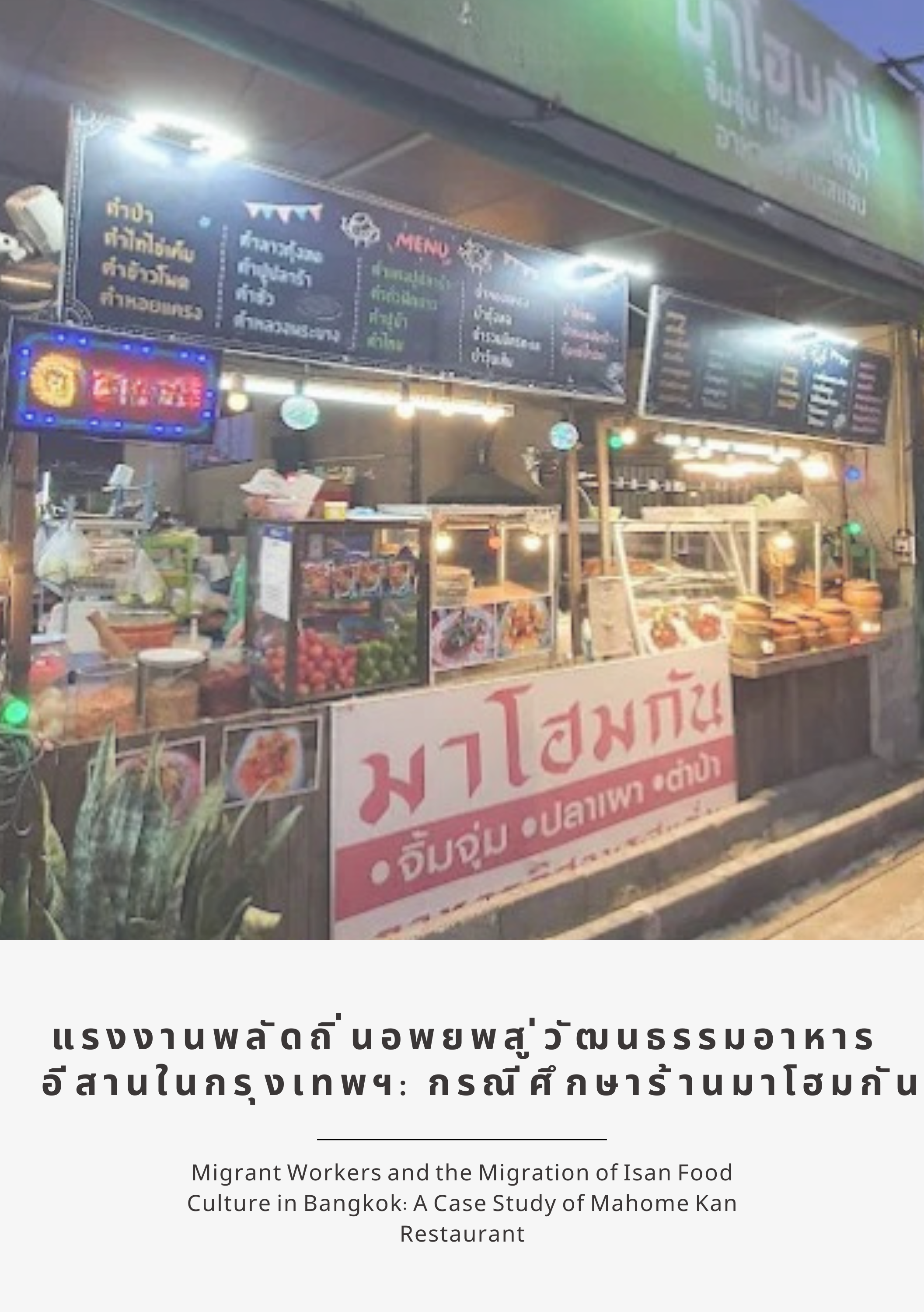
Migrant Workers and the Migration of Isan Food Culture in Bangkok: A Case Study of Mahome Kan Restaurant
Article Sidebar
Main Article Content
Abstract
Migrant labor plays a vital role in the economy, generating cultural fluidity particularly in the realm of food. Driven by economic conditions, Isan migrants move to Bangkok to pursue opportunities as restaurant entrepreneurs. This study explores the dynamics of mobility and adaptation of Isan food culture in Bangkok through migrant restaurateurs, analyzing their contribution to cultural and economic capital within the framework of creative industries. Using a case study of Ma Home Gun restaurant and structured interviews, the findings indicate two key patterns. First, migrants seek improved economic prospects by mobilizing family-based economic capital, reflecting Bourdieu’s concept of social capital, manifested through Isan culinary culture as a form of embodied cultural capital. Second, they adapt by modifying recipes and business practices to suit urban consumer tastes—for instance, introducing dishes such as Nam Tok Neua and Larb Suk, which diverge from tradition yet appeal to local preferences. Simultaneously, they preserve authentic flavors in dishes like Koi Suea Kua and Tam Dong Daeng, including seasonal varieties, demonstrating creativity in food production. These practices highlight a dual-locality identity, where entrepreneurs sustain ties to their hometowns while engaging in urban life, thereby positioning themselves as cultural production units. Overall, the study underscores how migrant restaurateurs act as agents of cultural reproduction and economic innovation within Bangkok’s creative food industry.
Article Details
References
ชนาภิวัฒน์ ขันทะ และอุ่นเรือน เล็กน้อย. (2563). ปลาแดก: การเชื่อมโยงพหุวัฒนธรรม การบริโภคของ คนอีสาน. วารสารวิจัยวิทยาการจัดการ มหาวิทยาลัยราชภัฏสุรินทร์, 4(2), 96-109.
ดุษฎีวัฒน์ แก้วอินทร์, ธนกิจ ไชยมาดี, เมธา ศิริประยูรศักดิ์, เกษมทรัพย์ ดงหงษ์, วิรัตน์ นาเมืองรักษ์ และทศพร พรหมเทศ. (2564). พฤติกรรมการตัดสินใจของผู้บริโภคในการบริโภคอาหารอีสานในเขตเทศบาลนครอุดรธานี จังหวัดอุดรธานี. วารสารธาตุพนมปริทรรศน์, 3(2), 1-10
ธิติญา เหล่าอัน. (2559). แรงงานอีสานสมัยใหม่ในภาคเหนือ. วารสารมนุษยศาสตร์และสังคมศาสตร์ปริทัศน์ มหาวิทยาลัยราชภัฏลำปาง, 4(1), 60-83.
ปิยพงษ์ บุญกว้าง และดุษฎี อายุวัฒน์. (2560). ความมั่นคงของครัวเรือนแรงงานย้ายถิ่นในภาคอีสานไป ทำงานต่างประเทศ. วารสารมหาวิทยาลัยนครพนม, 7(2), 108-115.
ภักดี มะนะเวศ. (2562). ปัจจัยที่มีผลต่อพฤติกรรมการใช้บริการร้านอาหารอีสาน ในเขต กรุงเทพมหานคร. วารสารวิชาการการตลาดและการจัดการ มหาวิทยาลัยเทคโนโลยีราชมงคลธัญบุรี, 6(1), 14-29.
ภาสพงศ์ ผิวพอใช้. (2565). คำแสดงโภชนลักษณ์ในตำราอาหารไทยและลาว: การศึกษาเปรียบเทียบ. วารสารสังคมศาสตร์และมานุษยวิทยาเชิงพุทธ, 7(3), 256-271.
วันทกาญจน์ สีมาโรฤทธิ์, สรายุทธ ชัยเลื่องลือ และวัฒนา ทนงค์แผง. (2565). รูปแบบการให้บริการอาหารอีสานตามหลักมาตรฐานอาหารสากลของจังหวัดมหาสารคาม. วารสารมนุษยศาสตร์และสังคมศาสตร์ มหาวิทยาลัยมหาสารคาม, 11(6), 125-134.
ศศิธร วงพิมล. (2560). แผนธุรกิจร้านอาหารอีสานสมัยใหม่สไตล์ฟิวชั่น Sit the Sea [การค้นคว้าอิสระบริหารธุรกิจมหาบัณฑิต]. มหาวิทยาลัยกรุงเทพ.http://dspace.bu.ac.th/jspui/handle/123456789/3594
ศาสตรา เหล่าอรรคะ. (2566). การส่งเสริมสร้างสรรค์การผลิตภาพยนตร์และละครโทรทัศน์ โดยใช้ข้อมูลทางประวัติศาสตร์ วิถีชีวิต ศิลปวัฒนธรรม ของชุมชนที่เกี่ยวข้องกับอัตลักษณ์อาหารอีสาน. วารสารศิลปกรรมศาสตร์ มหาวิทยาลัยขอนแก่น, 15(1), 187-208.
โสฬส ทีปประชัย. (2562). แผนธุรกิจร้านอาหารอีสานประเภท Food delivery “ร้าน Tum24” [สารนิพนธ์ปริญญาการจัดการมหาบัณฑิต]. วิทยาลัยการจัดการ มหาวิทยาลัยมหิดล.
อำนาจ เอี่ยมสำอางค์, อำนาจ เย็นสบาย, สาธิต ทิมวัฒนบรรเทิง และจารุวรรณ ขำเพชร. (2018). พลวัตทางสังคมกับการดำรงอยู่ของวัฒนธรรมอาหารไทดำ ในจังหวัดเพชรบุรี. วารสารมหาจุฬาวิชาการ, 5(ฉบับพิเศษ), 237-249. https://so04.tci-thaijo.org/index.php/JMA/article/view/14108
Bourdieu, P. (1986). The forms of capital. In J. Richardson (Ed.), Handbook of Theory and Research for the Sociology of Education (pp. 241-258). Greenwood.
Creswell, J.W. (2013). Research Design: Qualitative, Quantitative, and Mixed Methods Approaches (4th ed.). SAGE Publications Inc.
Draper, J., Garzoli, J., Kamnuansilpa, P., Lefferts, L., Mitchell, J. & Songkünnatham, P. (2019). The Thai Lao–Thailand's largest unrecognized transboundary national ethnicity. Nations and Nationalism, 25(4), 1131-1152.
Econ Digest. (2567 ธันวาคม 16). ธุรกิจร้านอาหารและร้านเครื่องดื่มปี 68 คาดขยายตัว 4.6% มูลค่าตลาด 657,000 ล้านบาท. https://www.kasikornresearch.com/th/analysis/k-social-media/Pages/IAO111-Restaurant-Industry-FB-16-12-2024.aspx
Gustafsson, J. (2017). Single Case Studies vs Multiple Case Studies: A Comparative Study (Unpublished manuscript). Academy of Business, Engineering and Science, Halmstad University. https://www.diva-portal.org/smash/get/diva2:1064378/FULLTEXT01.pdf
