
Development of Kimchi Product from Sweet Bamboo Shoots
Article Sidebar
Main Article Content
Abstract
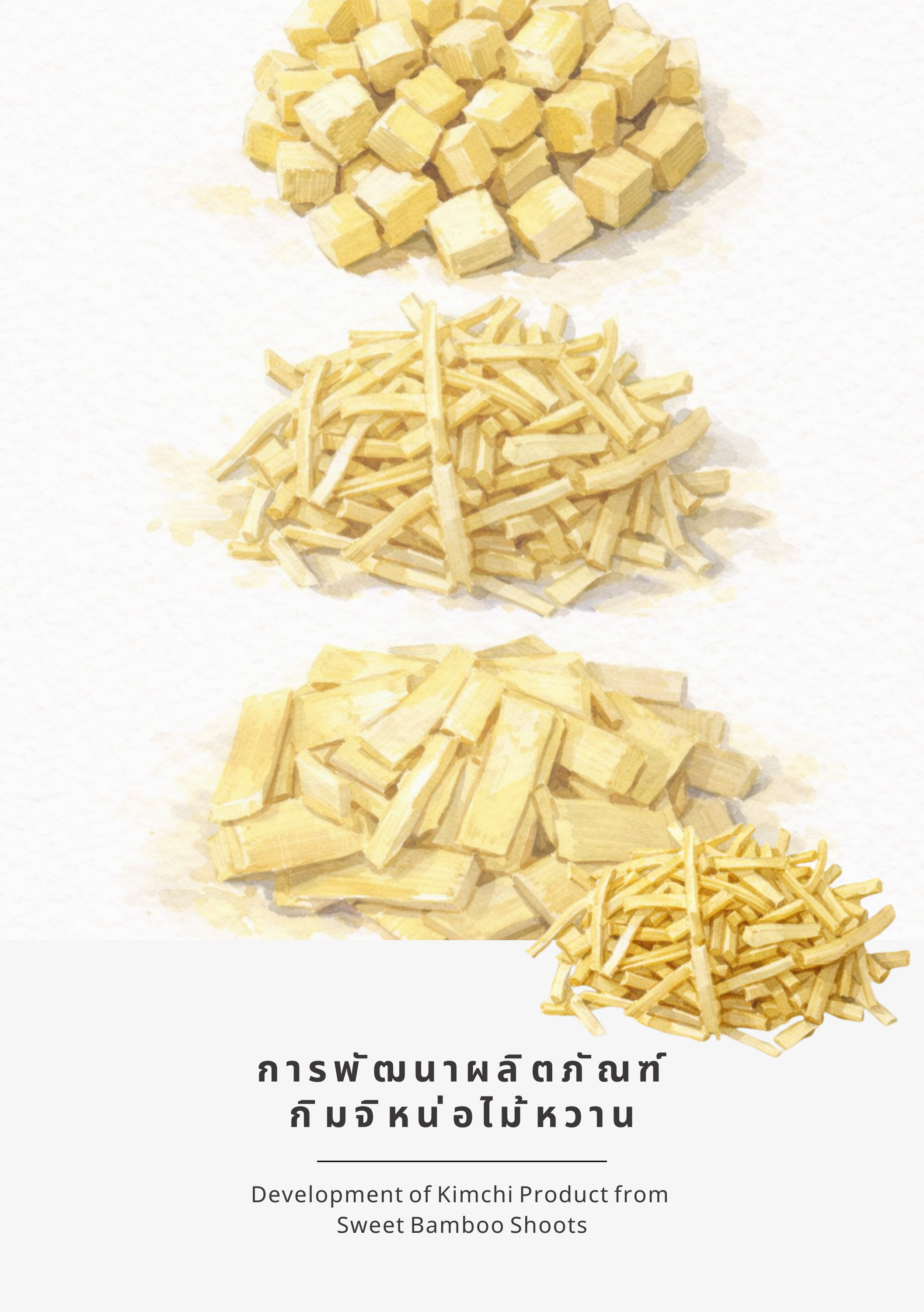
This study aimed to determine the appropriate shape of sweet bamboo shoots for the development of sweet bamboo shoot kimchi, to investigate the optimal substitution level of Chinese cabbage with sweet bamboo shoots, and to evaluate the physical and chemical properties of the final product. The results indicated that the shape of sweet bamboo shoots had a statistically significant effect on product development (p≤0.05). Sensory evaluation revealed that the shredded form of sweet bamboo shoots was the most preferred by panelists. Regarding the substitution of Chinese cabbage with sweet bamboo shoots, sensory scores showed significant differences among formulations (p≤0.05). The formulation with 50% substitution of Chinese cabbage with sweet bamboo shoots received the highest overall acceptance. The mean sensory scores for color, aroma, taste, texture, and overall liking were 7.97, 8.00, 8.20, 8.07, and 8.27, respectively. In terms of physical properties, significant differences in color values (L*, a*, b*) were observed among the four substitution levels (p≤0.05) after 5 days of fermentation. The formulation with 50% sweet bamboo shoot substitution exhibited L*, a*, and b* values of 40.10, 15.32, and 39.93, respectively. As for chemical properties, the pH values after 5 days of fermentation also differed significantly among treatments (p≤0.05). The 50% substitution formulation had a pH value of 4.24.
Article Details
References
นรินทร์ เจริญพันธ์ และรัชนี พุทธา. (2563). สูตรที่เหมาะสมของการผลิตแก่นตะวันดองและกิมจิจากแก่นตะวัน, วารสารวิทยาศาสตร์และเทคโนโลยี, 28(7), 1202-1215.
นิษฐกานต์ ประดิษฐศรีกุล. (2555). การพัฒนาผลิตภัณฑ์ผักกาดเขียวปลีดองเปรี้ยวและคิมฉิในบรรจุภัณฑ์สุญญากาศ (รายงานการวิจัย). มหาวิทยาลัยเทคโนโลยีราชมงคลสุวรรณภูมิ.
เบญฐนาศิวรัตน์ ไกรทิพย์ และเทอดเกียรติ แก้วพวง. (2564). การส่งเสริมองค์ความรู้และยกระดับคุณภาพหน่อไม้ดองให้ถูกสุขลักษณะ กลุ่มอาชีพหน่อไม้ดอง ตําบลบ้านแก้ง อําเภอเมืองสระแก้ว จังหวัดสระแก้ว. วารสารการบริหารการปกครองและนวัตกรรมท้องถิ่น, 5(2), 185-194.
มณฑาทิพย์ ยุ่นฉลาด, สิริพร สธนเสาวภาคย์ และรัศมี ศุภศรี. (2550). การแปรรูปหน่อไม้จากไผ่บนที่สูง: หน่อไม้ดองเต้าเจี้ยว. วารสารวนศาสตร์, 26(1), 13-22.
ภัทรพร แก้วพิภพ. (2564). การพัฒนากลยุทธ์ทางการตลาดตามแนวคิดปรัชญาของเศรษฐกิจ พอเพียงเพื่อความยั่งยืน ของผลิตภัณฑ์ที่เป็นมิตรต่อสิ่งแวดล้อม กรณีศึกษา ผลิตภัณฑ์หน่อไม้ดองน้ำมะพร้าว กลุ่มวิสาหกิจชุมชนแปลงใหญ่ไผ่จังหวัดปราจีนบุรี [วิทยานิพนธ์ปริญญามหาบัณฑิตไม่ได้ตีพิมพ์]. วิทยาลัยพาณิชยศาสตร์ มหาวิทยาลัยบูรพา.
วราภรณ์ กุศลารักษ์ และนิพัฒน์ ลิ้มสงวน. (2558). คุณค่าทางโภชนาการและโภชนเภสัชของหน่อไม้ไผ่บงหวาน (Bambusa burmanica gamble) และหน่อไม้ไผ่รวก (Thysostachys siamensis Gamble). วารสารวิชาการเกษตร, 33(2), 169-178.
สุภาวดี สําราญ, วรินทร์ธร โตพันธ์, ขวัญคณิศร์ อินทรตระกูล และณัฐฐิญา ทรัพย์ปุญญากุล. (2567). การพัฒนาผลิตภัณฑ์จากแก้วมังกรตามแนวคิดเศรษฐกิจสร้างสรรค์ในพื้นที่ตําบลร่องจิก อําเภอภูเรือ จังหวัดเลย, วารสารเกษตรพระวรุณ, 21(2), 127-135
อนัญญา วรรณา. (2564). คู่มือปฏิบัติการอาหารนานาชาติ, (อัดสำเนา), คณะเกษตรศาสตร์, มหาวิทยาลัยราชภัฏอุบลราชธานี.
amprohealth. (2562, มิถุนายน 27). กิมจิ ( Kimchi ) ผักดองเกาหลี สุดยอดโปรไบโอติก. https://amprohealth.com/food-dessert/kimchi/
Park, K. Y., Jeong, J. K., Lee, Y. E., & Daily, J. W. III. (2014). Health benefits of kimchi (Korean fermented vegetables) as a probiotic food. Journal of Medicinal Food, 17(1), 6-20.
Punpapas, A. (2022, September 4). Kimchi: The key influence of Korean Wave and its impact on Korean food towards Thai consumption [Thematic paper, Mahidol University]. CMMU Digital Archive.
Punfujinda, C., Pattarathitiwat, P., Songpranam, P., Chitravimol, U., Buranasuont, R., & Chumkaew, K. (2021). Product Development of Sweet Fish Sauce from Dried White Shrimp: Sensory Evaluation, Physical and Chemical Quality and Nutrition. Journal of Food Health and Bioenvironmental Science, 14(3), 42-51.
