Quality of gluten-free pasta from glutinous rice flour and mung bean flour
Article Sidebar
Main Article Content
Abstract
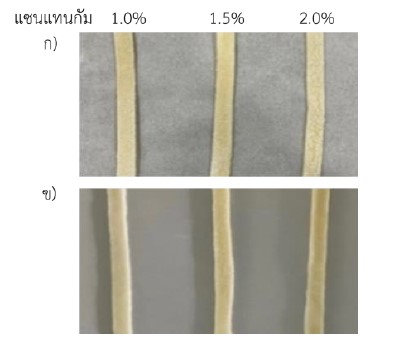
Pasta is usually made from wheat flour that contains gluten. Which is an allergen of some consumers, making them unable to consume regular pasta. Therefore, pasta has been developed from other gluten-free ingredients instead of wheat flour. This experiment aims to developed a formula for gluten-free pasta from glutinous rice flour and mung bean flour with the ratio of glutinous rice flour to mung bean flour 1.5:1.5, 2.0:1.0 and 2.5:0.5, they were compared with the basic formula and examined for physical quality such as color (L*,a*,b*), moisture content and texture attributions. It was found that the ratio of glutinous rice flour to mung bean flour 2.5:0.5, color value (L*,a*,b*), hardness, springiness, adhesiveness, gumminess, and chewiness of pasta were closest to the quality of basic pasta made with wheat flour (p≤0.05). Then, the xanthan gum were added to stabilize gluten-free pasta from glutinous rice flour and mung bean flour (ratio 2.5:0.5) in the amount of 1.0, 1.5 and 2.0% of the flour weight in the pasta recipe. It was found that pasta enriched with 2% xanthan gum, color values (L*, a*, b*), hardness, springiness, adhesiveness, gumminess and chewiness of gluten-free pasta are closest to the quality of basic pasta.
Article Details
References
กล้าณรงค์ ศรีรอต และเกื้อกูล ปิยะจอมขวัญ. (2550). เทคโนโลยีของแป้ง (พิมพ์ครั้งที่ 4). มหาวิทยาลัยเกษตรศาสตร์.
กุลยา ลิ้มรุ่งเรืองรัตน์, สมถวิล จริตควร, อโนชา สุขสมบูรณ์ และบงกช วรรธนะภูติ. (2556). การพัฒนาผลิตภัณฑ์พาสต้าเพื่อสุขภาพจากข้าวเจ้าเสริมสาหร่าย. โครงการวิจัยประเภทงบประมาณรายได้จากเงินอุดหนุนรัฐาบาล (งบประมาณแผ่นดิน). มหาวิทยาลัยบูรพา.
ขนิษฐา หมวดเอียด. (2561). การพัฒนาผลิตภัณฑ์เส้นพาสต้าปราศจากกลูเตนอบแห้งจากแป้งข้าวสังข์หยด. วารสารวิจัย มทร.กรุงเทพ, 12 (2), 91-102.
ชุติมา มุสิกะเจริญ. (2565, 15 มีนาคม). ศูนย์วิจัยกสิกรฯ เผยความขัดแย้งระหว่างรัสเซีย-ยูเครน ดันราคาข้าวสาลีโลกซ้ำเติมราคาอาหารไทยให้สูงขึ้น. สำนักข่าวอีไฟแนนซ์ไทยhttps://www.efinancethai.com/LastestNews/LatestNewsMain.aspx?ref=A&id=a2thbVVTeXZPNW89&security=KBANK.
นรินทร์ เจริญพันธ์ และวิยดา กวานเหียน. (2560). ผลของแป้งจากเศษเหลือทิ้งของทุเรียนต่อคุณภาพของพาสต้าปราศจากกลูเตน. โครงการวิจัยประเภทงบประมาณรายได้จากเงินอุดหนุนรัฐาบาล (งบประมาณแผ่นดิน). มหาวิทยาลัยบูรพา.
นิธิยา รัตนาปนนท์. (2557). เคมีอาหาร (พิมพ์ครั้งที่ 5). โอเดียนสโตร์
ปิยรัตน์ ศิริวงศ์ไพศาล และคืนจันทร์ ณ นคร. (2552). ผลของปริมาณอะมิโลสและสภาวะการผลิตต่อสมบัติเชิงหน้าที่ของสตาร์ชข้าวพรีเจลาติไนซ์. [วิทยานิพนธ์ปริญญาโท]. มหาวิทยาลัยสงขลานครินทร์.
พรรณทิพา เจริญไทยกิจ, อภิชญา พรมมินทร์, อาทิตยา สุรธนานันต์, ธีรารัตน์ อิทธิโสภณกุล, พิสุทธิ หนักแน่น และพจนีย์
พงศ์พงัน. (2561). สมบัติทางเคมีกายภาพและคุณภาพทางประสาทสัมผัสของพาสต้าปราศจากกลูเตนจากแป้งข้าวกล้องเสริมคุณค่าโปรตีนไข่ขาว. วารสารวิชาการพระจอมเกล้าพระนครเหนือ. 28(3), 627-638.
รัชนีพร โพธินาม, อนุชิตา มุ่งงาม และทัดดาว ภาษีผล. (2559). องค์ประกอบทางเคมีและคุณสมบัติทางกายภาพของสตาร์ชจากถั่วเขียวและถั่วพุ่มและการประยุกต์ใช้ในการผลิตวุ้นเส้น. วารสารแก่นเกษตร, 44 (ฉบับพิเศษ 10), 1073-1079.
สุธาสินี น้อยสุวรรณ และปราณี อ่านเปรื่อง. (2544). การใช้ผงบุกเพื่อเป็นสารที่ทำให้เกิดเจลในผลิตภัณฑ์เยลลี่. อาหาร. 31, 174-186.
อรอนงค์ นัยวิกุล. (2540). ข้าวสาลี (พิมพ์ครั้งที่ 2). ภาควิชาวิทยาศาสตร์และเทคโนโลยีการอาหาร คณะอุตสาหกรรมเกษตร, มหาวิทยาลัยเกษตรศาสตร์.
Gambus H., Sikora M., & Ziobro R. (2007). The effect of composition of hydrocolloids on properties of gluten-free bread. Acta Scientiarum Polonorum, Technologia Alimentaria, 6(3), 61-74. http://www.food.actapol.net/issue3/volume/6_3_2007.pdf
Guarda A., Rosell C.M., Benedito C. & Galotto M.J. (2004). Different hydrocolloids as bread improvers and antistaling agents. Food Hydrocolliods. 18, 241-247. https://doi.org/10.1016/S0268-005X(03)00080-8
Hoover, P. (2001). Composition, molecular structure, and physicochemical properties of tuber and root starches: a review. Carbohydrate Polymers. 45, 253-267. https://doi.org/10.1016/S0144-8617(00)00260-5
Rosell, C. ., Rojas, J., & Benedito de Barber, C. (2001). Influence of hydrocolloids on dough rheology and bread quality. Food Hydrocolloids, 15(1), 75–81. https://doi.org/10.1016/S0268-005X(00)00054-0
Tester, R. F., & Morrison, W. R. (1990). Swelling and gelatinization of cereal starches. Effects of amylopectin, amylose, and lipids. Cereal Chemistry, 67(6), 551-557. https://europepmc.org/article/AGR/IND91005375
Udachan I.S., & Sahoo A.K. (2017). Effect of hydrocolloids in the development of gluten free brown rice pasta. International Journal of ChemTech Research. 10(6), 407-415. https://www.sphinxsai.com/2017/ch_vol10_no6/2/(407-415)V10N6CT.pdf
Urlacher, B., & Noble, O. (1997). Xanthan gum. In Imeson, A. (ed.), Thickening and Gelling Agents for food. (2nd ed., p.284-311. London: Blackie Academic & Professional
