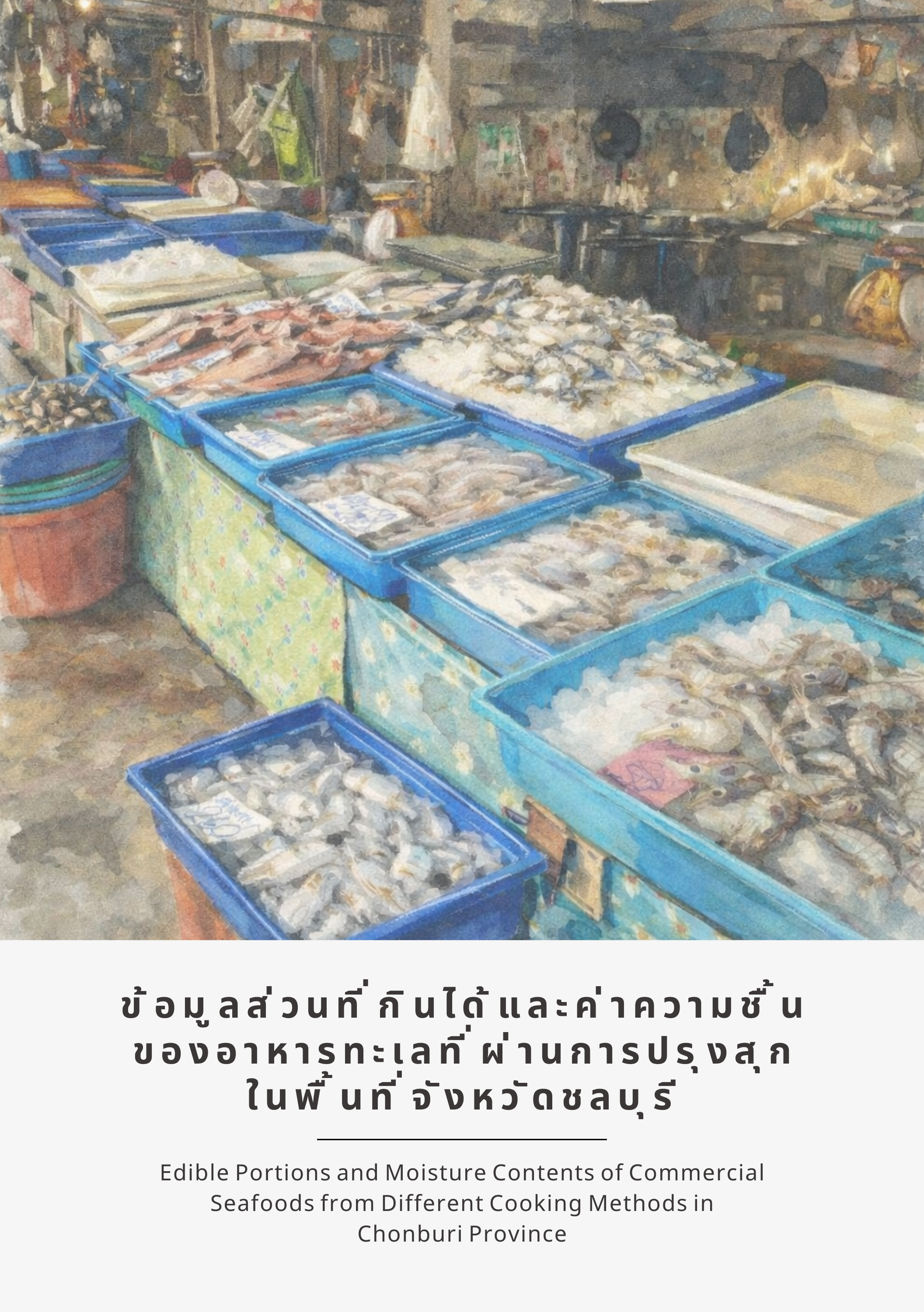
ข้อมูลส่วนที่กินได้และค่าความชื้นของอาหารทะเลที่ผ่านการปรุงสุกในพื้นที่จังหวัดชลบุรี
Article Sidebar
Main Article Content
บทคัดย่อ
การศึกษานี้มีวัตถุประสงค์เพื่อศึกษาหาส่วนที่กินได้ (Edible portion) และการเปลี่ยนแปลงค่าความชื้นของอาหารทะเล 20 ชนิดที่ผ่านกระบวนการปรุงด้วยวิธีต่าง ๆ ได้แก่ การต้ม การทอด และการย่าง ทำการชั่งน้ำหนักทั้งก่อนและหลังปรุง และก่อนหลังการทำแห้งแบบแช่เยือกแข็ง เพื่อคำนวณค่าความชื้นของอาหารแต่ละชนิด ผลที่ได้พบว่า อาหารทะเล แต่ละชนิดมีส่วนที่กินได้ในระดับที่หลากหลาย โดยปลาหมึกหอม (ร้อยละ 92.73) หอยหลอด (ร้อยละ 88.39) และปลาหมึกกระดอง (ร้อยละ 84.11) มีสัดส่วนที่กินได้สูง ขณะที่ปูจั๊กจั่น (ร้อยละ 10.01) หอยแครง (ร้อยละ 16.69) และปลาหมึกกล้วย (ร้อยละ 14.73) มีสัดส่วนต่ำ เมื่อผ่านการปรุงพบว่า อาหารทะเลมีค่าความชื้น (% Moisture content) ลดลง โดยการทอดทำให้ความชื้นลดลงมากที่สุด ส่งผลให้น้ำหนักแห้งเพิ่มขึ้น การต้มยังคงความชื้นไว้ได้สูงในหลายชนิด เช่น ปูดำ (ร้อยละ 84.21) และปลาหมึกกล้วย (ร้อยละ 83.67) ในขณะที่การย่างมีผลต่อค่าความชื้นในระดับกลางระหว่างต้มและทอด ผลที่ได้จากงานวิจัยนี้สามารถนำไปประยุกต์ใช้ในการเลือกวัตถุดิบอาหารทะเลเพื่อการบริโภคหรือการจัดซื้อจัดจ้าง โดยคำนึงถึงปริมาณส่วนที่กินได้ ความเปลี่ยนแปลงของน้ำหนัก และความเหมาะสมของวิธีปรุงอาหารให้สอดคล้องกับวัตถุดิบแต่ละประเภท เป็นประโยชน์ต่อการออกแบบเมนูอาหาร และการบริหารต้นทุนในอุตสาหกรรมอาหาร
Article Details
เอกสารอ้างอิง
Asokapandian, S., Swamy, G. J., & Hajjul, H. (2020). Deep fat frying of foods: A critical review on process and product parameters. Critical reviews in food science and nutrition, 60(20), 3400-3413.
Benton, D. (2015). Portion size: what we know and what we need to know. Critical reviews in food science and nutrition, 55(7), 988-1004.
Clement, J., Alenčikienė, G., Riipi, I., Starkutė, U., Čepytė, K., Buraitytė, A., Zabulionė, A., & Šalaševičienė, A. (2023). Exploring Causes and Potential Solutions for Food Waste among Young Consumers. Foods, 12(13), 2570.
Ding, Y., Yang, Y., Li, F., Shao, Y., Sun, Z., Zhong, C., Fan, P., Li, Z., Zhang, M., Li, X., Jiang, T., Song, C., Chen, D., Peng, X., Yin, L., She, Y., & Wang, Z. (2021). Development and validation of a photographic atlas of food portions for accurate quantification of dietary intakes in China. Journal of human nutrition and dietetics: the official journal of the British Dietetic Association, 34(3), 604-615.
Elieh Ali Komi, D., Sharma, L., & Dela Cruz, C. S. (2018). Chitin and Its Effects on Inflammatory and Immune Responses. Clinical reviews in allergy & immunology, 54(2), 213-223.
Hu, X., Tian, Z., Li, X., Wang, S., Pei, H., Sun, H., & Zhang, Z. (2020). Green, Simple, and Effective Process for the Comprehensive Utilization of Shrimp Shell Waste. ACS omega, 5(30), 19227–19235.
Iqbal, A., Zan, F., Liu, X., & Chen, G. (2023). Net zero greenhouse emissions and energy recovery from food waste: manifestation from modelling a city-wide food waste management plan. Water research, 244, 120481.
Jamali, M. A., Wang, Z., Zhu, Y., & Zhang, Y. (2022). Novel Water-Oil Mixed Frying: Fried Oil Quality and the Formation of Heterocyclic Amines and Trans Fatty Acids in Fried Duck. Foods, 11(5), 626.
Lévesque, J., Perreault, V., & Mikhaylin, S. (2024). Eco-efficiency as a prioritization tool in the reduction of food waste in restaurants. The Science of the total environment, 927, 171515.
Manjunatha, S. S., Ravi, N., Negi, P. S., Raju, P. S., & Bawa, A. S. (2014). Kinetics of moisture loss and oil uptake during deep fat frying of Gethi (Dioscorea kamoonensis Kunth) strips. Journal of food science and technology, 51(11), 3061-3071.
Pimsannil, K., Palamae, S., Fan, X., Zhao, Q., Zhang, B., & Benjakul, S. (2024). Edible portions of precooked blue swimming crab: Chemical composition and effect of chitooligosaccharide conjugate and high-pressure processing on microbial inactivation. Food chemistry: X, 25, 102070.
Xie, Y., Xu, J., Yang, R., Alshammari, J., Zhu, M. J., Sablani, S., & Tang, J. (2021). Moisture Content of Bacterial Cells Determines Thermal Resistance of Salmonella enterica Serotype Enteritidis PT 30. Applied and environmental microbiology, 87(3), e02194-20.
You, L., Zhang, Y., Ma, Y., Wang, Y., & Wei, Z. (2025). Effect of Boiling Time on the Color, Water, Protein Secondary Structure, and Volatile Compounds of Beef. Foods, 14(8), 1372.
