“Lumpini Park” Phenomenon and th The “Lumpini Park” Phenomenon and the Reconstruction of Exercise Meanigs through Social Media: Thai Lifestyle Soft Power in the Digital Age
Article Sidebar
Main Article Content
Abstract
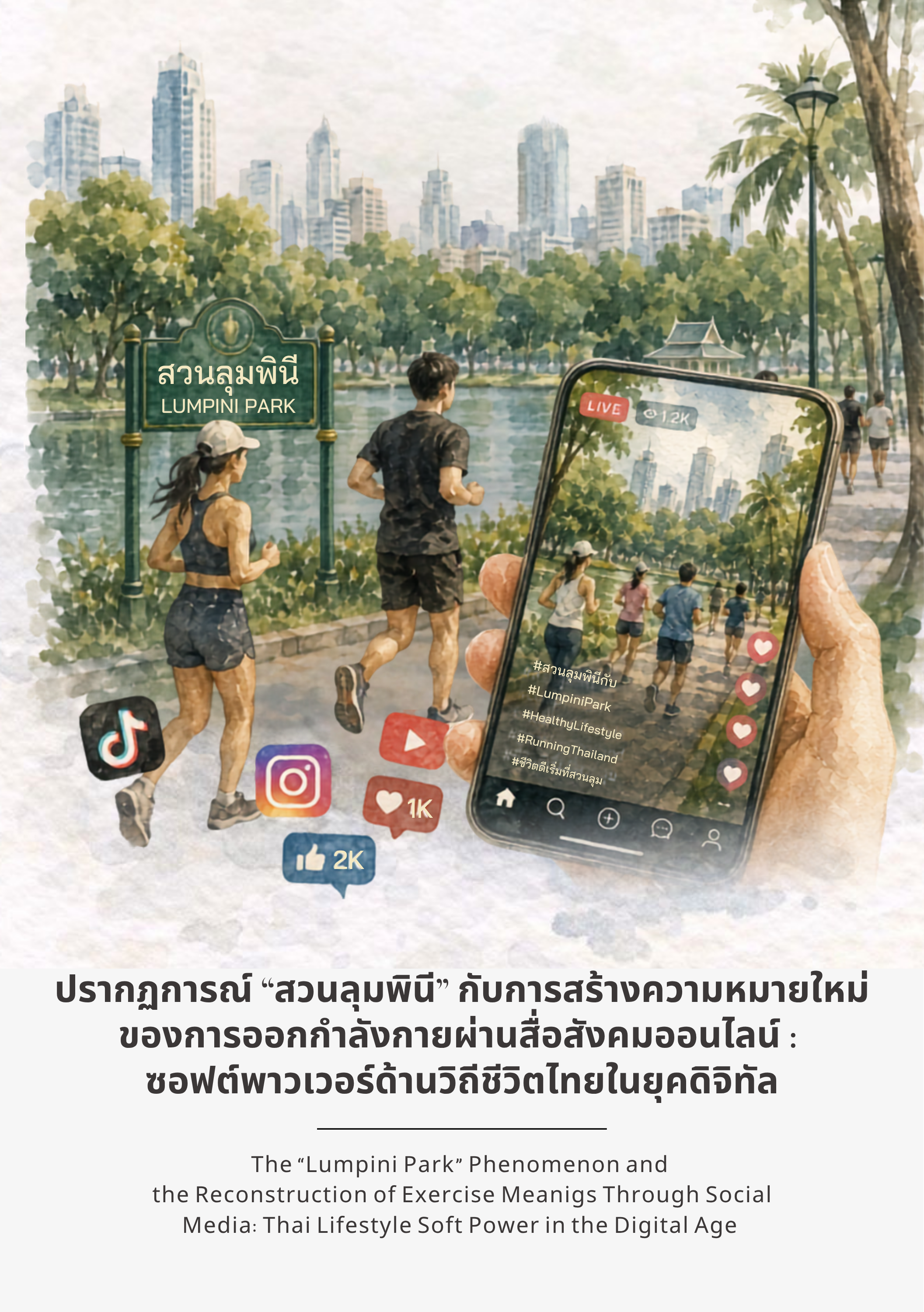
This academic article synthesizes relevant concepts and theories to explain how the aerobic dance phenomenon at Lumpini Park has been transformed into Thai lifestyle soft power through social media. Drawing on soft power theory, the concept of the mediated construction of reality, and short-video culture, the article identifies three key mechanisms: 1) intergenerational diversity in public spaces, 2) Thai-style enjoyment reflecting holistic wellness, and 3) the balance between urban life and quality of life. Digital communication tools such as filters, music, hashtags, and narrative techniques on social media platforms have amplified these perceptions internationally. This article proposes a "Grassroots Soft Power Model" as a new body of knowledge applicable to national image communication strategies and wellness tourism promotion in the digital era.
Article Details
References
Bedimo-Rung, A. L., Mowen, A. J. & Cohen, D. A. (2005). The significance of parks to physical activity and public health: A conceptual model. American Journal of Preventive Medicine, 28(2, Suppl. 2), 159-168. https://doi.org/10.1016/j.amepre.2004.10.024
Cohen, D. A., McKenzie, T. L., Sehgal, A., Williamson, S., Golinelli, D. & Lurie, N. (2007). Contribution of public parks to physical activity. American Journal of Public Health, 97(3), 509–514. https://doi.org/10.2105/AJPH.2005.072447
Couldry, N. & Hepp, A. (2017). The mediated construction of reality. Polity.
Dijck, J. V., Poell, T. & Waal, M. D. (2018). The platform society: Public values in a connective world. Oxford University Press. https://doi.org/10.1093/oso/9780190889760.001.0001
Gartner, W. C. (1994). Image formation process. Journal of Travel & Tourism Marketing, 2(2-3), 191-216. https://doi.org/10.1300/J073v02n02_12
Gehl, J. (2011). Life between buildings: Using public space. Island Press.
Jenkins, H., Ford, S. & Green, J. (2013). Spreadable media: Creating value and meaning in a networked culture. New York University Press.
Jennings, V. & Bamkole, O. (2019). The relationship between social cohesion and urban green space: An avenue for health promotion. International Journal of Environmental Research and Public Health, 16(3), 452. https://doi.org/10.3390/ijerph16030452
Kaplan, A. M. & Haenlein, M. (2010). Users of the world, unite! The challenges and opportunities of social media. Business Horizons, 53(1), 59-68. https://doi.org/10.1016/j.bushor.2009.09.003
Kaye, D. B. V., Chen, X. & Zeng, J. (2021). The co-evolution of two Chinese mobile short video apps: Parallel platformization of Douyin and TikTok. Mobile Media & Communication, 9(2), 229–253. https://doi.org/10.1177/2050157920952120
Marine-Roig, E. & Anton Clavé, S. (2015). Tourism analytics with massive user-generated content: A case study of Barcelona. Journal of Destination Marketing & Management, 4(3), 162-172. https://doi.org/10.1016/j.jdmm.2015.06.004
Montag, C., Yang, H. & Elhai, J. D. (2021). On the psychology of TikTok use: A first glimpse from empirical findings. Frontiers in Public Health, 9, 641673. https://doi.org/10.3389/fpubh.2021.641673
Munar, A. M. & Jacobsen, J. K. S. (2014). Motivations for sharing tourism experiences through social media. Tourism Management, 43, 46-54. https://doi.org/10.1016/j.tourman.2014.01.012
Neuhofer, B., Buhalis, D. & Ladkin, A. (2014). A typology of technology-enhanced tourism experiences. International Journal of Tourism Research, 16(4), 340-350. https://doi.org/10.1002/jtr.1958
Nye, J. S., Jr. (2004). Soft power: The means to success in world politics. PublicAffairs.
Peters, K., Elands, B. & Buijs, A. E. (2010). Social interactions in urban parks: Stimulating social cohesion? Urban Forestry & Urban Greening, 9(2), 93–100. https://doi.org/10.1016/j.ufug.2009.11.003
Prohmvitak, S. (2025). Authenticity and disparity between social media representations and real-life experiences. SSRU International Journal of Management Science (IJMS), 12(2), 28-40. https://so10.tci-thaijo.org/index.php/ssru/article/view/2927
Stepchenkova, S. & Zhan, F. (2013). Visual destination images of Peru: Comparative content analysis of DMO and user-generated photography. Tourism Management, 36, 590-601. https://doi.org/10.1016/j.tourman.2012.08.006
United Nations Human Settlements Programme (UN-Habitat). (2022). World cities report 2022: Envisaging the future of cities. https://unhabitat.org/world-cities-report-2022-envisaging-the-future-of-cities
Wang, N. (1999). Rethinking authenticity in tourism experience. Annals of Tourism Research, 26(2), 349-370. https://doi.org/10.1016/S0160-7383(98)00103-0
Xiang, Z. & Gretzel, U. (2010). Role of social media in online travel information search. Tourism Management, 31(2), 179-188. https://doi.org/10.1016/j.tourman.2009.02.016
Zulli, D. & Zulli, D. J. (2022). Extending the Internet meme: Conceptualizing technological mimesis and imitation publics on the TikTok platform. New Media & Society, 24(8), 1872-1890. https://doi.org/10.1177/1461444820983603
