Effect of Wolffia Powder (Wolffia Globosa) Supplementation on the Quality of Toddy Palm Curry (Gang Hua Tan)
Article Sidebar
Main Article Content
Abstract
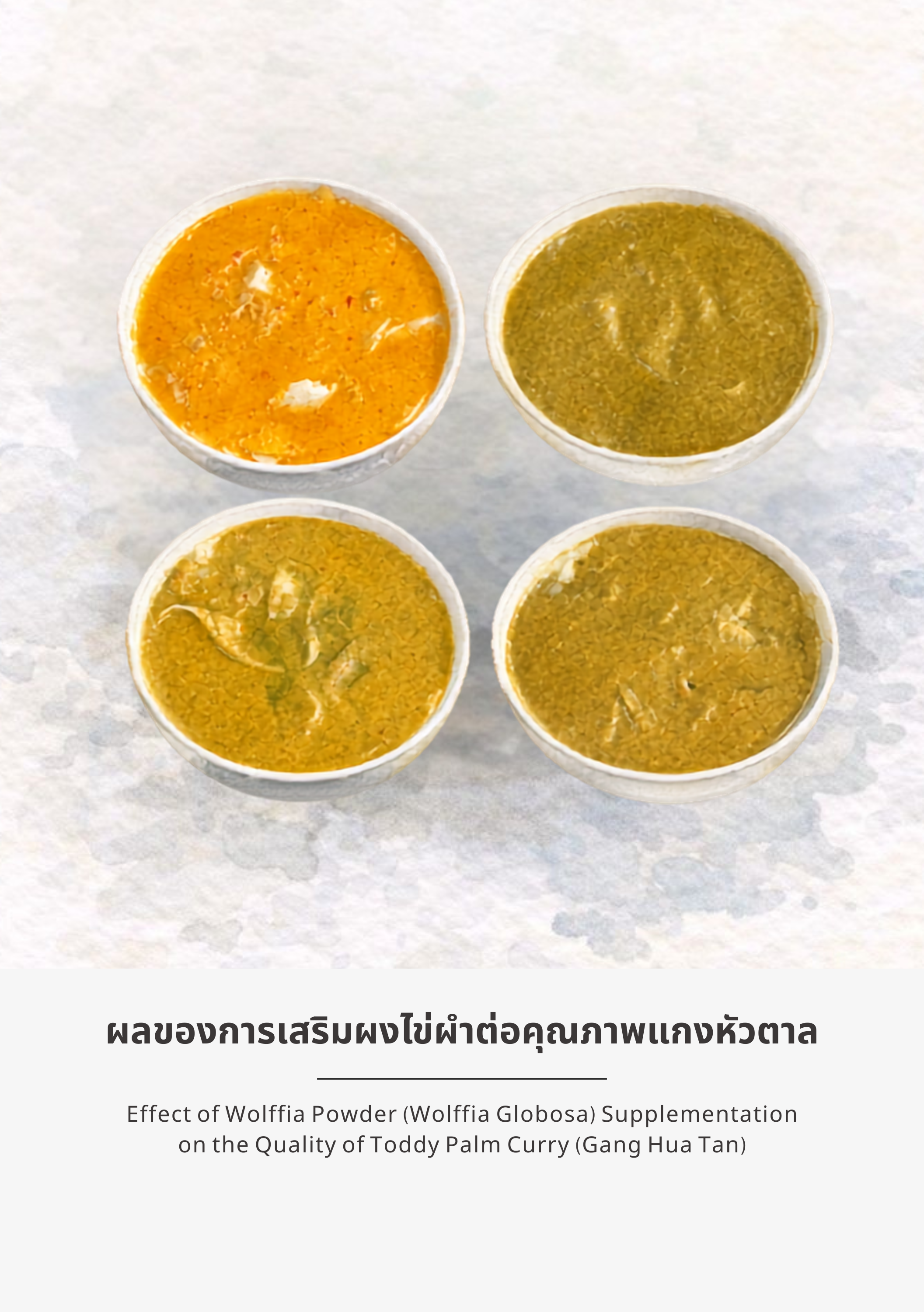
This study supports the enhancement of Wolffia powder to the quality of young toddy palm curry. The objectives of this study were to 1) determine the optimal amount of Wolffia powder in toddy palm curry 2) investigate the physical and chemical properties of the toddy palm curry. The study results showed that increasing the amount of Wolffia powder as a result, the brightness (L*) redness (a*) and yellowness (b*) values decrease. While viscosity and salinity tend to increase. However, the pH and total soluble solid decreased. Sensory evaluation was conducted on toddy palm curry supplemented with different percentages of Wolffia powder at 0% 1% 2% and 3% percent of the total weight of the ingredients. The taste testers found that the toddy palm curry supplemented with 1% Wolffia powder received the highest preference score. In terms of appearance, color, taste, texture, and overall preference, the average scores were 7.00 7.13 7.50 7.30 and 7.40 respectively. which was statistically significant (p<0.05). And from the chemical composition analysis of the toddy palm curry revealed that increasing the amount of Wolffia powder resulted in higher levels of protein, ash, dietary fiber, and energy. It was found that 100 grams of toddy palm curry supplemented with 3% Wolffia powder contained 195.73 kilocalories of energy. The protein, ash, and dietary fiber content was 9.51 3.21 and 2.10 grams, respectively. However, the moisture and fat content showed a decreasing trend.
Article Details
References
กุลพร พุทธมี และวริศชนม์ นิลนนท์. (2564). การพัฒนาผลิตภัณฑ์บะหมี่เสริมผำอบแห้ง. วารสารวิจัยและพัฒนาวไลยอลงกรณ์ ในพระบรมราชูปถัมภ์, 16(2), 57-69.
ขวัญฤทัย สุนทรธรรมรัต. (2568). ผลของการเสริมไข่ผำต่อคุณภาพของขนมอินทนิล. วารสารวิจัยราชภัฏพระนคร สาขาวิทยาศาสตร์และเทคโนโลยี, 20(2), 1-15.
ขวัญฤทัย สุนทรธรรมรัต, สุพัตรา ทรัพย์สินโอฬาร, ณัฏฐกิตติ์ เหมทานนท์, ธีราพร ปฏิเวธวิทูร และชนัญ รักฒ์สุวรรณวัฒน์. (2568). ผลของการใช้ไข่ผำเสริมโปรตีน ใยอาหาร และสารต้านอนุมูลอิสระในขนมไทย. วารสารวิทยาลัยดุสิตธานี, 19(2), 1-15.
ดวงกมล เรือนงาม. (2560). สภาวะที่เหมาะสมต่อการเลี้ยงสาหร่าย Scenedesmus armatus และฤทธิ์ต้านอนุมูลอิสระของสารที่สกัด. วารสารเทคโนโลยีการอาหาร มหาวิทยาลัยสยาม, 12(1), 59-70.
ไพรวัลย์ ประมัย, อรุณลักษณ์ โชตินาครินทร์, สุสิตรา สิงโสม และผกาวดี ภู่จันทร์. (2568). ผลของการเสริมผงเนื้อฟักข้าวต่อคุณภาพของผลิตภัณฑ์ขนมหม้อแกง. Life Sciences and Environment Journal, 26(1), 105-119.
ภาชณุมาศ ทองคำ. (2562). ผลของอุณหภูมิต่อต้านฤทธิ์ต้านอนุมูลอิสระในไข่ผำแห้งและการประยุกต์ใช้ในผลิตภัณฑ์อาหาร [วิทยานิพนธ์ปริญญามหาบัณฑิต]. มหาวิทยาลัยเทคโนโลยีราชมงคลธัญบุรี. https://repository.rmutt.ac.th/dspace/bitstream/123456789/3815/1/RMUTT-167649.pdf
ศุภัคษร มาแสวง, ศุภณัฐ เกิดน้อย, สุรเชฐ วรรณพันธ์, ณนนท์ แดงสังวาลย์ และศันสนีย์ ทิมทอง. (2566). ผลิตภัณฑ์น้ำสลัดครีมจากเต้าหู้ถั่วเหลืองเสริมไข่ผำแห้ง. PBRU SCIENCE JOURNAL, 20(2), 42-56.
ศจี สุวรรณศรี, รัตนา สนั่นเมือง, สุพัตรา สุวรรณธาดา และสอางค์ ไชยรินทร์. (2548, 28-29 กรกฎาคม). การผลิตก๋วยเตี๋ยวเส้นสดจากข้าวหัก [เอกสารนำเสนอ]. การประชุมทางวิชาการนเรศวรวิจัย ครั้งที่ 2. มหาวิทยาลัยนเรศวร, ประเทศไทย.
ศิริพร ตันจอ, ตรีรัตน์ สายวรรณ์, ประภาศรี ภูวเสถียร, อังคารศิริ ดีอ่วม และครรชิต จุดประสงค์. (2558). คุณค่าทางโภชนาการของไข่ที่นิยมบริโภคและผลของการประกอบอาหาร. วารสารวิทยาศาสตร์และเทคโนโลยี, 23(4), 651-666.
สำนักงานจังหวัดเพชรบุรี กลุ่มยุทธศาสตร์จังหวัดเพชรบุรี. (2561). แผนพัฒนาจังหวัดเพชรบุรี. เพชรบุรี: สำนักงานจังหวัดเพชรบุรี กลุ่มยุทธศาสตร์จังหวัดเพชรบุรี.
สำนักพัฒนานวัตกรรมชุมชนจัดการความรู้และสื่อสาร. (2567, มิถุนายน 13). ไข่ผำ Super Food พืชจิ๋วมหัศจรรย์ เลี้ยงง่ายราคาดี ที่พระแท่น กาญจนบุรี. https://web.codi.or.th/20240613-54496/
สุขุม เร้าใจ และสุทิน สมบูรณ์. (2550). การศึกษาปัจจัยที่มีผลต่อการเจริญเติบโตของไข่น้ำ (Wolffia arrhiza (L.) Wimm.). วารสารการประมง, 60(5), 405-413.
สุธีรา เข็มทอง, ภัทราพร ยุธาชิต, จิราวรรณ อุ่นเมตตาอารี, ลัดดาวรรณ แย้มทองหลาง, กิตติศักดิ์ มุ่งภู่กลาง และบุปผชาติ ต่อบุญสูง. (2564). ผลของการเสริมไข่น้ำผงต่อคุณภาพของบะหมี่สด. วารสารวิทยาศาสตร์ประยุกต์, 20(2), 183-200.
อภิรดา พรปัณณวิชญ์ และสุพรรณิการ์ กล่อมจอหอ. (2567). การพัฒนาผลิตภัณฑ์เส้นก๋วยเตี๋ยวเสริมโปรตีนจากไข่น้ำ. วารสารวิชาการวิทยาศาสตร์ มหาวิทยาลัยราชภัฏจันทรเกษม, 34(2), 160-169.
อรญานี ปันนวล และเสาวณีย์ เลิศวรสิริกุล. (2565, 22-23 กุมภาพันธ์). ผลกระทบของการเตรียมการอบแห้งที่แตกต่างกันต่อลักษณะด้านสี และปริมาณคลอโรฟิลล์ของไข่ผำ [เอกสารนำเสนอ]. การประชุมทางวิชาการของมหาวิทยาลัยเกษตรศาสตร์ ครั้งที่ 60.มหาวิทยาลัยเกษตรศาสตร์, ประเทศไทย.
อารี น้อยสำราญ, ศจีมาศ นันตสุคนธ์, นราธร สัตย์ซื่อ และทศพร ลิ้มดำเนิน. (2566).อาหารท้องถิ่นเมืองเพชรบุรี สูตรต้นตำรับและฟิวชั่นฟู้ด.http://mit.pbru.ac.th/2024/06/10/phetchaburi-food-final/
อารี น้อยสำราญ และศจีมาศ นันตสุคนธ์. (2567). การพัฒนาผลิตภัณฑ์ขนมเค้กหม้อแกง กล้วยหอมทองอบกรอบ. วารสารวิจัยและพัฒนา วไลยอลงกรณ์ ในพระบรมราชูปถัมภ์, 19(1), 125-138.
Anthonius, C., Seok Kian Yong, A. & Fui Fui, C., (2018). Supplementation of duckweed diet and citric acid on growth performance, feed utilization, digestibility and phosphorus utilization of TGGG hybrid grouper (Epinephelus fuscoguttatus x Epinephelus lanceolatus) juvenile. Songklanakarin Journal of Science & Technology, 40(5), 1009-1016.
AOAC. (2000). Official methods of analysis of AOAC international (17th ed.). The Association of Official Analytical Inc. Chemists Washinton D.C.
AOAC. (2012). Official methods of analysis of AOAC international (19th ed.). The Association of Official Analytical Inc. Chemists Washinton D.C.
AOAC. (2016). Official methods of analysis of AOAC international. (20th ed.).The Association of Official Analytical Inc. Chemists Washinton D.C.
AOAC. (2019). Official methods of analysis of AOAC international. (21st ed.) The Association of Official Analytical Inc. Chemists Washinton D.C.
Appenroth, K. J., Sree, K. S., Bog, M., Ecker, J., Seeliger, C., Böhm, V., Lorkowski, S., Sommer., K, Vetter., W, Tolzin-Banzsch., K, Kirmse., R, Leiterer., M, Dawczynski., C, Liebisch., G. & Jahreis., G. (2018). Nutritional value of the duckweed species of the genus Wolffia (Lemnaceae) as human food. Frontiers in chemistry, 6, 483. https://doi.org/10.3389/fchem.2018.00483
Chakrabarti, R., Clark, W. D., Sharma, J. G., Goswami, R. K., Shrivastav, A. K. & Tocher, D. R. (2018). Mass production of Lemna minor and its amino acid and fatty acid profiles. Frontiers in chemistry, 6, 479. https://doi.org/10.3389/fchem.2018.00479
Cheng, J. J. & Stomp, A. M. (2009). Growing duckweed to recover nutrients from wastewaters and for production of fuel ethanol and animal feed. Clean–Soil, Air, Water, 37(1), 17-26. https://doi.org/10.1002/clen.200800210
De Beukelaar, M. F. A., Zeinstra, G. G., Mes, J. J. & Fischer, A. R. H. (2019). Duckweed as human food. The influence of meal context and information on duckweed acceptability of Dutch consumers. Food quality and preference, 71, 76-86. https://doi.org/10.1016/j.foodqual.2018.06.005
Deliza, R. & MacFie, H. J. H. (1996). The Generation of Sensory Expectation By External Cues and Its Effect on Sensory Perception and Hedonic Ratings: A Review. Journal of Sensory Studies, 11(2), 103-128. https://doi.org/10.1111/j.1745-459X.1996.tb00036.x
Díaz-Montes, E. (2025). Advances in the Preservation of Plant-Based Pigments Via Spray Drying A Systematic Review. Processes, 13(3), 663. https://doi.org/10.3390/pr13030663
Di Stefano, E., Agyei, D., Njoku, E. N. & Udenigwe, C. C. (2018). Plant RuBisCo: An underutilized protein for food applications. Journal of the American Oil Chemists' Society, 95(8), 1063-1074. https://doi.org/10.1002/aocs.12104
Dupont, J., Harms, T. & Fiebelkorn, F. (2022). Acceptance of Cultured Meat in Germany-Application of An Extended Theory of Planned Behaviour. Foods, 11(3), 424. https://doi.org/10.3390/foods11030424
Lawless, H. T. & Heymann, H. (2010). Sensory evaluation of food: principles and practices. (2nd ed.) Springer Science & Business Media.
Moskowitz, H. R., Beckley, J. H. & Resurreccion, A. V. (2012). Sensory and consumer research in food product design and development. John Wiley & Sons.
Seephua, N., Liu, Y., Li, H., Bunyatratchata, A., Phuseerit, O. & Siriamornpun, S. (2025). Nutritional Enhancement of Rice Noodles with Watermeal (Wolffia globosa). Foods, 14(7), 1096. https://doi.org/10.3390/foods14071096
