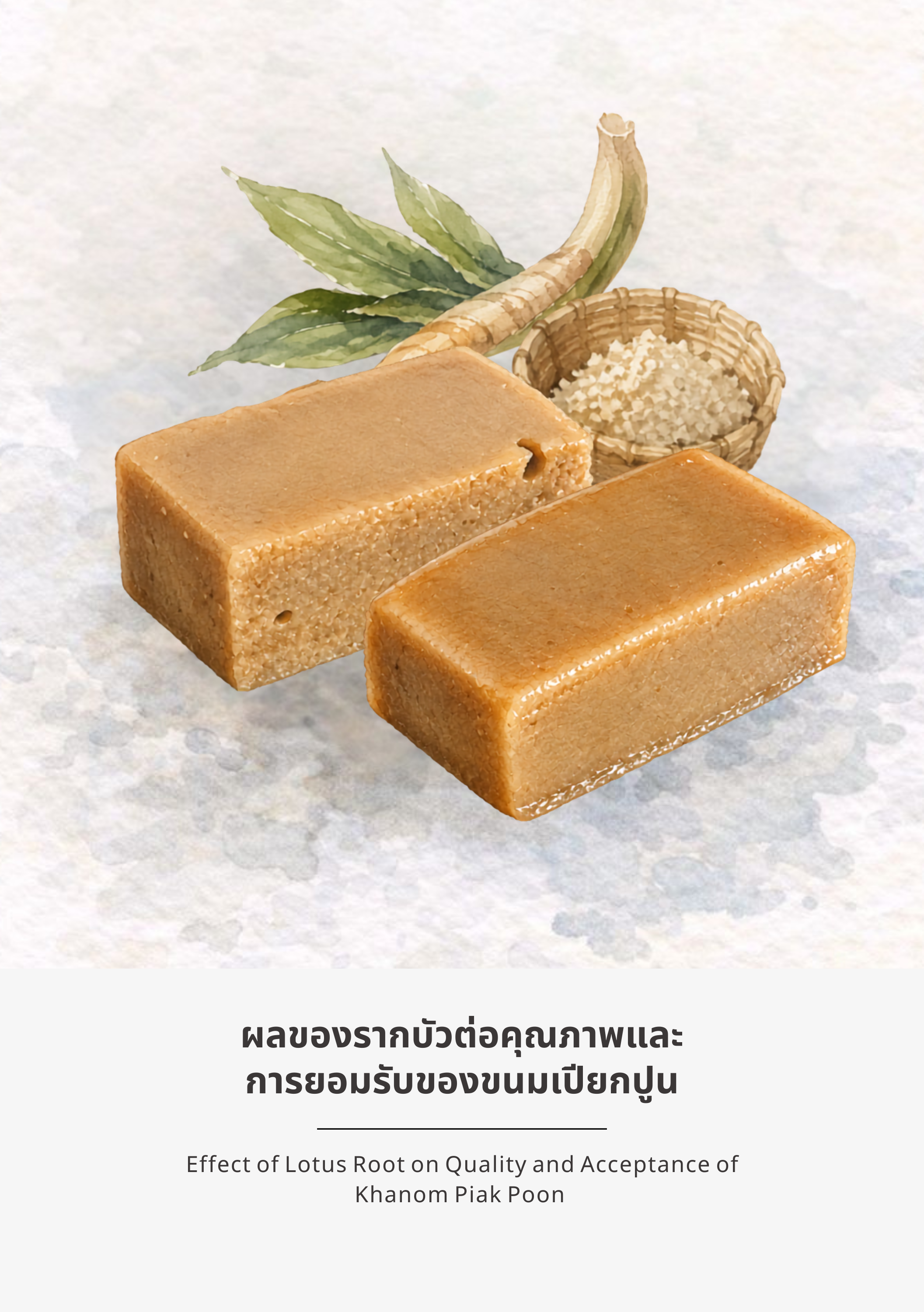
Effect of Lotus Root on Quality and Acceptance of Khanom Piak Poon
Article Sidebar
Main Article Content
Abstract
Khanom Piak Poon is a traditional Thai dessert characterized by its unique color and flavor derived from natural ingredients, such as black color from burnt coconut husk or green color from pandan extract. However, modern consumers are increasingly health-conscious, leading to the use of health-promoting natural ingredients such as lotus root, which contains dietary fiber and phytochemicals, particularly phenolic compounds with antioxidant properties. This study aimed to develop lotus root-supplemented Khanom Piak Poon to enhance product variety and health benefits. Lotus root was incorporated at levels of 0 5 10 and 15% based on total ingredient weight. The results showed that increasing lotus root content decreased the L* value, whereas a* b* and hardness values significantly increased (p<0.05). Sensory evaluation revealed that the formulation supplemented with 10% lotus root received the highest overall liking score among all lotus root-supplemented treatments, with no significant difference compared to the 0% (p>0.05). Nutritional analysis indicated that 100 g of the 10% lotus root-supplemented Khanom Piak Poon provided 202.50 kcal of energy, 48.94 g of moisture, 0.09 g of fat, 1.30 g of protein, 49.13 g of carbohydrates, 1.05 g of dietary fiber, 0.54 g of ash, and 2.20 mg CE/100 g of total flavonoids. Consumer acceptance testing showed 100% product acceptance, with a preference for square foil cup packaging and purchase intent at a retail price of 30 Baht. Incorporating lotus root improves the physical and chemical properties of this Thai dessert, while enriching its health benefits and offering more alternatives for health-conscious consumers.
Article Details
References
กษพร เอกก้านตรง และณรงค์ ทมเจริญ. (2568). ปัจจัยส่วนประสมทางการตลาดที่ส่งผลต่อการตัดสินใจซื้อขนมไทย ผ่านช่องทางออนไลน์ของผู้บริโภคในจังหวัดปทุมธานี. วารสารนวัตกรรมทางธุรกิจและสังคม, 2(5), 29-41.
ภาวินีย์ ธนาอนวัช. (2563). การวิเคราะห์ต้นทุนการผลิตและการกำหนดราคาผลิตภัณฑ์ขนมไทยโบราณของวิสาหกิจชุมชน จังหวัดพระนครศรีอยุธยา. วารสารวิทยาการจัดการปริทัศน์, 22(2), 169-180.
AOAC. (2019). Official Methods of Analysis of AOAC International (21st ed). Washington, USA: The Association of official analytical chemists Inc.
Barron, C., Bar-L’Helgouac’h, C., Champ, M. & Saulnier, L. (2020). Arabinoxylan content and grain tissue distribution are good predictors of the dietary fibre content and their nutritional properties in wheat products. Food Chemistry, 328, 127111. https://doi.org/10.1016/j.foodchem.2020.127111
Erfiza, N. M., Purba, N. R., Ahda, K., Sulaiman, I., Rohaya, S. & Razi, F. (2021, September 21). Characterization of tannin based colorimetric indicator and its application on fish packaging. In Proceedings. IOP conference Series: Earth and Environmental Indonesia: Kota Banda Aceh.
Friedman, M. & Jurgens, H. S. (2000). Effect of pH the stability of plant phenolic compounds. Journal of Agricultural and Food Chemistry, 48, 2101-2110. https://doi.org/10.1021/jf990489j
Kang, R., Halliday, T., Railton, J. & Benlloch-Tinoco, M. (2026). Green tea polyphenols improve the texture and storage stability of starch matrices with reduced digestibility. Applied Food Research, 6, 101665. https://doi.org/10.1016/j.afres.2026.101665
Ma, S., Wang, Z., Liu, H., Li, L., Zheng, X., Tian X. & Sun, B. (2022). Supplementation of wheat flour products with wheat bran dietary fiber: Purpose, mechanisms, and challenges. Trends in Food Science & Technology, 123, 281-289. https://doi.org/10.1016/j.tifs.2022.03.012
Martínez, S., Fuentes, C. & Carballo, J. (2022). Antioxidant activity, total phenolic content and total flavonoid content in sweet chestnut (Castanea sativa Mill.) cultivars grown in Northwest Spain under different environmental conditions. Foods, 11, 3519. https://doi.org/10.3390/foods11213519
Park, Y. S., Towantakavanit, K., Kowalska, T., Jung, S. T., Ham, K. S., Heo, B. G., Cho, J. Y., Yun, J. G., Kim, H. J. & Gorinstein, S. (2009). Bioactive compounds and antioxidant and antiproliferative activities of Korean white lotus cultivars. Journal of Medicinal Food, 12, (5), 1057-1064. https://doi.org/10.1089/jmf.2009.00
Showkat, Q. A., Rather, A. J., Jabeen, A., Dar, B.N., Makroo, H.A. & Majid, D. (2021). Bioactive components, physicochemical and starch characteristics of different parts of lotus (Nelumbo nuciera Gaertn.) plant: a review. International Journal of Food Science and Technology, 56, 2205-2214. https://doi.org/10.1111/ijfs.14863
Wang, J., Bai, J., Fan, M., Li, T., Li, Y., Qian, H., Wang, L., Zhang, H., Qi, X. & Rao, Z. (2020). Cereal-derived arabinoxylans: Structural features and structure-activity correlations. Trends in Food Science & Technology, 96, 157-165. https://doi.org/10.1016/j.tifs.2019.12.016
Yang, D., Wang, Q., Ke, L., Jiang, J. & Ying, T. (2007). Antioxidant activities of various extracts of lotus (Nelumbo nucifera Gaertn) rhizome. Asia Pacific Journal of Clinical Nutrition, 16 (Suppl1), 158-163.
Zheng, Z., Gao, W., Zhu, Z., Li, S. Chen, X., Cravotto, G. & Sui Y. (2024). Complexes of soluble dietary fiber and polyphenols from lotus root regulate high-fat diet-induced hyperlipidemia in mice. Antioxidants, 13, 466. https://doi.org/10.3390/antiox13040466
