Development of Cocoa-Flavored Konjac Pearls Enriched with Protein from Cricket Powder
Article Sidebar
Main Article Content
Abstract
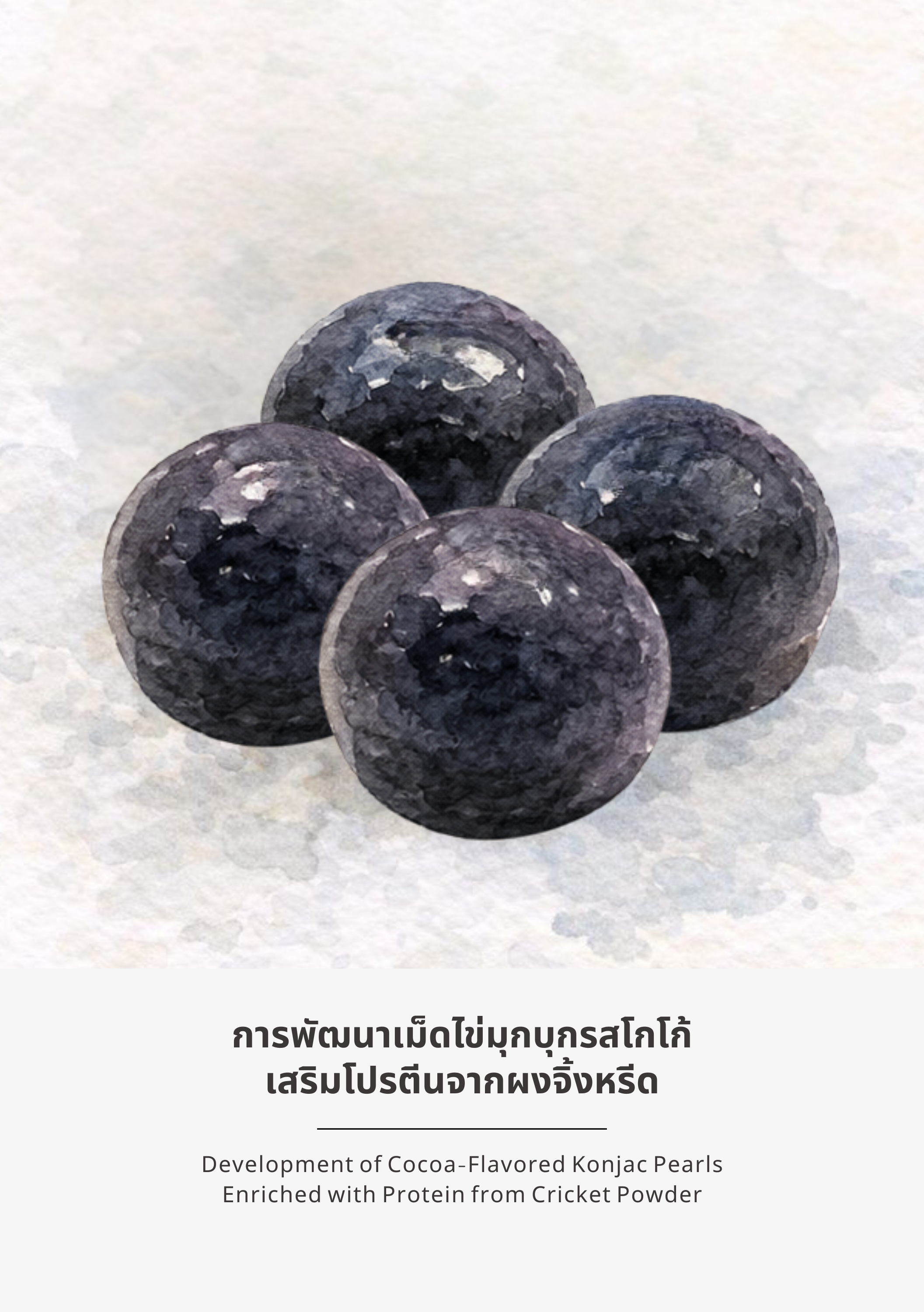
This study aimed to develop cocoa-flavored konjac pearls enriched with cricket powder. A Completely Randomized Design (CRD) was employed to investigate the effects of incorporating cricket powder at levels of 0%, 2.5%, 5%, and 7.5% (w/w) on the physical (color and texture), chemical (moisture, protein, fat, ash, crude fiber, and energy content), and sensory (using a 9-point hedonic scale) qualities of the product. The results showed that increasing the level of cricket powder caused a decrease in lightness (L*) of the konjac pearls, while redness (a*), yellowness (b*), and hardness increased significantly (p ≤ 0.05). The cocoa-flavored konjac pearls fortified with cricket powder exhibited color difference (∆E) values ranging from 5.69 to 6.44 compared with the control. In addition, cricket powder fortification increased protein, fat, and crude fiber contents, whereas moisture and ash contents decreased. Sensory evaluation revealed that cocoa-flavored konjac pearls fortified with 2.5% cricket powder showed no significant difference in overall acceptability compared with the control. Therefore, fortification with 2.5% cricket powder was considered an appropriate level for developing cocoa-flavored konjac pearls, as it enhanced nutritional value. One serving (30 g) of the developed product provided an energy value of 131 kcal while maintaining consumer acceptance.
Article Details
References
กองส่งเสริมความรอบรู้และสื่อสารสุขภาพ กรมอนามัย กระทรวงสาธารณสุข. (2562, สิงหาคม 26). กรมอนามัย เผยชานมไข่มุกพลังงานสูง ชี้ดูด 1 แก้ว รับพลังงานสูงถึง 360 กิโลแคลอรี แนะเลี่ยง ดีต่อสุขภาพ. https://multimedia.anamai.moph.go.th/news/news260862-2/
ตวงรัตน์ สนนาค, รวิสรา ชื่นประไพ, ปาริสุทธิ์ เฉลิมชัยวัฒน์ และดวงกมล แสงธีรกิจ. (2566). ผลของแซนแทนกัมและกัวร์กัมต่อคุณภาพของเม็ดไข่มุกจากการใช้แป้งข้าวกล้องงอกและแป้งข้าวเหนียวดำงอกทดแทนแป้งมันสำปะหลัง. วารสารวิชาการและวิจัย มทร. พระนคร, 17(1), 14-26.
ตรีรัตน์ เกื้อจันทร์, ธัญวรัตม์ วรรัตน์, ปาริสุทธิ์ เฉลิมชัยวัฒน์ และดวงกมล แสงธีรกิจ. (2567). ผลของการทดแทนแป้งสาลีด้วยผงจิ้งหรีดพันธุ์ทองดำต่อคุณภาพทางกายภาพ เคมี และประสาทสัมผัสของบราวนี่กรอบ. วารสารวิจัย มหาวิทยาลัยเทคโนโลยีราชมงคลศรีวิชัย, 16(2), 316-329.
ธิดารัตน์ พันโท. (2563). แมลงกินได้: คุณค่าทางโภชนาการและการแปรรูปเพื่อนำไปใช้ประโยชน์. วารสารอาหาร, 50(1), 5-12.
นวรัตน์ ฐานกิตติคุณ, พรทิพย์ พสุกมลเศรษฐ์ และปาริสุทธิ์ เฉลิมชัยวัฒน์. (2564, 10-12 มีนาคม). ผลของการทดแทนแป้งมันสำปะหลังด้วยแป้งถั่วขาวต่อสมบัติทางกายภาพ ประสาทสัมผัส และฤทธิ์การยับยั้งกิจกรรมของเอนไซม์แอลฟา-อะไมเลส ในผลิตภัณฑ์เม็ดไข่มุก [เอกสารนำเสนอ]. การประชุมทางวิชาการ ครั้งที่ 59 ของมหาวิทยาลัยเกษตรศาสตร์. มหาวิทยาลัยเกษตรศาสตร์, ประเทศไทย.
ปาลิตา ไม้ประเสริฐ, ชนกานต์ พยัคฆพันธ์, ปาริสุทธิ์ เฉลิมชัยวัฒน์, พราวตา จันทโร, ปัทมา หิรัญโญภาส และดวงกมล แสงธีรกิจ. (2567). การพัฒนาผลิตภัณฑ์แผ่นเฟลกส์ผสมผงจิ้งหรีด และการประยุกต์ในกราโนล่าบอล. วารสารวิจัย มหาวิทยาลัยเทคโนโลยีราชมงคลศรีวิชัย, 16(3), 772-784.
พงศ์พิพัฒน์ สนม และกมลวรรณ แจ้งชัด. (2563). ผลของจิ้งหรีด ผงโปรตีนถั่วเหลืองสกัด และแซนแทนกัมที่มีต่อคุณภาพคุกกี้แป้งข้าวเจ้า. วารสารวิชาการและวิจัย มทร.พระนคร, 14(2), 72-84.
มาริษา ภู่ภิญโญกุล, ภูวดล หมอกยา และวิชชา ตรีสุวรรณ. (2563, มิถุนายน 25-26). การศึกษาลักษณะทางกายภาพ องค์ประกอบทางเคมีของจิ้งหรีดทองแดงลาย และการประยุกต์ใช้ในผลิตภัณฑ์คุ้กกี้จีน [เอกสารนำเสนอ]. การประชุมวิชาการบัณฑิตศึกษาระดับชาติ ครั้งที่ 10. มหาวิทยาลัยศิลปากร บัณฑิตวิทยาลัย, ประเทศไทย
วัฒนพงศ์ ใจวัฒน์. (2565, สิงหาคม 17). รายงานชี้ตลาดชานมไข่มุกของไทยใหญ่เป็นอันดับ 2 ในอาเซียน เจ้าใหญ่อยู่กับเจ้าเล็กได้. https://positioningmag.com/1396605
สถาบันส่งเสริมการสอนวิทยาศาสตร์และเทคโนโลยี. (2567, เมษายน 23). แมลง : อาหารแห่งอนาคต. https://www.ipst.ac.th/knowledge/61703/20240423-01.html
สุกฤตา อนุตระกูลชัย, สมสมสร แก้วบริสุทธิ์ และยุพา หาญบุญทรง. (2557). การลดต้นทุนและเพิ่มมูลค่าการเลี้ยงจิ้งหรีดบ้าน. วารสารแก่นเกษตร, 42(3), 329-336.
สุทธิดา สุเต็น, นันท์ยง เฟื่องขจรฟุ้ง, ปัทมา หิรัญโญภาส, จิราพร วีณุตตรานนท์ และธิดารัตน์ แสนพรม. (2564). ผลของปริมาณผงจิ้งหรีดต่อคุณภาพทางเนื้อสัมผัส คุณภาพทางประสาทสัมผัสและคุณค่าทางโภชนาการของบราวนี่ฟลาวมันสำปะหลัง. วารสารวิทยาศาสตร์แห่งมหาวิทยาลัยราชภัฏเพชรบุรี, 18(1), 42-51.
สุทัศน์ สุวรรณ์, ภพ เบียดนอก, ปทิตตา อ่อนคำผาง, อัยยาดา วีระติ, สุธางษุ์รัตน์ ชลกาญจน์, ปาณัสม์ พันธุ์เอี่ยม, ภัทรปภา จันน้ำท่วม และณัฐพัชร์ ทับทิม. (2568). การพัฒนาผลิตภัณฑ์เม็ดไข่มุกจากควินัวและบุก “บุก คาโบควินัว”. วารสารวิชาการรัตนบุศย์, 7(1), 107-114.
องุ่น ลิ่ววานิช, ยงยุทธ ไวคกุล, อาจินต์ รัตนพันธุ์ และยุพา หาญบุญทรง. (2544). การสำรวจแมลงกินได้ในภาคตะวันออกเฉียงเหนือ. วารสารแก่นเกษตร, 29(1), 35-44.
อรรณพ ทัศนอุดม, สมจิตต์ หอมจันทร์ และวรรณภา สระพินครบุรี. (2564). ผลของการใช้ผงจิ้งหรีด (Acheta domesticus L.) ทดแทนแป้งสาลีบางส่วนต่อคุณลักษณะทางเคมีกายภาพของคุกกี้ข้าวพองหอมมะลิ. วารสาร มทร.อีสาน ฉบับวิทยาศาสตร์และเทคโนโลยี, 14(3), 117-134.
AOAC. (2019). Official Methods of Analysis of Association of Official Analytical Chemists (18th ed.). Washington DC: Gaithersburg.
Duda, A., Adamczak, J., Chelminska, P., Juszkiewicz, J. & Kowalczewski, P. (2019). Quality and nutritional/textural properties of durum wheat pasta enriched with cricket powder. Foods Journal, 8(2), 46. https://doi.org/10.3390/foods8020046
Ghosh, S., Lee, S.M., Jung, C. & Meyer Rochow, V.B. (2017). Nutritional composition of five commercial edible insects in South Korea. Journal of Asia Pacific Entomology, 20(2), 686-694. https://doi.org/10.1016/j.aspen.2017.04.003
Ribeiro, J. C., Lima, R. C., Maia, M. R. G., Almeida, A. A., Fonseca, A. J. M., Cabrita, A. R. J. & Cunha, L. M. (2019). Impact of defatting freeze-dried edible crickets (Acheta domesticus and Gryllodes sigillatus) on the nutritive value, overall liking and sensory profile of cereal bars, LWT- Food Science and Technology, 113, 1-7. https://doi.org/10.1016/j.lwt.2019.108335
Smarzynski, K., Sarbak, P., Kowalczewski, P. L., Rozanska, M. B., Rybicka, I., Polanowska, K., Fedko, M., Kmiecik, D., Masewicz, L., Nowicki, M., Lewandowicz, J., Jezowski, P., Kacaniova, M., Slachcinski, M., Piechota, T. & Baranowska, H.M. (2021). Low-field NMR study of shortcake biscuits with cricket powder, and their nutritional and physical characteristics. Molecules, 26(17), 5417. https://doi.org/10.3390/molecules26175417
Stone, A. K., Tanaka, T. & Nickerson, M. T. (2019). Protein quality and physicochemical properties of commercial cricket and mealworm powders. Journal of Food Science and Technology, 56(7), 3355-3363. https://doi.org/10.1007/s13197-019-03818-2
Zielinska, E., Pankiewicz, U. & Sujka, M. (2021). Nutritional, physiochemical, and biological value of muffins enriched with edible insects flour. Antioxidants (Basel), 10(1122), 1-17. https://doi.org/10.3390/antiox10071122
