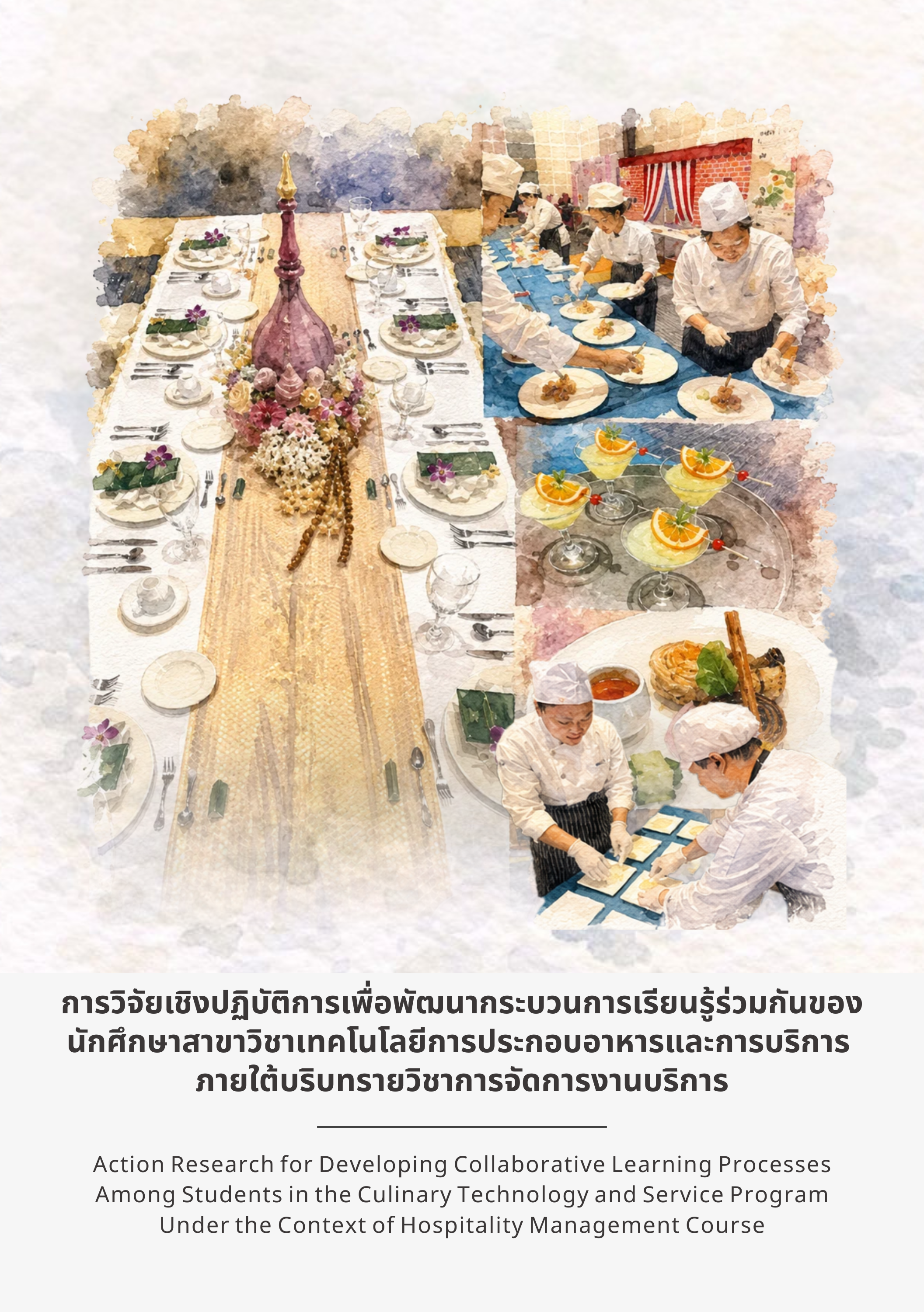
Action Research for Developing Collaborative Learning Processes Among Students in the Culinary Technology and Service Program Under the Context of Hospitality Management Course
Article Sidebar
Main Article Content
Abstract
This action research aimed to examine students’ collaborative learning behaviors, analyze the development of 21st-century skills, and evaluate students’ learning achievement through a collaborative learning process in a Service Management course. The sample consisted of 38 undergraduate students in the Culinary Technology and Service program. Data were collected using questionnaires, in-depth interviews, classroom observations, performance-based assessments through service simulation, and group report analysis. The findings revealed that students demonstrated collaborative learning behaviors at a high to highest level, particularly in terms of idea exchange and teamwork. Qualitative data indicated that the collaborative learning process enhanced students’ self-expression, active listening, shared decision-making, and acceptance of diverse perspectives. In terms of learning achievement, students were able to plan and solve problems systematically, with performance scores ranging from good to very good. Furthermore, document analysis reflected students’ abilities in organizing content, using academic language, and delivering creative presentations, along with clear role distribution and reflective practices within groups. In conclusion, the collaborative learning process had a positive impact on students’ learning behaviors, 21st-century skills, and learning achievement. These competencies are essential for workforce readiness in the service industry in the 21st century.
Article Details
References
Freeman, S., Eddy, S. L., McDonough, M., Smith, M. K., Okoroafor, N., Jordt, H. & Wenderoth, M. P. (2014). Active learning increases student performance in science, engineering, and mathematics. Proceedings of the National Academy of Sciences, 111(23), 8410-8415. https://doi.org/10.1073/pnas.1319030111
Johnson, D. W. & Johnson, R. T. (2009). An educational psychology success story: Social interdependence theory and cooperative learning. Educational Researcher, 38(5), 365-379. https://doi.org/10.3102/0013189X09339057
Johnson, D. W. & Johnson, F. P. (2020). Joining together: Group theory and group skills (12th ed.). Pearson.
Kolb, D. A. (2015). Experiential learning: Experience as the source of learning and development (2nd ed.). Pearson.
Laal, M. & Ghodsi, S. M. (2012). Benefits of collaborative learning. Procedia - Social and Behavioral Sciences, 31, 486-490. https://doi.org/10.1016/j.sbspro.2011.12.091
OECD. (2021). Beyond academic learning: First results from the survey of social and emotional skills. https://doi.org/10.1787/92a11084
Prince, M. (2004). Does active learning work? A review of the research. Journal of Engineering Education, 93(3), 223-231. https://doi.org/10.1002/j.2168-9830.2004.tb00809.x
Rogers, E. M. (2003). Diffusion of innovations (5th ed.). Free Press.
Sawyer, R. K. (2012). Explaining creativity: The science of human innovation (2nd ed.). Oxford University Press.
Slavin, R. E. (2020). Educational psychology: Theory and practice (13th ed.). Pearson.
UNESCO. (2022). Reimagining our futures together: A new social contract for education. UNESCO Publishing.
Vygotsky, L. S. (1978). Mind in society: The development of higher psychological processes. Harvard University Press.
