Effectiveness of Integrated Marketing Communication on Vaccine Acceptance among the Elderly: The Critical Role of Personal Media and Family Involvement
Article Sidebar
Main Article Content
Abstract
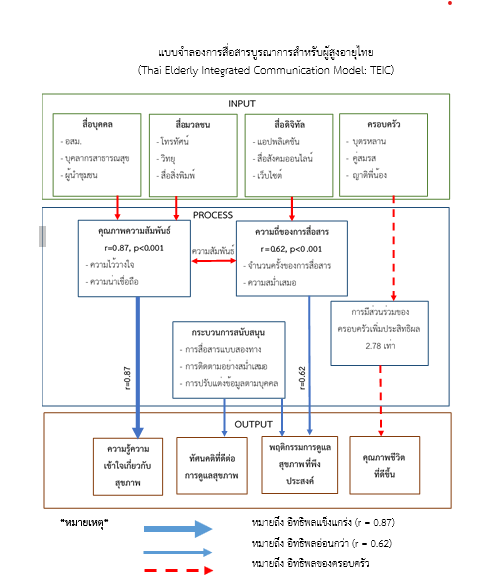
This mixed-method research aimed to study the following: 1) to study the level of access, understanding, and acceptance of vaccine information via integrated marketing communication channels among the elderly; 2) to compare the effectiveness of different communication channels on vaccine acceptance among the elderly; 3) to analyze the influence of family participation and personal media on the elderly's decision to get vaccinated; and 4) to develop policy recommendations. Quantitative data were collected from 429 elderly in Mueang District, Suphan Buri Province using a 5-part questionnaire that was tested for content validity (IOC = 0.91) and reliability (α = 0.89) using multistage sampling. The qualitative data were collected using in-depth interviews with 50 informants selected by purposive sampling. The results of the study found that 1) the elderly had the most access to information via personal media (VHV) and had a high level of understanding (x̅ = 4.25), significantly higher than other types of media (p<0.001); 2) personal media was the most effective in promoting vaccine acceptance; and 3) Trust and personal relationships between public health volunteers and the elderly were strengthened. Including two-way communication and continuous follow-up as important factors for communication effectiveness, and 4) communication strategies that focus on strengthening personal media networks, developing integrated communication systems, and promoting family participation should be developed. The results of this study reflect the importance of developing communication strategies that focus on personal and family media participation in the Thai social context.
Article Details
References
กรมการปกครอง. (2566). สถิติประชากรผู้สูงอายุ อำเภอเมือง จังหวัดสุพรรณบุรี, (อัดสำเนา), กระทรวงมหาดไทย.
เกตุนรินทร์ บุญคล้าย, วรรณชาติ ตาเลิศ, อนุศร การะเกษ, พชิ ญาณัฏฐ์ แก้วอำไพ และนนทรัตน์ จำเริญวงศ์. (2566). การรับรู้ ทัศนคติ และความรอบรู้ด้านวัคซีนโรคโควิด 19 ของประชาชนในแระเทศไทย. วารสารวิชาการสาธารณสุข, 32(3), 417-427.
สำนักงานสาธารณสุขจังหวัดสุพรรณบุรี. (2566). รายงานประจำปีเรื่องอัตราการได้รับวัคซีนของผู้สูงอายุและยุทธศาสตร์การสื่อสาร พ.ศ. 2566, (อัดสำเนา), สำนักงานสาธารณสุขจังหวัดสุพรรณบุรี.
องค์การอนามัยโลก. (2566). รายงานยุทธศาสตร์ว่าด้วยประสิทธิผลของการสื่อสารเรื่องวัคซีนในประชากรผู้สูงอายุ, (อัดสำเนา), องค์การอนามัยโลก.
Anderson, M. & Perrin, A. (2017). Technology use among seniors. https://www.pewresearch.org/internet/2017/05/17/technology-use-among-seniors/
Belch, G. E. & Belch, M. A. (2021). Advertising and promotion: An integrated marketing communications perspective (12th ed.). McGraw-Hill Education.
Brazinová, I. & Chytil, O. (2024). The family as a source of social support for older adults: Implications for gerontological social work. International Social Work, 67(2), 123-140. https://doi.org 10.1177/14680173231222612
Cochran, W. G. (1977). Sampling techniques (3rd ed.). John Wiley & Sons.
Cohen, J. (1988). Statistical power analysis for the behavioral sciences (2nd ed.). Lawrence Erlbaum Associates.
Creswell, J. W. & Plano Clark, V. L. (2017). Designing and conducting mixed methods research (3rd ed.). SAGE Publications.
Cronbach, L. J. (1951). Coefficient alpha and the internal structure of tests. Psychometrika, 16(3), 297-334. https://doi.org/10.1007/BF02310555
Denzin, N. K. (2017). The research act: A theoretical introduction to sociological methods, Routledge.
Field, A. (2018). Discovering statistics using IBM SPSS statistics (5th ed.). SAGE Publications.
Green, L. W. & Kreuter, M. W. (2005). Health program planning: An educational and ecological approach (4th ed.). McGraw-Hill.
Hosmer, D. W., Lemeshow, S. & Sturdivant, R. X. (2013). Applied logistic regression (3rd ed.). John Wiley & Sons.
IBM Corp. (2021). IBM SPSS Statistics for Windows, Version 28.0. IBM Corp.
Kotler, P. & Keller, K. L. (2016). Marketing management (15th ed.). Pearson Education.
Krippendorff, K. (2018). Content analysis: An introduction to its methodology (4th ed.). SAGE Publications.
Likert, R. (1932). A technique for the measurement of attitudes. Archives of Psychology, 22(140), 5-55.
Liu, Y. & Duarte, H. (2023). Repairing public trust through communication in health crises: A systematic review of the literature. Public Management Review, 27(5). https://doi.org/10.1080/14719037.2023.2284224.
Martinez, R., Garcia, S. & Lopez, J. (2023). Effectiveness of community-based health communication: A longitudinal study. Journal of Community Health,
Patton, M. Q. (2014). Qualitative research & evaluation methods: Integrating theory and practice (4th ed.). SAGE Publications.
Putnam, R. D. (2000). Bowling alone: The collapse and revival of American community, Simon & Schuster.
QSR International. (2020). NVivo 14 Windows [Computer software]. QSR International.
Robinson, M. N., Tansil, K. A., Elder, R. W., Soler, R. E., Labre, M. P., Mercer, S. L., Eroglu, D., Baur, C., Lyon-Daniel, K., Fridinger, F., Sokler, L. A., Green, L. W., Miller, T., Dearing, J. W., Evans, W. D., Snyder, L. B., Viswanath, K., Beistle, D. M., Chervin, D. D., ….. and Rimer, B. K. & Community Preventive Services Task Force. (2014). Mass media health communication campaigns combined with health-related product distribution: A community guide systematic review. American Journal of Preventive Medicine, 47(3), 360-371. https://doi.org/10.1016/j.amepre.2014.05.034.
Rogers, E. M. (2003). Diffusion of innovations (5th ed.). Free Press.
Sedgwick, P. (2014). Cross sectional studies: advantages and disadvantages. BMJ, 348, g2276. https://doi.org/10.1136/bmj.g2276
Shumba, C. S., Kiraithe, P., Kambo, I. & Shaibu, S. (2024). Community Health Volunteers' experiences of implementing COVID-19 vaccine education and promotion in Kenya: A qualitative descriptive study. Frontiers in Public Health, 12, Article 1406959. https://doi.org/10.3389/fpubh.2024.1406959
Tripodoro, V. A., Veloso, V. I., Víbora Martín, E., Kodba-Čeh, H., Bakan, M., Rasmussen, B. H., Zambrano, S. C., Joshi, M., Hálfdánardóttir, S. Í., Ásgeirsdóttir, G. H., Romarheim, E., Faksvåg Haugen, D., McGlinchey, T., Yildiz, B., Barnestein-Fonseca, P., Goossensen, A., Lunder, U. & van der Heide, A. (2024). 'Someone must do it': Multiple views on family's role in end-of-life care – An international qualitative study. SAGE Open Medicine, 12, Article 26323524241260425. https://doi.org/10.1177/26323524241260425
Turner, R. C. & Carlson, L. (2003). Indexes of item-objective congruence for multidimensional items. International Journal of Testing, 3(2), 163-171. https://doi.org/10.1207/S15327574IJT0302_5.
Yamane, T. (1967). Statistics: An introductory analysis (2nd ed.). Harper and Row.
