Semi-Instant Cubes Roasted Chili Paste Produced by Solar Drying Technology
Article Sidebar
Main Article Content
Abstract
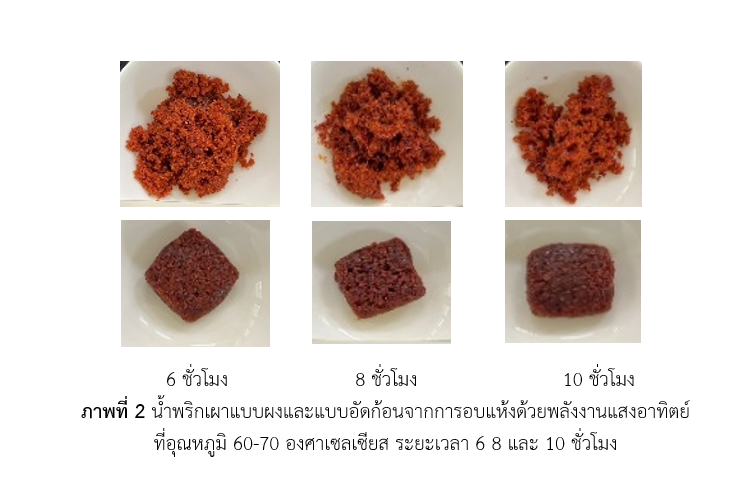
The purpose of this study was to study the basic recipe for roasted chili paste. To study the drying time of chili paste using solar drying technology to suit the use of semi-instant compressed cubes and examine the restoration of chili paste for dry semi-finished roasted chili paste. Evaluate the sensory quality by the 5-Point Hedonic Scale using 60 test panelists. The results of the study showed that the test rated Formula 1 the most favorable, with the ingredients consisting of coconut sugar 14.74%, shrimp paste 4.52%, tamarind juice, and tamarind juice 4.52%. Percent fish sauce 2.525%, vegetable oil 6.70% shallots 20.10 %, burnt Chinese garlic 23.11%, 19.93 % of roasted Chinese garlic, and 8.38 %of dried chili peppers. It was found that the chili paste dried for 6 hours was acceptable to be a cube; it was dark red and had moisture and free water content (AW) values according to the Community Product Standard (MPCHOR 4/2013). Results of the restoration test with the addition of boiled water. It was found that the amount of boiled water, 5 grams added to 10 grams of chili paste cubes, was the best sensory acceptance, with color, smell, taste, texture, and overall preference like the basic recipe.
Article Details
References
กองบรรณาธิการหนังสือพิมพ์ไทยรัฐ. (2564, เมษายน 16). น้ำพริกเผาไทยโอกาสใหม่ในตลาดโลก. https://www.thairath.co.th
กองบรรณาธิการศิลปวัฒนธรรม. (2568, มกราคม 18). เทียบ“น้ำพริกเผา” ในวังกับแบบขวดขายทั่วไปซึ่งในวังไม่เรียก”น้ำพริกเผา”. https://www.silpa-mag.com/culture/article_22218
จันทร ทศานนท์. (2535). อาหารไทย (พิมพ์ครั้งที่ 9). ศิริวัฒนาอินเตอร์ พริ้นท์.
ภูชิษย์ สว่างสุข. (2568). น้ำปลาพริก: เครื่องจิ้ม ประเภทน้ำปลาสิ่งเล็ก ๆ ในสำรับแต่ยิ่งใหญ่ เรื่องรสชาติ. วารสารคหกรรมศาสตร์และวัฒนธรรมอย่างยั่งยืน, 7(1), 148-161.
วรรณา ยงพิศาลภพ. (2565). อุตสาหกรรมอาหารพร้อมทาน. วิจัยกรุงศรี. https://www.krungsri.com/getmedia/ef8c87f3-f000-49ff-b9fe-c1f053c3937a/IO_Ready_to_Eat_Food_220926_TH_EX.pdf
ณฐมน บัวพรมมี, นัชชา พรหมติ๊บ, ลักษณา โพธิ์ตั้น และวริษฐา คงเขียว. (2565). ปัจจัยที่ส่ง ผลต่อการตัดสินใจซื้อซ้ำผลิตภัณฑ์น้ำพริกเผาไทยยี่ห้อหนึ่งผ่านช่องทางห้างค้าส่ง ขนาดใหญ่ของผู้บริโภคในเขตจังหวัดปทุมธานี. วารสารเครือข่ายส่งเสริมกาวิจัยทาง มนุษยศาสตร์และสังคมศาสตร์, 5(3), 19-31.
ศศิธร อภิรัตนานนท์สรรค์ และขนิษฐา ชินภัคร. (2556). การพัฒนาบรรจุภัณฑ์สำหรับผลิตภัณฑ์น้ำพริกพร้อมบริโภค. วารสารวิจัยและพัฒนา มจธ, 36(4), 451-464.
สำนักงานมาตรฐานผลิตภัณฑ์อุตสาหกรรม. (2536). มาตรฐานผลิตภัณฑ์อุตสาหกรรมน้ำพริกเผา (มอก.1152-2536), (อัดสำเนา), สำนักงานมาตรฐานผลิตภัณฑ์อุตสาหกรรม.
สุพรรณนิภา สุทธศรี, สุมลนาถ ผดุงรัตน์ และอรศิริ วงศ์สวัสดิ์เวช. (2547). น้ำพริกเผาเสริมกล้วยน้ำว้า [แผนงานพิเศษ ปริญญาบัณทิต]. มหาวิทยาลัยเทคโนโลยีราชมงคลพระนคร.
สุจินตนา สืบสีสุก. (2554). ตำรับน้ำจิ้มน้ำพริกเครื่องแกงคู่ครัวไทย. Feel good-Delicious.
Fellows, P. J. (2009). Food Processing Technology: Principles and Practice (3rd ed.). Woodhead Publishing.
Ireri, F. K. (2022). Product Quality Characteristics of Solar Dried Chilli Products. University of Nairobi.
Krokida, M. K. & Maroulis, Z. B. (2001). Structural properties of dehydrated products during rehydration. International Journal of Food Science and Technology, 36(5), 529-538. https://ifst.onlinelibrary.wiley.com/doi/10.1046/j.1365-2621.2001.00483.x
Martins, S. I. F. S., Jongen, W. M. F. & van Boekel, M. A. J. S. (2000). A review of Maillard reaction in food and implications to kinetic modelling. Trends in Food Science & Technology, 11(9-10), 364–373.
Nadia Sarina, M. F., Mohd Adzahan, N., Sobhi, B., Ab Karim, M. S. & Karim, R. (2010). Formulation and process improvement for chili shrimp paste using sensory evaluation. International Food Research Journal, 17(4), 927-935.
Rahman, M. S. (2007). Handbook of Food Preservation (2nd ed.). CRC Press.
