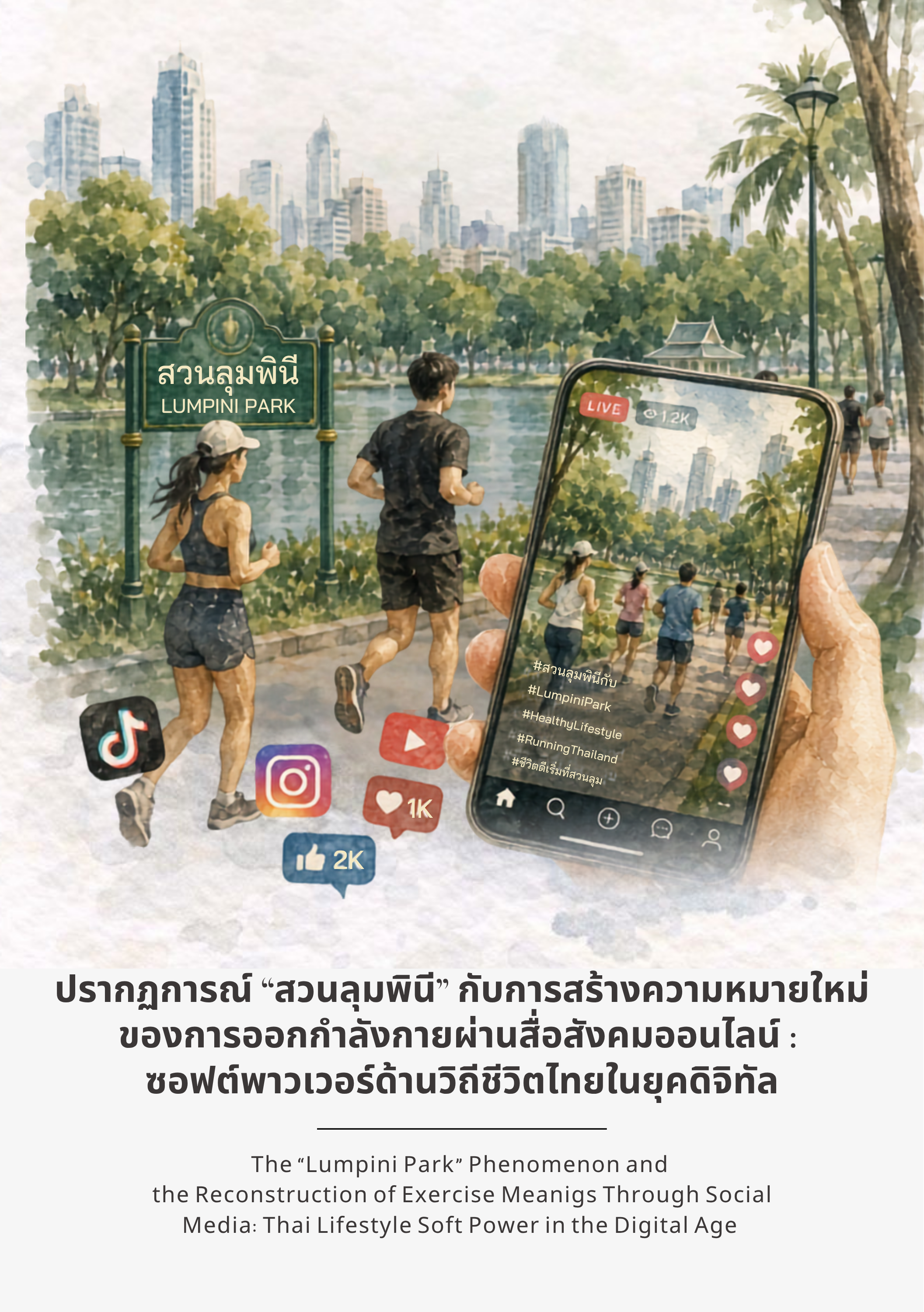
ปรากฏการณ์ “สวนลุมพินี” กับการสร้างความหมายใหม่ของการออกกำลังกายผ่านสื่อสังคมออนไลน์ : ซอฟต์พาวเวอร์ด้านวิถีชีวิตไทยในยุคดิจิทัล
Article Sidebar
Main Article Content
บทคัดย่อ
บทความวิชาการฉบับนี้มุ่งสังเคราะห์แนวคิดและทฤษฎีที่เกี่ยวข้องเพื่ออธิบายว่า ปรากฏการณ์การเต้นแอโรบิกในสวนลุมพินีในการยกระดับสู่การเป็นซอฟต์พาวเวอร์ด้านวิถีชีวิตไทยผ่านสื่อสังคมออนไลน์ ด้วยการบูรณาการแนวคิดซอฟต์พาวเวอร์ แนวคิดการประกอบสร้างความเป็นจริงผ่านสื่อ และวัฒนธรรมวิดีโอสั้น แสดงให้เห็นว่ากลไกสำคัญที่ทำให้สวนลุมพินีกลายเป็นภาพแทนของวิถีชีวิตไทยร่วมสมัย ประกอบด้วย 3 องค์ประกอบหลัก ได้แก่ 1) ความหลากหลายระหว่างช่วงวัยในพื้นที่สาธารณะ 2) ความสนุกแบบไทยที่สะท้อนสุขภาวะแบบองค์รวม และ 3) ความสมดุลระหว่างเมืองกับคุณภาพชีวิต ทั้งนี้ กระบวนการสื่อสารผ่านฟิลเตอร์ ดนตรี แฮชแท็ก และการเล่าเรื่องบนแพลตฟอร์มดิจิทัลได้ขยายการรับรู้เหล่านี้สู่ระดับสากล บทความนี้นำเสนอโมเดล “ซอฟต์พาวเวอร์จากฐานราก” (Grassroots Soft Power Model) ซึ่งมีปฏิสัมพันธ์ระหว่างการรับรู้ดิจิทัลและการจัดการพื้นที่จริง ในฐานะองค์ความรู้ที่เป็นประโยชน์ต่อการวางกลยุทธ์การสื่อสารภาพลักษณ์ประเทศและการส่งเสริมการท่องเที่ยวเชิงสุขภาวะในยุคดิจิทัล
Article Details
เอกสารอ้างอิง
Bedimo-Rung, A. L., Mowen, A. J. & Cohen, D. A. (2005). The significance of parks to physical activity and public health: A conceptual model. American Journal of Preventive Medicine, 28(2, Suppl. 2), 159-168. https://doi.org/10.1016/j.amepre.2004.10.024
Cohen, D. A., McKenzie, T. L., Sehgal, A., Williamson, S., Golinelli, D. & Lurie, N. (2007). Contribution of public parks to physical activity. American Journal of Public Health, 97(3), 509–514. https://doi.org/10.2105/AJPH.2005.072447
Couldry, N. & Hepp, A. (2017). The mediated construction of reality. Polity.
Dijck, J. V., Poell, T. & Waal, M. D. (2018). The platform society: Public values in a connective world. Oxford University Press. https://doi.org/10.1093/oso/9780190889760.001.0001
Gartner, W. C. (1994). Image formation process. Journal of Travel & Tourism Marketing, 2(2-3), 191-216. https://doi.org/10.1300/J073v02n02_12
Gehl, J. (2011). Life between buildings: Using public space. Island Press.
Jenkins, H., Ford, S. & Green, J. (2013). Spreadable media: Creating value and meaning in a networked culture. New York University Press.
Jennings, V. & Bamkole, O. (2019). The relationship between social cohesion and urban green space: An avenue for health promotion. International Journal of Environmental Research and Public Health, 16(3), 452. https://doi.org/10.3390/ijerph16030452
Kaplan, A. M. & Haenlein, M. (2010). Users of the world, unite! The challenges and opportunities of social media. Business Horizons, 53(1), 59-68. https://doi.org/10.1016/j.bushor.2009.09.003
Kaye, D. B. V., Chen, X. & Zeng, J. (2021). The co-evolution of two Chinese mobile short video apps: Parallel platformization of Douyin and TikTok. Mobile Media & Communication, 9(2), 229–253. https://doi.org/10.1177/2050157920952120
Marine-Roig, E. & Anton Clavé, S. (2015). Tourism analytics with massive user-generated content: A case study of Barcelona. Journal of Destination Marketing & Management, 4(3), 162-172. https://doi.org/10.1016/j.jdmm.2015.06.004
Montag, C., Yang, H. & Elhai, J. D. (2021). On the psychology of TikTok use: A first glimpse from empirical findings. Frontiers in Public Health, 9, 641673. https://doi.org/10.3389/fpubh.2021.641673
Munar, A. M. & Jacobsen, J. K. S. (2014). Motivations for sharing tourism experiences through social media. Tourism Management, 43, 46-54. https://doi.org/10.1016/j.tourman.2014.01.012
Neuhofer, B., Buhalis, D. & Ladkin, A. (2014). A typology of technology-enhanced tourism experiences. International Journal of Tourism Research, 16(4), 340-350. https://doi.org/10.1002/jtr.1958
Nye, J. S., Jr. (2004). Soft power: The means to success in world politics. PublicAffairs.
Peters, K., Elands, B. & Buijs, A. E. (2010). Social interactions in urban parks: Stimulating social cohesion? Urban Forestry & Urban Greening, 9(2), 93–100. https://doi.org/10.1016/j.ufug.2009.11.003
Prohmvitak, S. (2025). Authenticity and disparity between social media representations and real-life experiences. SSRU International Journal of Management Science (IJMS), 12(2), 28-40. https://so10.tci-thaijo.org/index.php/ssru/article/view/2927
Stepchenkova, S. & Zhan, F. (2013). Visual destination images of Peru: Comparative content analysis of DMO and user-generated photography. Tourism Management, 36, 590-601. https://doi.org/10.1016/j.tourman.2012.08.006
United Nations Human Settlements Programme (UN-Habitat). (2022). World cities report 2022: Envisaging the future of cities. https://unhabitat.org/world-cities-report-2022-envisaging-the-future-of-cities
Wang, N. (1999). Rethinking authenticity in tourism experience. Annals of Tourism Research, 26(2), 349-370. https://doi.org/10.1016/S0160-7383(98)00103-0
Xiang, Z. & Gretzel, U. (2010). Role of social media in online travel information search. Tourism Management, 31(2), 179-188. https://doi.org/10.1016/j.tourman.2009.02.016
Zulli, D. & Zulli, D. J. (2022). Extending the Internet meme: Conceptualizing technological mimesis and imitation publics on the TikTok platform. New Media & Society, 24(8), 1872-1890. https://doi.org/10.1177/1461444820983603
