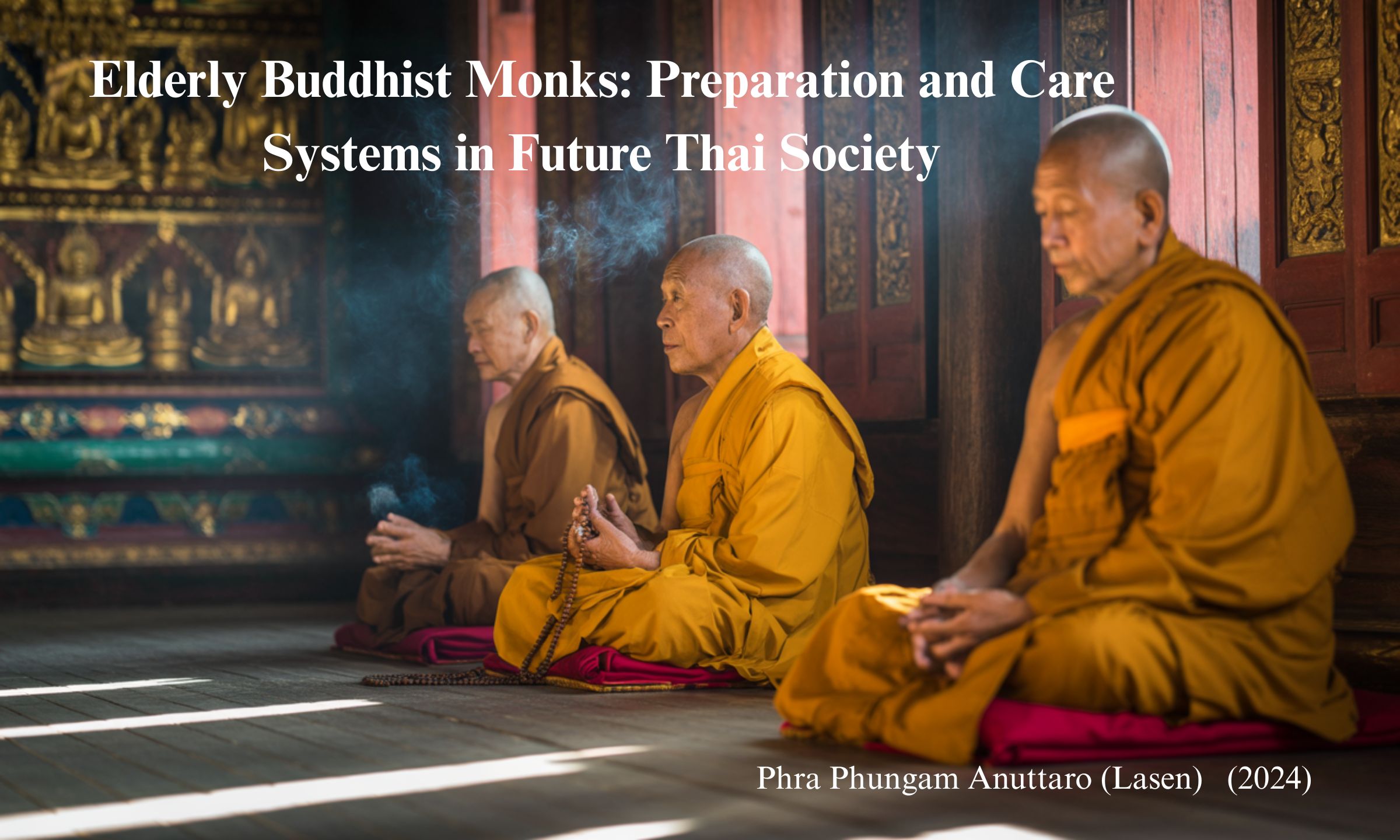
Elderly Buddhist Monks: Preparation and Care Systems in Future Thai Society
DOI:
https://doi.org/10.65680/jahs.v2i2.7186Keywords:
elderly monks, care systems, Thai society, Buddhism, preparationAbstract
The demographic transition in Thai society significantly impacts Buddhist institutions, particularly the increasing number of elderly monks requiring specialized care systems. This article aims to study the current situation of elderly monks in Thailand, analyze challenges and problems, and propose appropriate preparation approaches and care system development. This study employs qualitative analysis through literature review, in-depth interviews, and participant observation. The findings reveal that elderly monks currently face health problems, living conditions issues, and difficulties accessing healthcare services. Addressing these problems requires integration between temples, communities, and government agencies through developing a Holistic Care Model that combines Buddhist wisdom with modern knowledge. This study proposes a conceptual framework and policy recommendations for preparing to cope with the aging monastic society in the future. The research emphasizes the necessity of systematic preparation involving personnel development, infrastructure improvement, technology adoption, and sustainable financial systems. The proposed holistic care model integrates medical and health dimensions, psychological and spiritual dimensions, social and community dimensions, and management and coordination dimensions to provide comprehensive care that meets the diverse needs of elderly monks.
References
nurak Suksomsomboon, Preeda Chareonsubsap, & Niran Sukjai. (2022). Economic situation of elderly monks. Journal of Development Economics, 29(2), 67-84.
Arun Srisawat. (2022). Challenges in providing medical services to monks. Journal of Medicine, 88(3), 234-248.
Department of Religious Affairs. (2024). Thai monk statistics 2024. Bangkok: Department of Religious Affairs.
Institute for Population and Social Research, Mahidol University. (2023). Elderly monk health survey 2023. Nakhon Pathom: Institute for Population and Social Research.
Naphadol Charoensuek. (2022). Cost analysis of elderly monk care in Thailand. Journal of Health Economics, 12(3), 45-62.
National Office of Buddhism. (2023). Temple facility survey 2023. Bangkok: National Office of Buddhism.
National Office of Buddhism. (2024). Thai monk statistics report 2024. Bangkok: National Office of Buddhism.
Nitithorn Charoenwit, Sombat Jaidee, & Wichai Thammasarn. (2022). Preparation for aging among Thai monks. Journal of Buddhist Studies, 28(1), 112-128.
Prasert Hancharoen. (2023). Geographical distribution of elderly monks in Thailand. Journal of Geography, 15(2), 34-48.
RadaKhet, M. (2023). Healing the Mind: Buddhist Mental Health in Hospitals. Journal of Applied Humanities Studies, 1(2). Retrieved from https://so09.tci-thaijo.org/index.php/J_AHS/article/view/6756
Siriporn Kaewmanee, & Chaiwat Anantkul. (2023). Barriers to healthcare access among elderly monks. Journal of Thai Traditional Medicine, 18(2), 89-103.
Somsak Wongyai. (2023). Changes in community participation in monk care. Journal of Community Development, 22(3), 156-170.
Suraphol Chancharoen, & Sombat Jaidee. (2023). Limitations of current elderly monk care systems. Journal of Community Health, 19(1), 45-59.
Sutin Intarasit. (2022). Technology for elderly care in Buddhist contexts. Journal of Information Technology, 11(4), 78-92.
Theerasak Mongkolsit. (2023). Pressure and adaptation of elderly monks in urban society. Journal of Social Sciences, 45(2), 78-95.
Werachai Silasang. (2023). Health problems and welfare of elderly monks. Journal of Public Health Sciences, 46(1), 23-38.
Wichai Thiangtharm, & Supaporn Nakdee. (2023). Inter-agency coordination in elderly monk care. Journal of Public Administration, 31(2), 112-127.
Downloads
Published
How to Cite
Issue
Section
License
Copyright (c) 2024 Journal of Applied Humanities Studies

This work is licensed under a Creative Commons Attribution 4.0 International License.
Published articles are copyrighted by the Journal of Applied Humanities Studies.
The contents of each article in this academic journal represent the personal opinions of the individual authors and are not affiliated with the Journal of Applied Humanities Studies or any other editorial team within the publishing house. The responsibility for all content of each article rests with the individual authors. Any errors or omissions are solely the responsibility of each individual author.