สมบัติทางกายภาพและเคมีของเม็ดบีดส์ขมิ้นชันผสมน้ำสมุนไพรด้วยเทคนิครีเวิร์สสเฟียริฟิเคชัน
Article Sidebar
Main Article Content
บทคัดย่อ
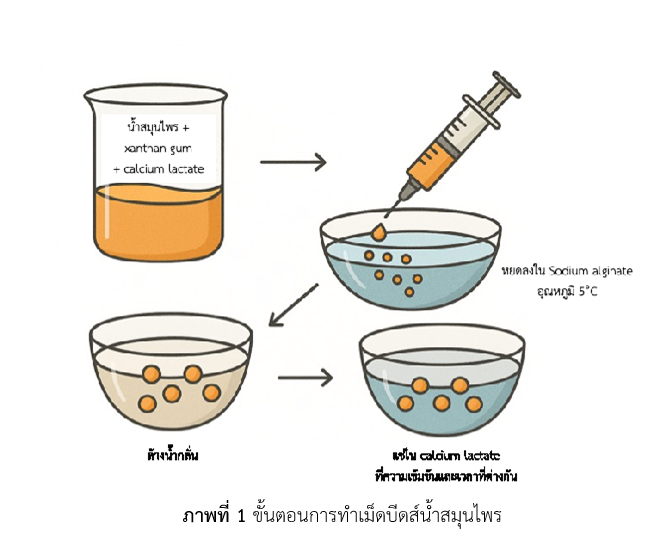
งานวิจัยนี้มีวัตถุประสงค์เพื่อศึกษาสภาวะที่เหมาะสมในการผลิตเม็ดบีดส์ขมิ้นชันผสมน้ำสมุนไพรด้วยเทคนิครีเวิร์สสเฟียริฟิเคชัน ศึกษาสมบัติทางกายภาพ และฤทธิ์ในการต้านอนุมูลอิสระของเม็ดบีดส์ที่มีความเข้มข้นของขมิ้นชันที่แตกต่างกัน 4 ระดับ ได้แก่ ร้อยละ 0 5 10 และ 15 ของน้ำหนักส่วนผสมเม็ดบีดส์ทั้งหมด เมื่อแช่เม็ดบีดส์ใน calcium lactate ที่ความเข้มข้นที่แตกต่างกัน 2 ระดับ (1 กรัม/น้ำ 100 กรัม และ 1.2 กรัม/น้ำ 100 กรัม) นาน 10 นาที และ 15 นาที พบว่า การแช่เม็ดบีดส์ใน calcium lactate ที่ความเข้มข้น 1.2 กรัม/น้ำ100 กรัม เป็นระยะเวลา 15 นาที ส่งผลให้เม็ดบีดส์มีค่าความแข็งสูงที่สุด (0.808±0.052 N) และเม็ดบีดส์มีความสามารถในการบวมน้ำต่ำที่สุดแสดงให้เห็นถึงความแข็งแรงและความหนาของผนังเม็ดบีดส์ โดยที่เม็ดบีดส์ทุกสูตรมีอัตราส่วนด้านยาวด้านสั้นเฉลี่ยไม่แตกต่างกัน (1.19-1.25) เมื่อวิเคราะห์ฤทธิ์ในการต้านอนุมูลอิสระด้วยวิธี FRAP และ ABTS พบว่าการเพิ่มปริมาณขมิ้นชันทำให้เม็ดบีดส์มีฤทธิ์ในการต้านอนุมูลอิสระเพิ่มขึ้นอย่างมีนัยสำคัญทางสถิติ (p<0.05) แสดงให้เห็นว่าขมิ้นชันมีสารออกฤทธิ์ทางชีวภาพที่อาจเป็นประโยชน์ต่อผู้บริโภค ดังนั้นเม็ดบีดส์ขมิ้นชันนี้สามารถนำไปประยุกต์ใช้ในอุตสาหกรรมอาหารและเครื่องดื่มกลุ่มอาหารฟังก์ชั่นได้
Article Details
เอกสารอ้างอิง
ธงชัย ไทรน้อย, สุนิตรา คามีศักดิ์ และอรรถพล รุกขพันธ์. (2563). เอกสารทางวิชาการ ขมิ้นชัน Curcuma longa L. สถาบันวิจัยพืชสวน กรมวิชาการเกษตร.
พัชริน ส่งศร. (2555). ฟักข้าว พืชพื้นบ้านคุณค่าสูงเพื่อสุขภาพ. แก่นเกษตร, 40(1), 1-6.
พัชรี คำประเวช และสุธีรา วัฒนกุล. (2561). การผลิตเม็ดบีดส์น้ำเสาวรสด้วยเทคนิครีเวิร์สสเฟียริฟิเคชัน. วารสารวิทยาศาสตร์และเทคโนโลยี, 26(8), 1381-1393.
Bennacef, C., Desobry, S., Jasniewski, J., Leclerc, S., Probst, L. & Desobry-Banon, S. (2023). Influence of alginate properties and calcium chloride concentration on alginate bead reticulation and size: A phenomenological approach. Polymers, 15(20), 4163. https://doi.org/ 10.3390/polym15204163
Bevan, P., Codina-Torrella, I., Xydia, C., Hammadi, N. E. & Almajano, M. P. (2024). Alginate spheres: Influence of agar and xanthan gum incorporation on membrane stability and permeability. Polymers (Basel), 16(19), 2746. https://doi.org/10.3390/polym16192746
Bortolini, D. G., Maciel, G. M. & Haminiuk, C. W. I. (2024). Edible bubbles: A delivery system for enhanced bioaccessibility of phenolic compounds in red fruits and edible flowers. Innovative Food Science & Emerging Technologies, 91, 103523. https://doi.org/10.1016/j.ifset.2023.103523
Chuacharoen, T. & Sabliov, C. M. (2019). Comparative effects of curcumin when delivered in a nanoemulsion or nanoparticle form for food applications: Study on stability and lipid oxidation inhibition. LWT - Food Science and Technology, 113, 108319. https://doi.org/10.1016/j.lwt.2019.108319
El-Saadony, M. T., Yang, T., Korma, S. A., Sitohy, M., Abd El-Mageed, T. A., Selim, S., Al Jaouni, S. K., Salem, H. M., Mahmmod, Y., Soliman, S. M., Mo’men, S. A. A., Mosa, W. F. A., El-Wafai, N. A., Abou-Aly, H. E., Sitohy, B., Abd El-Hack, M. E., El-Tarabily, K. A. & Saad, A. M. (2023). Impacts of turmeric and its principal bioactive curcumin on human health: Pharmaceutical, medicinal, and food applications: A comprehensive review. Frontiers in Nutrition, 9, 1040259. https://doi.org/10.3389/fnut.2022.1040259
Fan, Z., Li, L. & Bai, X. (2019). Extraction optimization, antioxidant activity, and tyrosinase inhibitory capacity of polyphenols from Lonicera japonica. Food Science & Nutrition, 7(5), 1786-1794. https://doi.org/ 10.1002/fsn3.1021
Lee, P. & Rogers, M. A. (2012). Effect of calcium source and exposure-time on basic caviar spherification using sodium alginate. International Journal of Gastronomy and Food Science, 1(2), 96-100. https://doi.org/10.1016/ j.ijgfs.2013.06.003
Moulick, S. P., Jahan, F., Islam, M. B., Bashera, M. A., Hasan, M. S., Islam, M. J., Ahmed, S., Karmakar, D., Ahmed, F., Saha, T., Dey, S. S., Boby, F., Saha, M., Saha, B. K. & Bhuiyan, M. N. H. (2023). Nutritional characteristics and antiradical activity of turmeric (Curcuma longa L.), beetroot (Beta vulgaris L.), and carrot (Daucus carota L.) grown in Bangladesh. Heliyon, 9(11), e21495. https://doi.org/10.1016/j.heliyon.2023.e21495
Patomchaiviwat, V., Sriamornsak, P., Chansiri, G., Limmatvapirat, S., Supawattanakul, A., Chonganon, T., Keattiteerachai, A. & Piriyaprasarth, S. (2022). Development of edible bubbles of calcium alginate for encapsulating energy drinks. Science, Engineering and Health Studies, 16, 22050018. https://doi.org/10.14456/sehs.2022.42
Patthamakanokporn, O., Puwastien, P., Nitithamyong, A. & Sirichakwal, P, P. (2008). Changes of antioxidant activity and total phenolic compounds during storage of selected fruits. Journal of Food Composition and Analysis, 21(3), 241-248. https://doi.org/10.1016/j.jfca.2007.10.002
Singh, K., Srichairatanakool, S., Chewonarin, T., Prommaban, A., Samakradhamrongthai, R. S., Brennan, M. A., Brennan, C. S. & Utama-ang, N. (2022). Impact of green extraction on Curcuminoid content, antioxidant activities and anti-cancer efficiency (in vitro) from turmeric rhizomes (Curcuma longa L.). Foods, 11(22), https://doi.org/3633.10. 3390/foods11223633
Tsai, F.-H., Chiang, P.-Y., Kitamura, Y., Kokawa, M. & Islam, M. Z. (2017). Producing liquid-core hydrogel beads by reverse spherification: Effect of secondary gelation on physical properties and release characteristics. Food Hydrocolloids, 62, 140–148. https://doi.org/10.1016/j.foodhyd. 2016.07.002
Zibadi, S., Argüelles, M. & Watson, R. R. (2008). Passion fruit (Passiflora edulis): composition, efficacy and safety. Botanical medicine in clinical practice, 761-766. https://doi.org/10.1079/9781845934132.0761
