Socio-Demographic Predictors Of Medical Social Workers’ Awareness Of Their Roles Beyond Advocacy In Healthcare Institutions In Lagos State, Nigeria
DOI:
https://doi.org/10.65680/jahs.v4i1.9147Keywords:
Assessment, Medical Social Worker, Counselling, Care coordination, Care mamagementAbstract
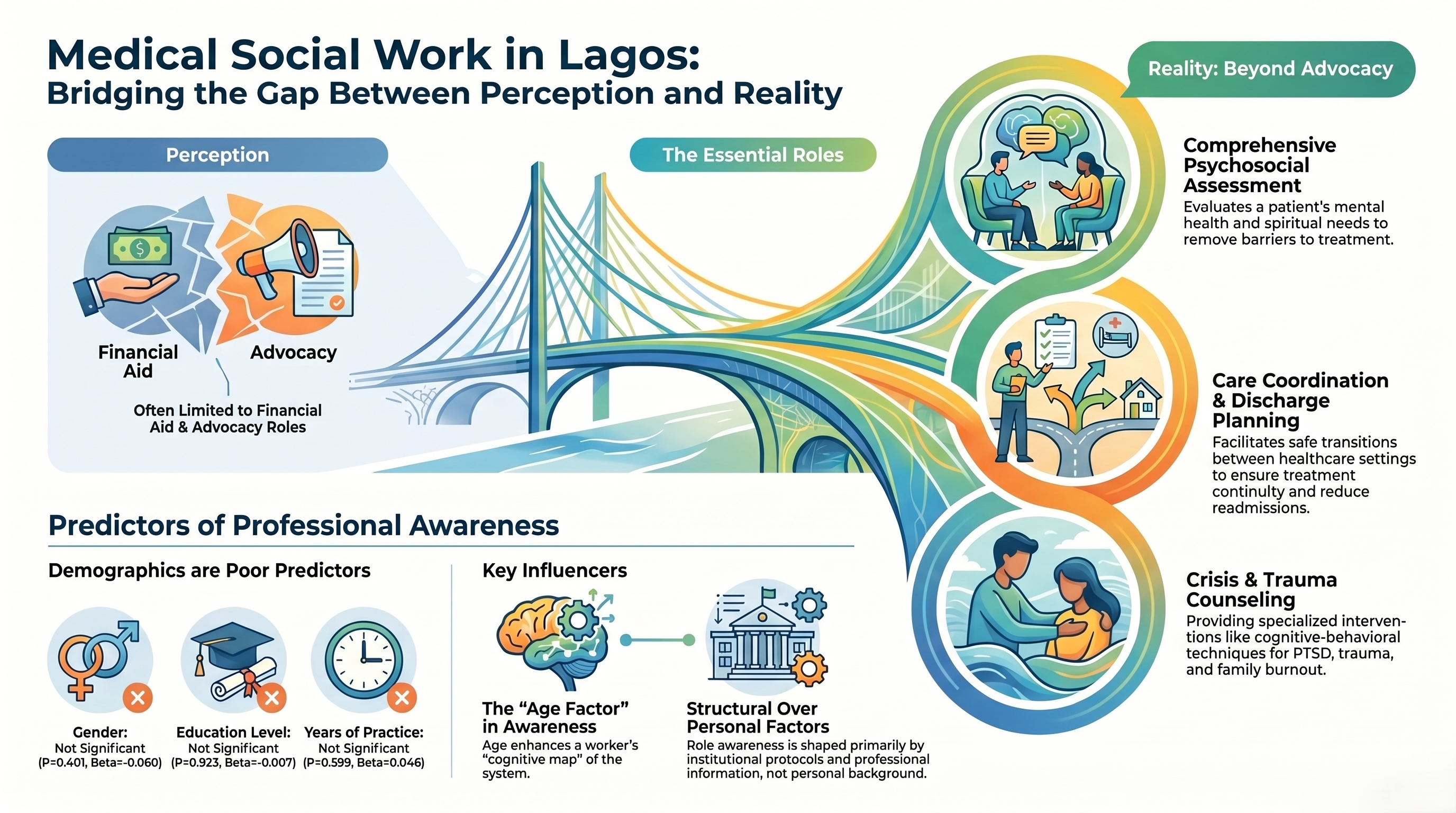
Medical Social Work is essential in healthcare delivery especially in the management of social and mental aspects of health, encouraging social integration, and improving societal well-being. The study investigated the socio-demographic predictors of the awareness of the roles of medical social workers beyond advocacy in Lagos State, Nigeria. The study used a cross-sectional, descriptive survey design with 205 participants, including patients and medical staff from the chosen healthcare facilities. Data were gathered using a structured questionnaire with a reliability coefficient of 0.816 and a stratified sampling technique. The data was analyzed using an inferential statistical method (multiple regression analysis). The findings of the study indicated no significant relative influence of age, gender, level of education, and years of practice of the social workers on the efficiency of their skills (R =.076, R2 = .006, f(4,201) = 0.293; P = .882), while 6.5% of the total variance in social workers’ roles awareness beyond advocacy is accounted for by age, gender, level of education, and years of practice in the selected healthcare institutions in Lagos State. It is therefore, concluded that age, gender, education level, and years of practice often turn out to be poor predictors of awareness of medical social workers’ roles (beyond advocacy) because awareness in this context is shaped more by structural, professional, and informational factors than by personal background characteristics.
References
Abdulgafar, O. A., & Oloruntoba, E. I. (2022). Practice roles and the constraints of social workers in healthcare. Benin Journal of Social Work and Community Development, 5(1), 104–112. https://www.researchgate.net/publication/371607497
Acharya, S. (2018). The study of medical social worker how was this evolved in India and how medical social service officer in AIIMS can changed the problem faced by patients. Acta Scientific Medical Science, 2 (6), 33-36. https://actascientific.com/ASMS/pdf/ASMS-02-0083.pdf
Afolabi, G. O. (2025). Understanding the role performance of medical social workers in Nigeria hospitals: Issues and perspectives. In Ibadan Journal of Adult Education. https://ibadanadulteducationjournals.com.ng/media/2025/01/Understanding-The-Role-Performance-of-Medical-Social-Workers-in-Nigeria-Hospitals-Issues-and-Perspectives.pdf
Agwu, P. & Okoye, U. (2021). Social work and COVID-19: A gap in Nigeria’s intervention. International Social Work, 64(5), 761-770. https://doi.org/10.1177/0020872820980799
Alkayri, A., Alresheedi, A., Almutairi, D., Alrasheedi, N., Alquayri, N., ………… &Alreshidi, M. (2024). Psychosocial Support for Patients with Chronic Illnesses: Roles of Nurses, Social Workers, and Psychologists. International Journal of Computational and Experimental Science and Engineering, 10(4), 2363-2371 https://doi.org/10.22399/ijcesen.4028
Bichi, A. A. (2015). AMSWON makes case for increased social workers in hospitals. Vanguard. http://www.vanguardngr.com/2015/11/amswon-makes-case-forincreased-medical-social-workersin-hospitals/
Biddle, B. J. (1986). Recent developments in role theory. Annual Review of Sociology, 12(1), 67–92. https://doi.org/10.1146/annurev.so.12.080186.000435
Biddle, B. J., & Thomas, E. J. (Eds.). (1966). Role theory: Concepts and research. John Wiley & Sons.https://psycnet.apa.org/record/1966-12199-000
Bronstein, L. R. (2003). A model for interdisciplinary collaboration. Social Work, 48(3), 297–306. https://doi.org/10.1093/sw/48.3.297
Bronfenbrenner, U., & Evans, G. W. (2000). Developmental science in the 21st century: Emerging questions, theoretical models, research designs and empirical findings. Social Development, 9(1), 115–125. https://doi.org/10.1111/1467-9507.00114
Chukwuemerie, C. E., Omosuzi, M. O., & Chukwuemerie, O. C. (2024). Knowledge and perception of the relevance and roles of medical social workers among outpatients’ community of University College Hospital Ibadan, Nigeria. ESP International Journal of Science, Humanities & Management Studies, 2(2), 18–27. https://doi.org/10.56472/25849756/IJSHMS-V2I2P103
Enemaku, O. (2024). Addressing the Challenges of Medical Social Workers in Nigeria: A Study of Hospital-based Care Dynamics. Current Journal of Applied Science and Technology, 43(1), 1–16. https://doi.org/10.9734/cjast/2024/v43i14339
Guy-Evans, O (2020). Bronfenbrenner’s ecological systems theory. Simply Psychology. https://www.simplypsychology.org/bronfenbrenner.html
Heenan, D. A., & Birrell, D. (2018). The integration of health and social care in the UK:Policy and practice. Macmillan Education UK.https://libkoha.alfaisal.edu/cgi-bin/koha/opac-detail.pl?biblionumber=488235
Okoye, U.O., (2013). Social work Practice in Nigerian Healthcare Institutions. University of Nigeria Press.
Okoye, U. O. (2019). Health care social work in Nigeria. In R. Winnett, R. Furman, D. Epps, & G. Lamphear (Eds.), Health care social work: A global perspective (pp. 149–161). Oxford University Press.https://www.researchgate.net/profile/Uzoma-Okoye/publication/335871166_Health_care_social_work_in_Nigeria/links/5d8165a7a6fdcc12cb989275/Health-care-social-work-in-Nigeria.pdf
Yu, Z., Chen, Q., Zheng, G., & Zhu, Y. (2021). Social work involvement in the COVID-19 response in China: Interdisciplinary remote networking. Journal of Social Work, 21(2), 246–256. https://doi.org/10.1177/1468017320945025
Downloads
Published
How to Cite
Issue
Section
License
Copyright (c) 2026 Journal of Applied Humanities Studies

This work is licensed under a Creative Commons Attribution 4.0 International License.
Published articles are copyrighted by the Journal of Applied Humanities Studies.
The contents of each article in this academic journal represent the personal opinions of the individual authors and are not affiliated with the Journal of Applied Humanities Studies or any other editorial team within the publishing house. The responsibility for all content of each article rests with the individual authors. Any errors or omissions are solely the responsibility of each individual author.