Reimagining Human-AI Co-Teaching in Southeast Asian Teacher Education: The CARE Framework for Hybrid Pedagogical Intelligence
DOI:
https://doi.org/10.65680/jahs.v4i1.9138Keywords:
generative artificial intelligence, teacher education, teacher agency, human-AI co-teaching, Southeast AsiaAbstract
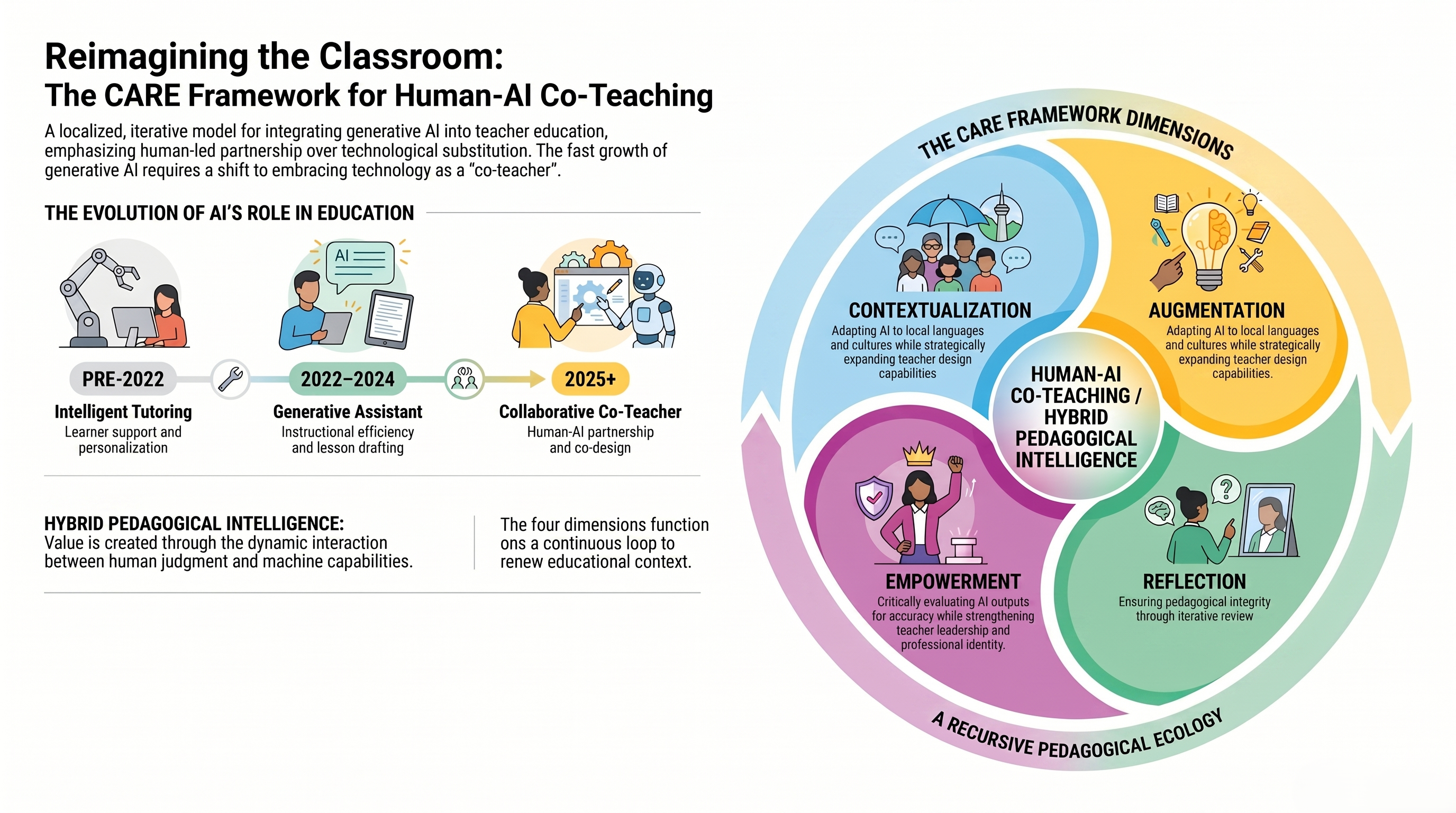
The worldwide teacher education system is currently experiencing transformation because of the fast growth of generative artificial intelligence technology which generates new challenges for teachers regarding their professional decision-making and their ability to create effective teaching methods in AI-based educational settings. Existing research mainly investigates how people use AI technology as a teaching resource while researchers have not studied Human–AI Co-Teaching models that meet academic standards in Southeast Asian educational systems. The article presents a CARE Framework which establishes a conceptual framework for understanding hybrid pedagogical intelligence in teacher education through its components of Contextualization, Augmentation, Reflection, and Empowerment. The article conducts an integrative conceptual review which combines various academic fields by examining teacher education materials and educational technology resources and teacher agency information and learning design resources and hybrid intelligence studies and Global South educational research published between 2016 and 2026. The review uses policy reports and theoretical scholarship together with new research on generative AI in education which exists in international databases and institutional sources that include UNESCO and OECD publications. The synthesis identifies four interrelated dimensions necessary for sustainable Human–AI Co-Teaching and argues that AI integration should be understood as a recursive pedagogical ecology rather than a technological substitution process. The proposed framework establishes a new contribution to international literature through its development of a context-specific model that highlights multilingualism, cultural responsiveness, teacher professionalism, and ethical pedagogical judgment as essential elements of Southeast Asian teacher education. The study presents implications that affect three areas: curriculum redesign, teacher professional development, and future empirical research on human–AI collaboration in diverse educational settings.
References
Alvarez, C., Ruiz, L., Bonilla, J., & Fajardo, Y. (2025). English language teaching in Ecuadorian primary schools: Teacher beliefs in the context of the curriculum reform versus actual practices. International Electronic Journal of Elementary Education, 17(4), 479–490. https://doi.org/10.26822/iejee.2025.393
Barnes, M., & Tour, E. (2026). Teachers’ use of generative AI: A ‘dirty little secret’? Language and Education, 40(1), 24–39. https://doi.org/10.1080/09500782.2025.2485935
Biesta, G., & Tedder, M. (2007). Agency and learning in the lifecourse: Towards an ecological perspective. Studies in the Education of Adults, 39(2), 132–149. https://doi.org/10.1080/02660830.2007.11661545
Brown, T. (2008). Design thinking. Harvard Business Review, 86(6), 84–92. https://www.researchgate.net/publication/5248069_Design_Thinking
Chiu, T. K. F., Bali, S., Tondeur, J., Howard, S., & Chan, K. K. H. (2026). Teacher education for artificial intelligence literacy through a self-determination theory perspective. European Journal of Teacher Education, 1–21. https://doi.org/10.1080/02619768.2026.2621848
Conole, G. (2013). Designing for learning in an open world. Springer. https://doi.org/10.1007/978-1-4419-8517-0
Dellermann, D., Ebel, P., Söllner, M., & Leimeister, J. M. (2019). Hybrid intelligence. Business & Information Systems Engineering, 61(5), 637–643. https://doi.org/10.1007/s12599-019-00595-2
Design-Based Research Collective. (2003). Design-based research: An emerging paradigm for educational inquiry. Educational Researcher, 32(1), 5–8. https://doi.org/10.3102/0013189X032001005
Ding, S., & Magerko, B. (2025). Rethinking AI evaluation in education: The TEACH-AI framework and benchmark for generative AI assistants. ArXiv. https://doi.org/10.48550/arXiv.2512.04107
Dwivedi, Y. K., Kshetri, N., Hughes, L., Slade, E. L., Jeyaraj, A., Kar, A. K., … Wright, R. (2023). So what if ChatGPT wrote it? Multidisciplinary perspectives on opportunities, challenges and implications of generative conversational AI for research, practice and policy. International Journal of Information Management, 71, 102642. https://doi.org/10.1016/j.ijinfomgt.2023.102642
Frøsig, T. B., & Romero, M. (2024). Teacher agency in the age of generative AI: Towards a framework of hybrid intelligence for learning design. ArXiv. https://doi.org/10.48550/arXiv.2407.06655
Gamlem, S. M., McGrane, J., Brandmo, C., Moltudal, S., Sun, S. Z., & Hopfenbeck, T. N. (2026). Exploring pre-service teachers’ attitudes and experiences with generative AI: A mixed methods study in Norwegian teacher education. Educational Psychology, 46(1), 27–51. https://doi.org/10.1080/01443410.2025.2528663
Gay, G. (2018). Culturally responsive teaching: Theory, research, and practice (3rd ed.). Teachers College Press. https://eric.ed.gov/?id=ED581130
Gidiotis, I., & Hrastinski, S. (2026). Imagining the future of artificial intelligence in education: A review of social science fiction. Learning, Media and Technology, 51(1), 35–47. https://doi.org/10.1080/17439884.2024.2365829
Goodyear, P. (2005). Educational design and networked learning: Patterns, pattern languages and design practice. Australasian Journal of Educational Technology, 21(1). https://doi.org/10.14742/ajet.1344
Goodyear, P., & Dimitriadis, Y. (2013). In medias res: Reframing design for learning. Research in Learning Technology, 21. https://doi.org/10.3402/rlt.v21i0.19909
Guan, L., Lee, J. C. K., Zhang, Y., & Gu, M. M. (2025). Investigating the tripartite interaction among teachers, students, and generative AI in EFL education: A mixed-methods study. Computers and Education: Artificial Intelligence, 8, 100384. https://doi.org/10.1016/j.caeai.2025.100384
Hermawan, J., Wijaya, L. I., & Rianawati, A. (2025). Digital transformation for economic growth and SDG 8 alignment in Southeast Asia: A bibliometric analysis and systematic literature review with ADO-TCM framework. Journal of Lifestyle and SDGs Review, 5(2), e04052. https://doi.org/10.47172/2965-730X.SDGsReview.v5.n02.pe04052
Holmes, W., Bialik, M., & Fadel, C. (2019). Artificial intelligence in education: Promises and implications for teaching and learning (2nd ed.). Center for Curriculum Redesign. https://curriculumredesign.org/our-work/artificial-intelligence-in-education/
Hosna, R., Idawati, K., Hanifudin, H., Mahsun, A., Budiarti, E. M., Ilahiyah, I. I., & Mustaji, M. (2026). Development of artificial intelligence-based Akidah Akhlak teaching materials for Islamic senior high schools in Indonesia. Nazhruna: Jurnal Pendidikan Islam, 9(1), 207–226. https://doi.org/10.31538/nzh.v9i1.355
Kadenhe, N., Al Musleh, M., & Lompot, A. (2025). Human-AI co-design and co-creation: A review of emerging approaches, challenges, and future directions. Proceedings of the AAAI Symposium Series, 6(1), 265–270. https://doi.org/10.1609/aaaiss.v6i1.36061
Kasneci, E., Sessler, K., Küchemann, S., Bannert, M., Dementieva, D., Fischer, F., … Kasneci, G. (2023). ChatGPT for good? On opportunities and challenges of large language models for education. Learning and Individual Differences, 103, 102274. https://doi.org/10.1016/j.lindif.2023.102274
Laksanasut, S. (2026). Artificial intelligence in EFL/ESL education: Transforming language learning and teaching through adaptive technology and ethical innovation. International Journal of Sociologies and Anthropologies Science Reviews, 6(1), 211–224. https://doi.org/10.60027/ijsasr.2026.10022
Le-Khanh, H., Do, K., & Tran-Thanh, V. (2024). EFL writing teachers’ agency in response to AI emergence from an ecological perspective. Innovations in Technologies for Language Teaching and Learning, 1159, 79–94. https://doi.org/10.1007/978-3-031-63447-5_5
Le, T. H., Huynh, L., Dang, B., Pham, H. H., Nguyen, N. T. V., & Nguyen, A. (2026). Development and evaluation of artificial intelligence literacy training for teacher education students. British Journal of Educational Technology, 00, 1–32. https://doi.org/10.1111/bjet.70047
Luckin, R., Holmes, W., Griffiths, M., & Forcier, L. B. (2016). Intelligence unleashed: An argument for AI in education. Pearson. https://static.googleusercontent.com/media/edu.google.com/en//pdfs/Intelligence-Unleashed-Publication.pdf
Lund, B., Mannuru, N. R., Teel, Z. A., Lee, T. H., Ortega, N. J., Simmons, S., & Ward, E. (2025). Student perceptions of AI-assisted writing and academic integrity: Ethical concerns, academic misconduct, and use of generative AI in higher education. AI in Education, 1(1), 2. https://doi.org/10.3390/aieduc1010002
Mahmoudi-Dehaki, M., & Nasr-Esfahani, N. (2025). Utilising GenAI to create a culturally responsive EFL curriculum for pre-teen learners in the MENA region. Education 3-13, 53(7), 1175–1189. https://doi.org/10.1080/03004279.2025.2502016
OECD. (2023). OECD digital education outlook 2023: Towards an effective digital education ecosystem. OECD Publishing. https://doi.org/10.1787/c74f03de-en
OECD. (2026). OECD digital education outlook 2026: Human agency and AI in education. OECD Publishing. https://doi.org/10.1787/062a7394-en
Priestley, M., Biesta, G., & Robinson, S. (2015). Teacher agency: An ecological approach. Bloomsbury. http://dx.doi.org/10.5040/9781474219426
Roe, J., & Perkins, M. (2024). Generative AI and agency in education: A critical scoping review and thematic analysis. ArXiv. https://arxiv.org/abs/2411.00631
Rokkones, R. K., & Giannakos, M. (2025). Toward hybrid teaching intelligence: Investigating the potential of teacher–AI collaboration using large language models. Behaviour & Information Technology, 1–19. https://doi.org/10.1080/0144929X.2025.2564368
Romero, M. (2025). From consumption to co-creation: A systematic review of six levels of AI-enhanced creative engagement in education. Multimodal Technologies and Interaction, 9(10), 110. https://doi.org/10.3390/mti9100110
Schön, D. A. (1992). The reflective practitioner: How professionals think in action. Routledge. https://doi.org/10.4324/9781315237473
Snyder, H. (2019). Literature review as a research methodology: An overview and guidelines. Journal of Business Research, 104, 333–339. https://doi.org/10.1016/j.jbusres.2019.07.039
Torraco, R. J. (2005). Writing integrative literature reviews: Guidelines and examples. Human Resource Development Review, 4(3), 356–367. https://doi.org/10.1177/1534484305278283
UNESCO. (2025). Artificial intelligence in education: Key competencies for teachers and learners. UNESCO. https://www.unesco.org/en/articles/artificial-intelligence-education-unesco-advances-key-competencies-teachers-and-learners
UNESCO. (2026). AI competency framework for teachers. UNESCO. https://www.unesco.org/en/articles/ai-competency-framework-teachers
Wiggins, G., & McTighe, J. (2005). Understanding by design (2nd ed.). ASCD. https://doi.org/10.14483/calj.v19n1.11490
Yusuf, H., Money, A., & Daylamani-Zad, D. (2025). Pedagogical AI conversational agents in higher education: A conceptual framework and survey of the state of the art. Educational Technology Research and Development, 73(2), 815–874. https://doi.org/10.1007/s11423-025-10447-4
Downloads
Published
How to Cite
Issue
Section
License
Copyright (c) 2026 Journal of Applied Humanities Studies

This work is licensed under a Creative Commons Attribution 4.0 International License.
Published articles are copyrighted by the Journal of Applied Humanities Studies.
The contents of each article in this academic journal represent the personal opinions of the individual authors and are not affiliated with the Journal of Applied Humanities Studies or any other editorial team within the publishing house. The responsibility for all content of each article rests with the individual authors. Any errors or omissions are solely the responsibility of each individual author.