Psychology of Life Conduct of Private Sector Executives According to Buddhist Philosophy
DOI:
https://doi.org/10.65680/jahs.v4i1.8760Keywords:
Buddhist philosophy, executive psychology, life conduct, mindfulness leadership, organizational behaviorAbstract
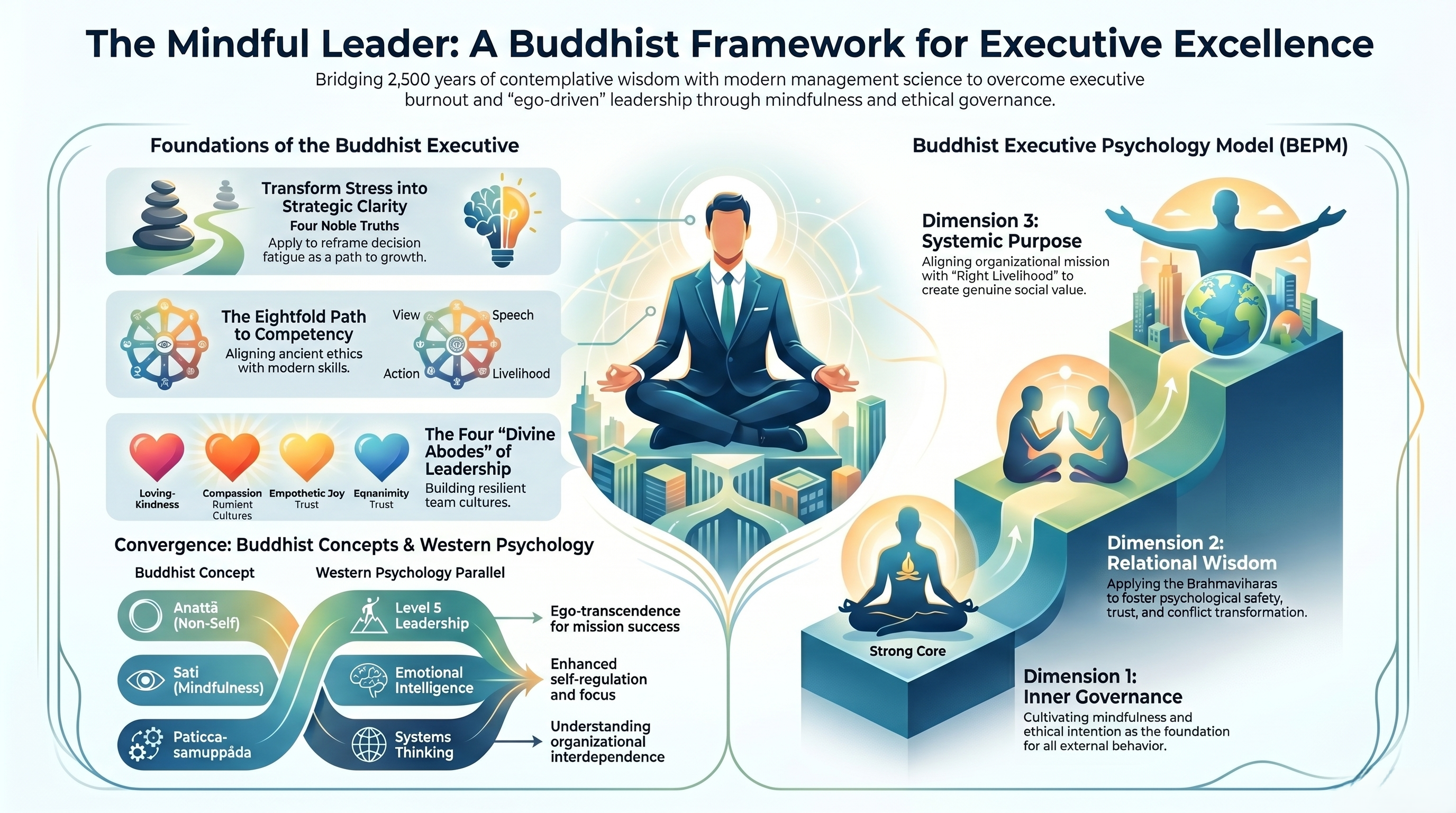
This documentary research examines the psychology of life conduct among private sector executives through the lens of Buddhist philosophy. The study explores how Buddhist psychological principles—particularly the concepts of the Middle Way (Majjhimā Paṭipadā), mindfulness (Sati), wisdom (Paññā), and the Four Brahmaviharas—can systematically guide executive behavior, decision-making, and organizational leadership. The integration of Buddhist psychology with contemporary psychological frameworks such as positive psychology and cognitive-behavioral approaches reveals significant convergences in promoting mental well-being, ethical conduct, and resilient leadership. The research identifies three core dimensions of Buddhist-informed executive life conduct: (1) inner governance through mindfulness and self-regulation, (2) relational conduct through compassionate leadership and ethical communication, and (3) systemic wisdom through Right Livelihood and organizational purpose. Findings indicate that the Four Noble Truths (Ariya Sacca) offer a comprehensive phenomenological account of executive suffering and its transformation; the Noble Eightfold Path (Aṭṭhaṅgika Magga) prescribes systematic ethical and psychological development aligned with core leadership competencies; and the Four Brahmaviharas cultivate the relational capacities essential to effective organizational leadership. The study proposes a conceptual framework—the Buddhist Executive Psychology Model (BEPM)—synthesizing classical Buddhist teachings with modern organizational psychology to guide executive development in Thai and ASEAN corporate contexts. The BEPM is organized around three integrated dimensions: inner governance (mindfulness and ethical intention), relational wisdom (the Brahmaviharas in organizational relationships), and systemic purpose (Right Livelihood and interdependence). This research contributes to the growing literature on contemplative leadership, Buddhist psychology in applied settings, and the integration of Eastern philosophical traditions into management science and organizational behavior.
References
Best, J. W., & Kahn, J. V. (2006). Research in education (10th ed.). Pearson Education.
Bodhi, B. (2011). The noble eightfold path: Way to the end of suffering. Buddhist Publication Society.
Boyatzis, R., & McKee, A. (2005). Resonant leadership: Renewing yourself and connecting with others through mindfulness, hope, and compassion. Harvard Business School Press.
Cheng, B. S., Chou, L. F., Wu, T. Y., Huang, M. P., & Farh, J. L. (2004). Paternalistic leadership and subordinate responses: Establishing a leadership model in Chinese organizations. Asian Journal of Social Psychology, 7(1), 89–117. https://doi.org/10.1111/j.1467-839X.2004.00137.x
Collins, J. (2001). Good to great: Why some companies make the leap and others don't. HarperBusiness.
Davidson, R. J., & Begley, S. (2012). The emotional life of your brain: How its unique patterns affect the way you think, feel, and live—and how you can change them. Hudson Street Press.
Deci, E. L., & Ryan, R. M. (2000). The 'what' and 'why' of goal pursuits: Human needs and the self-determination of behavior. Psychological Inquiry, 11(4), 227–268. https://doi.org/10.1207/S15327965PLI1104_01
de Silva, P. (2010). An introduction to Buddhist psychology and counselling: Pathways of mindfulness-based therapies (4th ed.). Palgrave Macmillan.
Edmondson, A. C. (2018). The fearless organization: Creating psychological safety in the workplace for learning, innovation, and growth. Wiley.
Gardner, H. (1983). Frames of mind: The theory of multiple intelligences. Basic Books.
Goleman, D. (2000). Leadership that gets results. Harvard Business Review, 78(2), 78–90.
Greenleaf, R. K. (1977). Servant leadership: A journey into the nature of legitimate power and greatness. Paulist Press.
Hanh, T. N. (2008). The world we have: A Buddhist approach to peace and ecology. Parallax Press.
Heifetz, R., Grashow, A., & Linsky, M. (2009). The practice of adaptive leadership: Tools and tactics for changing your organization and the world. Harvard Business Press.
Hölzel, B. K., Carmody, J., Vangel, M., Congleton, C., Yerramsetti, S. M., Gard, T., & Lazar, S. W. (2011). Mindfulness practice leads to increases in regional brain gray matter density. Psychiatry Research: Neuroimaging, 191(1), 36–43. https://doi.org/10.1016/j.pscychresns.2010.08.006
Kets de Vries, M. F. R. (2014). The leadership mystique: Leading behavior in the human enterprise (2nd ed.). Pearson.
Komin, S. (1990). Psychology of the Thai people: Values and behavioral patterns. Research Center, National Institute of Development Administration.
Lawler, J. J., & Atmiyanandana, V. (2004). HRM in Thailand: A post-1997 update. Asia Pacific Business Review, 10(2), 268–288. https://doi.org/10.1080/1360238042000255560
Luthans, F., & Avolio, B. J. (2003). Authentic leadership development. In K. S. Cameron, J. E. Dutton, & R. E. Quinn (Eds.), Positive organizational scholarship: Foundations of a new discipline (pp. 241–258). Berrett-Koehler.
Prayoon, M. (2018). Buddhist ethics and corporate governance in Thai organizations. Journal of Buddhist Ethics, 25, 439–468.
Purser, R. E., & Loy, D. (2013). Beyond McMindfulness. Huffington Post. https://www.huffpost.com/entry/beyond-mcmindfulness_b_3519289
Reitz, M., & Chaskalson, M. (2016). Mindfulness works but only if you work at it. Harvard Business Review. https://hbr.org/2016/11/mindfulness-works-but-only-if-you-work-at-it
Seligman, M. E. P., & Csikszentmihalyi, M. (2000). Positive psychology: An introduction. American Psychologist, 55(1), 5–14. https://doi.org/10.1037/0003-066X.55.1.5
Senge, P. M. (2006). The fifth discipline: The art and practice of the learning organization (Rev. ed.). Doubleday.
Sternberg, R. J. (1998). A balance theory of wisdom. Review of General Psychology, 2(4), 347–365. https://doi.org/10.1037/1089-2680.2.4.347
Suchart, T. (2020). Buddhist psychology and leadership effectiveness in Thai private enterprises. Journal of Applied Humanities Studies, 3(1), 45–62.
Thomas, J., & Harden, A. (2008). Methods for the thematic synthesis of qualitative research in systematic reviews. BMC Medical Research Methodology, 8(1), 45. https://doi.org/10.1186/1471-2288-8-45
Worline, M. C., & Dutton, J. E. (2017). Awakening compassion at work: The quiet power that elevates people and organizations. Berrett-Koehler.
Downloads
Published
How to Cite
Issue
Section
License
Copyright (c) 2026 Journal of Applied Humanities Studies

This work is licensed under a Creative Commons Attribution 4.0 International License.
Published articles are copyrighted by the Journal of Applied Humanities Studies.
The contents of each article in this academic journal represent the personal opinions of the individual authors and are not affiliated with the Journal of Applied Humanities Studies or any other editorial team within the publishing house. The responsibility for all content of each article rests with the individual authors. Any errors or omissions are solely the responsibility of each individual author.