The Role of Belief in Isan Literature in Shaping Social Norms in Northeastern Thai Society
DOI:
https://doi.org/10.65680/jahs.v4i1.8655Keywords:
Isan Literature, Belief Systems, Social Norms, Cultural Identity, Northeastern ThailandAbstract
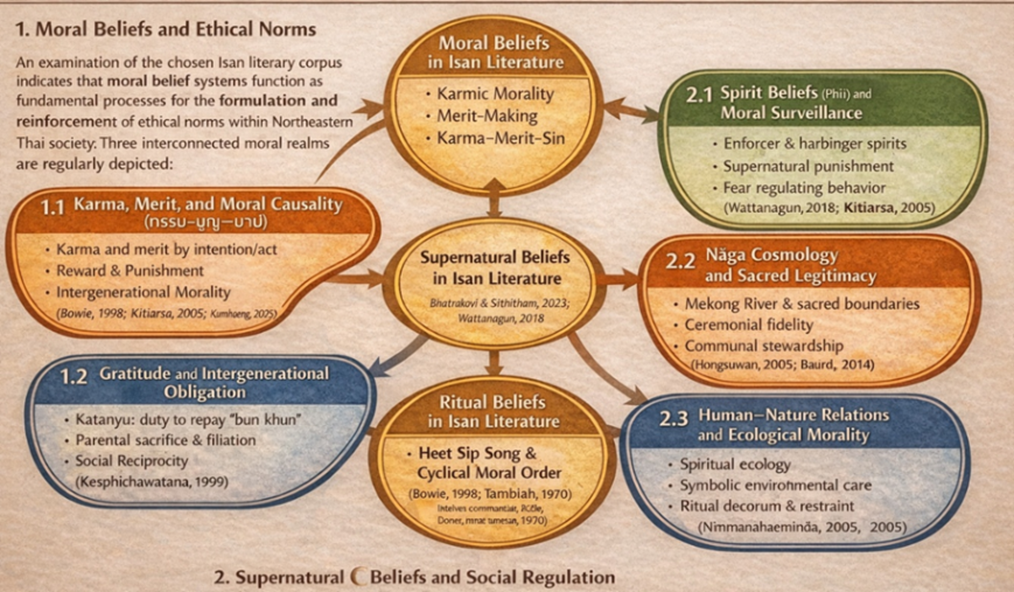
This study investigates the influence of belief systems in Isan literature on the formation of social norms within Northeastern Thai society. Utilizing a documentary research design and qualitative textual analysis, the study examines specific Isan literary texts, encompassing folktales, didactic narratives, and ritual-related literature, to investigate the representation and function of beliefs within the social structure. Utilizing social norm theory and sociological literary criticism, the study examines how moral, supernatural, and ritual ideas within these narratives facilitate the formation and reinforcement of normative conduct.
The findings indicate that Isan literature serves not just as a cultural product but also as a normative framework that imparts moral ideals, governs social behavior, and preserves communal identity. Beliefs about karma, merit-making, gender roles, ancestral spirits, and holy cosmology serve as symbolic processes that validate societal norms and communal duties. Moreover, these literary belief systems persist in shaping modern social activities, especially in rural areas where ancient rites and moral norms are essential to daily existence.
The study posits that Isan literature functions as an applied humanities resource that connects narrative tradition with experienced social reality, illustrating the influence of cultural belief systems on normative structures over generations.
References
Akkaphrom, P. C. Y. (2018). (2018). Sang Sin Chai: using folk-literature in the process of creating community-based theatre. Journal of Fine and Applied Arts Khon Kaen University, 10(2), 124–142. Retrieved from https://so02.tci-thaijo.org/index.php/fakku/article/view/166761
Baird, I. G. (2014). The cult of Phaya Narin Songkhram: Spirit mediums and shifting sociocultural boundaries in northeastern Thailand. Journal of Southeast Asian Studies, 45(1), 50–73. https://doi.org/10.1017/S0022463413000593
Bhatrakavi, P. A., & Sitthitham, J. (2023). Ecological Tradition Perspective on Heet Sipsong – The Isan Twelve-Month Traditions. Journal of Man and Society, 8(2), 87–106. Retrieved from https://so06.tci-thaijo.org/index.php/husocjournal/article/view/259023
Bicchieri, C. (2006). The grammar of society: The nature and dynamics of social norms. Cambridge University Press.
Bowen, G. A. (2009). Document analysis as a qualitative research method. Qualitative Research Journal, 9(2), 27–40. https://doi.org/10.3316/QRJ0902027
Bowie, K. A. (1998). The alchemy of charity: Of class and Buddhism in northern Thailand. American Anthropologist, 100(2), 469–481. https://doi.org/10.1525/aa.1998.100.2.469
Braun, V., & Clarke, V. (2006). Using thematic analysis in psychology. Qualitative Research in Psychology, 3(2), 77–101. https://doi.org/10.1191/1478088706qp063oa
Burke, K. (1941). Literature as equipment for living. In The philosophy of literary form: Studies in symbolic action (pp. 293–304). University of California Press.
Cialdini, R. B., Reno, R. R., & Kallgren, C. A. (1990). A focus theory of normative conduct: Recycling the concept of norms to reduce littering in public places. Journal of Personality and Social Psychology, 58(6), 1015–1026. https://doi.org/10.1037/0022-3514.58.6.1015
Durkheim, E. (1995). The elementary forms of religious life (K. E. Fields, Trans.). Free Press. (Original work published in 1912)
Geertz, C. (1973). The interpretation of cultures: Selected essays. Basic Books.
Gelfand, M. J., Raver, J. L., Nishii, L., Leslie, L. M., Lun, J., Lim, B. C., & Van de Vliert, E. (2011). Differences between tight and loose cultures: A 33-nation study. Science, 332(6033), 1100–1104. https://doi.org/10.1126/science.1197754
Gross, J., & Vostroknutov, A. (2022). Why do people follow social norms? Current Opinion in Psychology, 44, 1–6. https://doi.org/10.1016/j.copsyc.2021.08.016
Hechter, M. (2018). Norms in the evolution of social order. Social Research, 85(1), 23–51. https://doi.org/10.1353/sor.2018.0003
Hongsuwan, P. (2005). The myths of the Buddha’s relics of the Tai people: Reflections on the relationship between Buddhism and indigenous beliefs. Manusya: Journal of Humanities, 8(9), 1–14. https://doi.org/10.1163/26659077-00803001
Jaruworn, P. (2005). The roles of the Buddha in Thai myths: Reflections on the attempt to integrate Buddhism into Thai local beliefs. Manusya: Journal of Humanities, 8(9), 15–26. https://doi.org/10.1163/26659077-00803002
Kallgren, C. A., Reno, R. R., & Cialdini, R. B. (2000). A focus theory of normative conduct: When norms do and do not affect behavior. Personality and Social Psychology Bulletin, 26(8), 1002–1012. https://doi.org/10.1177/01461672002610009
Kesphichawatana, J. (1999). Katanyu Katavedi and caregiving for frail elderly parents: The perspectives of Thai families in metropolitan Bangkok. Journal of Nursing Research, Innovation, and Health, 11(3), 51–64. https://digital.car.chula.ac.th/cuns/vol11/iss3/6/
Khunarak, K. (2022). Pali and Sanskrit words in the Isan folktale “The legend of Phadaeng Nang Ai.” Journal of the Institute of Trainer Monk Development, 5(3), 233–242. https://so06.tci-thaijo.org/index.php/tmd/article/view/258481
Kitiarsa, P. (2005). Magic monks and spirit mediums in the politics of Thai popular religion. Inter-Asia Cultural Studies, 6(2), 209–226. https://doi.org/10.1080/14649370500065920
Kumhaeng, K. (2025). Context shift, word drift: The meaning transference of the word prèet in Thai society. Humanities and Social Sciences Communications, 12, Article 1050. https://doi.org/10.1057/s41599-025-05454-y
Morris, M. W., Hong, Y.-Y., Chiu, C.-Y., & Liu, Z. (2015). Normology: Integrating insights about social norms to understand cultural dynamics. Organizational Behavior and Human Decision Processes, 129, 1–13. https://doi.org/10.1016/j.obhdp.2015.03.001
Nimmanahaeminda, P. (2005). Water lore: Thai-Tai folk beliefs and literature. Manusya: Journal of Humanities, 8(9), 27–39. https://digital.car.chula.ac.th/manusya/vol8/iss9/3/
Opp, K.-D. (2001). How do norms emerge? An outline of a theory. Mind & Society, 2, 101–128. https://doi.org/10.1007/BF02512077
Parsons, T. (1951). The social system. Free Press.
Pinthongvijayakul, V. (2018). Personhood and political subjectivity through ritual enactment in Isan (northeast Thailand). Journal of Southeast Asian Studies, 49(1), 63–83. https://doi.org/10.1017/S0022463417000698
Sukrak, S., & Jaengsawang, S. (2025). Women in Thai-Lao manuscript culture: Alternative worship of text(iles) in support of monkhood. Southeast Asian Studies, 14(3), 437–467. https://doi.org/10.20495/seas.25007
Sungkhapantanont, T., & Nunphooban, S. (2017). The conception of the world creation myths is contained in the Isan folk literature. Manusya: Journal of Humanities, 20(1), 52–67. Retrieved from https://digital.car.chula.ac.th/manusya/vol20/iss1/4
Tambiah, S. J. (1970). Buddhism and the spirit cults in north-east Thailand. Cambridge University Press. https://noolaham.net/project/992/99181/99181.pdf
Wattanagun, K. (2018). The phenomenology of supernatural belief: The ravenous spirit (phii pob) belief tradition in contemporary northeast Thailand. Asian Ethnology, 77(1–2), 79–97. https://asianethnology.scholasticahq.com/article/149895
Downloads
Published
How to Cite
Issue
Section
License
Copyright (c) 2026 Journal of Applied Humanities Studies

This work is licensed under a Creative Commons Attribution 4.0 International License.
Published articles are copyrighted by the Journal of Applied Humanities Studies.
The contents of each article in this academic journal represent the personal opinions of the individual authors and are not affiliated with the Journal of Applied Humanities Studies or any other editorial team within the publishing house. The responsibility for all content of each article rests with the individual authors. Any errors or omissions are solely the responsibility of each individual author.