Local Belief Systems and Cultural Learning in Northeastern Thailand: Animism and Social Norm Formation
DOI:
https://doi.org/10.65680/jahs.v4i1.8654Keywords:
Animism, Cultural learning, Social norms, Indigenous knowledge, Northeastern ThailandAbstract
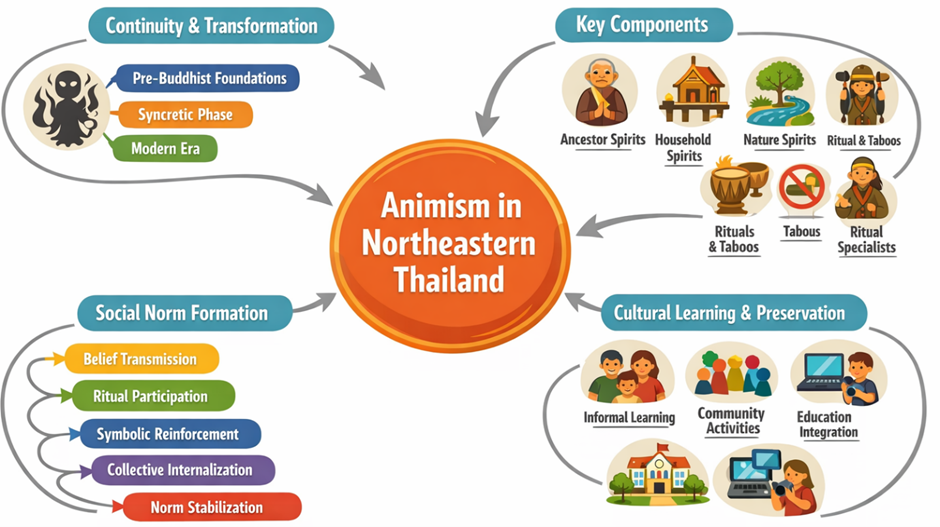
This documentary investigation examines animism as a regional belief system and a means of cultural education in Northeastern Thailand, highlighting its significance in the establishment of societal norms. Despite extensive examination of animism in anthropological research, its role as an informal educational mechanism that influences collective values and governs social conduct is still insufficiently investigated. This study seeks to examine the historical evolution of animism in Northeastern Thailand, delineate its primary forms and elements, elucidate its role in the construction of social norms, and explore its ramifications for modern cultural education.
Data were gathered from historical sources, anthropological literature, religious studies, and local cultural records, and subsequently examined through content and thematic analysis. The results indicate that animism in Northeastern Thailand developed through indigenous customs, syncretic amalgamation with Buddhism, and adaptation to contemporary socio-cultural environments. Fundamental components—such as ancestor veneration, spiritual beliefs, ritualistic behaviors, and communal prohibitions—function as conduits for the transfer of beliefs and the internalization of social norms. Animism instills moral standards into daily life by ritual participation and symbolic reinforcement, therefore maintaining community norms.
The study suggests that animism operates as an informal cultural learning mechanism that preserves social cohesion and facilitates intergenerational information transfer. Acknowledging its educational aspect offers significant insights for intercultural and community-oriented learning in modern Thai culture.
References
Baird, I. G. (2014). The cult of Phaya Narin Songkhram: Spirit mediums and shifting sociocultural boundaries in northeastern Thailand. Journal of Southeast Asian Studies, 45(1), 50–73. https://doi.org/10.1017/S0022463413000593
Berkes, F., Colding, J., & Folke, C. (2000). Rediscovery of traditional ecological knowledge as adaptive management. Ecological Applications, 10(5), 1251–1262. https://doi.org/10.2307/2641280
Bird-David, N. (1999). “Animism” revisited: Personhood, environment, and relational epistemology. Current Anthropology, 40(S1), S67–S91. https://doi.org/10.1086/200061
Cialdini, R. B., Reno, R. R., & Kallgren, C. A. (1990). A focus theory of normative conduct: Recycling the concept of norms to reduce littering in public places. Journal of Personality and Social Psychology, 58(6), 1015–1026. https://doi.org/10.1037/0022-3514.58.6.1015
Cohen, E. (2020). Spirit mediumship and the state in mainland Southeast Asia: A comparative perspective. Journal of Southeast Asian Studies, 51(1–2), 72–94. https://doi.org/10.1017/S0022463420000223
Fukuura, K. (2011). A ritual community: The religious practices of spirit mediums who worship the spirit of the Chiang Mai city pillar. Sojourn: Journal of Social Issues in Southeast Asia, 26(1), 105–127. https://doi.org/10.1355/sj26-1f
Gelfand, M. J., Nunn, N., & Gavrilets, S. (2024). Norm dynamics: Interdisciplinary perspectives on social norm emergence, persistence, and change. Annual Review of Psychology, 75, 341–367. https://doi.org/10.1146/annurev-psych-033020-013319
Henrich, J., & Gil-White, F. J. (2001). The evolution of prestige: Freely conferred deference as a mechanism for enhancing the benefits of cultural transmission. Evolution and Human Behavior, 22(3), 165–196. https://doi.org/10.1016/S1090-5138(00)00071-4
Ingold, T. (2006). Rethinking the animate, re-animating thought. Ethnos, 71(1), 9–20. https://doi.org/10.1080/00141840600603111
Irvine, W. (1984). Decline of village spirit cults and growth of urban spirit mediumship: The persistence of spirit beliefs, the position of women, and modernization. Mankind, 14(4), 315–324. https://doi.org/10.1111/j.1835-9310.1984.tb00988.x
Kirsch, A. T. (1977). Complexity in the Thai religious system: An interpretation. The Journal of Asian Studies, 36(2), 241–266. https://doi.org/10.2307/2053722
Kitiarsa, P. (2005). Beyond syncretism: Hybridization of popular religion in contemporary Thailand. Journal of Southeast Asian Studies, 36(3), 461–487. https://doi.org/10.1017/S0022463405000251
Legare, C. H., & Nielsen, M. (2015). Imitation and innovation: The dual engines of cultural learning. Trends in Cognitive Sciences, 19(11), 688–699. https://doi.org/10.1016/j.tics.2015.08.005
Mesoudi, A., Whiten, A., & Laland, K. N. (2006). Towards a unified science of cultural evolution. Behavioral and Brain Sciences, 29(4), 329–347. https://doi.org/10.1017/S0140525X06009083
Nilsen, M. (2011). The spirit of a heroine: Ya Mo—Spirit reverence, patriotism, and Thai Buddhism. Modern Asian Studies, 45(6), 1599–1625. https://doi.org/10.1017/S0026749X09000122
Norenzayan, A., Shariff, A. F., Gervais, W. M., Willard, A. K., McNamara, R. A., Slingerland, E., & Henrich, J. (2016). The cultural evolution of prosocial religions. Behavioral and Brain Sciences, 39, e1. https://doi.org/10.1017/S0140525X14001356
Paradise, R., & Rogoff, B. (2009). Side by side: Learning by observing and pitching in. Ethos, 37(1), 102–138. https://doi.org/10.1111/j.1548-1352.2009.01033.x
Pinthongvijayakul, V. (2018). Personhood and political subjectivity through ritual enactment in Isan (northeast Thailand). Journal of Southeast Asian Studies, 49(1), 63–83. https://doi.org/10.1017/S0022463417000698
Pinthongvijayakul, V. (2019). Performing alterity of desire: Bodiliness and sexuality in spirit mediumship in Northeast Thailand. American Anthropologist, 121(1), 101–112. https://doi.org/10.1111/aman.13160
Porath, N., & Vaddhanaphuti, C. (2017). Animism and personal religion in Southeast Asia. Bijdragen tot de Taal-, Land- en Volkenkunde / Journal of the Humanities and Social Sciences of Southeast Asia, 173(4), 552–558. https://doi.org/10.1163/22134379-17304005
Ruengmak, A., & Dejpawuttikul, T. (2024). The emergence of the ‘Ai Khai’ worship and the social revival in post-COVID-19 southern Thailand: the interplay between local folklore and sacred tourism. Cogent Arts & Humanities, 11(1). https://doi.org/10.1080/23311983.2024.2313845
Tomasello, M., Kruger, A. C., & Ratner, H. H. (1993). Cultural learning. Behavioral and Brain Sciences, 16(3), 495–552. https://doi.org/10.1017/S0140525X0003123X
Wenzel, M., & Woodyatt, L. (2025). The power and pitfalls of social norms. Annual Review of Psychology, 76, 583–606. https://doi.org/10.1146/annurev-psych-020124-120310
Downloads
Published
How to Cite
Issue
Section
License
Copyright (c) 2026 Journal of Applied Humanities Studies

This work is licensed under a Creative Commons Attribution 4.0 International License.
Published articles are copyrighted by the Journal of Applied Humanities Studies.
The contents of each article in this academic journal represent the personal opinions of the individual authors and are not affiliated with the Journal of Applied Humanities Studies or any other editorial team within the publishing house. The responsibility for all content of each article rests with the individual authors. Any errors or omissions are solely the responsibility of each individual author.