End of Life: Preparing Body, Mind, and Society for a Peaceful Death
DOI:
https://doi.org/10.65680/jahs.v4i1.8517Keywords:
peaceful death, end-of-life care, Buddhist psychology, palliative care, elderly ThailandAbstract
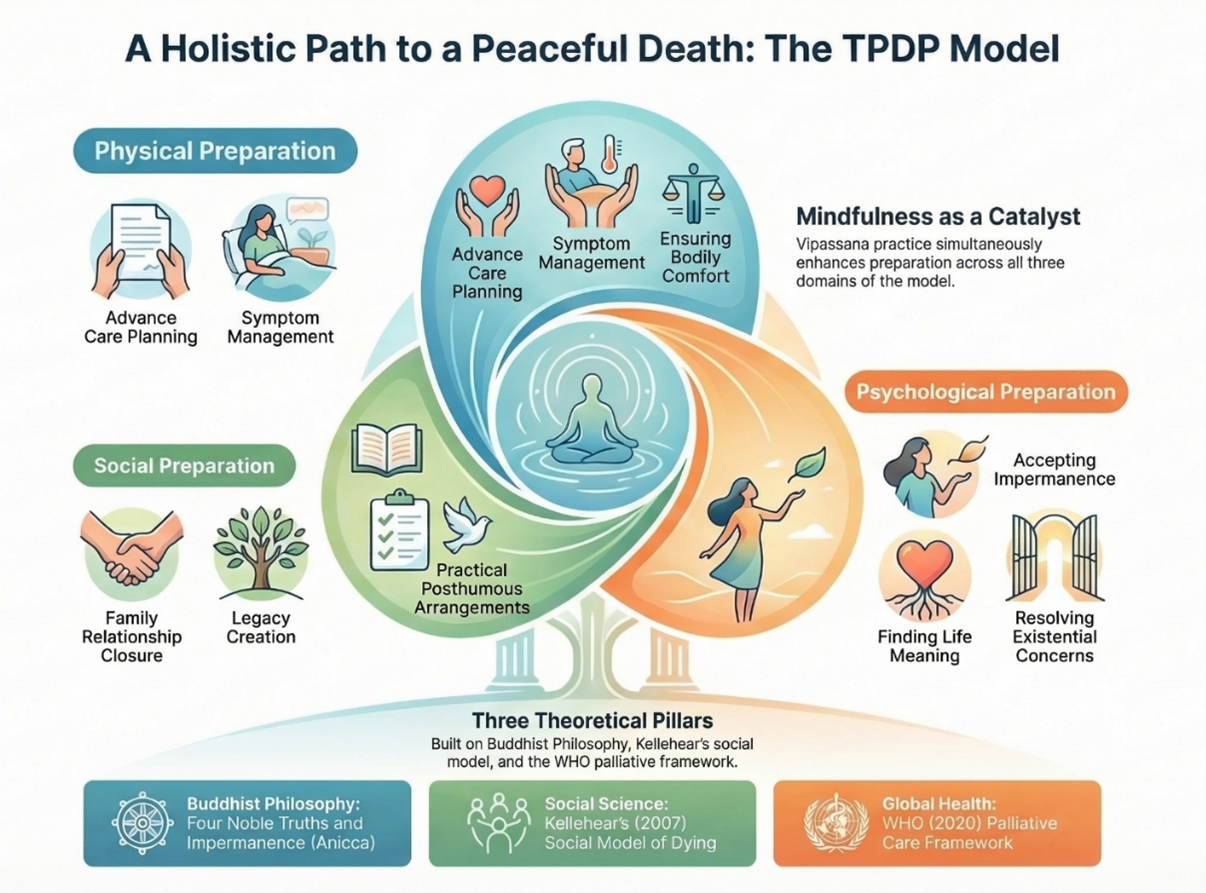
This mixed-methods research aimed to: (1) investigate the levels of physical, psychological, and social preparation for a peaceful death among elderly people in Thai Buddhist communities; (2) examine factors influencing peaceful death preparation; and (3) develop a conceptual model for holistic end-of-life preparation integrating Buddhist psychology and modern palliative care principles. The research population comprised elderly individuals aged 60 years and above residing in Buddhist communities in Central Thailand. A stratified random sampling technique was employed to select 420 participants for the quantitative phase, while purposive sampling was used to select 30 key informants for the qualitative phase. Research instruments included a validated questionnaire (IOC = 0.89, Cronbach's alpha = 0.91) and semi-structured interview guidelines. Data were collected during October 2024 to January 2025. Quantitative data were analyzed using descriptive statistics, Pearson correlation, and multiple regression analysis. Qualitative data were analyzed using thematic analysis and triangulation. Results indicated that overall peaceful death preparation was at a high level (Mean = 3.78, SD = 0.62). Physical preparation (Mean = 3.85, SD = 0.58) was highest, followed by social preparation (Mean = 3.76, SD = 0.71) and psychological preparation (Mean = 3.73, SD = 0.69). Buddhist mindfulness practice, family support, and access to palliative care services were significant predictors of peaceful death preparation (p < 0.001). The developed holistic model, the Triadic Peaceful Death Preparation Model (TPDP), integrates Dhamma practice, social connectedness, and medical care. Findings suggest that integrating Buddhist psychological principles with contemporary palliative care can significantly enhance quality of dying among Thai elderly populations.
References
Braun, V., & Clarke, V. (2006). Using thematic analysis in psychology. Qualitative Research in Psychology, 3(2), 77–101. https://doi.org/10.1191/1478088706qp063oa DOI: https://doi.org/10.1191/1478088706qp063oa
Byock, I. (1997). Dying well: The prospect for growth at the end of life. Riverhead Books.
Chochinov, H. M. (2002). Dignity-conserving care—A new model for palliative care: Helping the patient feel valued. JAMA, 287(17), 2253–2260. https://doi.org/10.1001/jama.287.17.2253 DOI: https://doi.org/10.1001/jama.287.17.2253
Chochinov, H. M. (2012). Dignity therapy: Final words for final days. Oxford University Press. DOI: https://doi.org/10.1093/acprof:oso/9780195176216.001.0001
Creswell, J. W., & Plano Clark, V. L. (2018). Designing and conducting mixed methods research (3rd ed.). SAGE Publications.
Department of Mental Health, Thailand. (2022). Annual survey on mental health and aging in Thailand 2022. Ministry of Public Health.
Greenberg, J., Pyszczynski, T., & Solomon, S. (1986). The causes and consequences of a need for self-esteem: A terror management theory. In R. F. Baumeister (Ed.), Public self and private self (pp. 189–212). Springer. https://doi.org/10.1007/978-1-4613-9564-5_10 DOI: https://doi.org/10.1007/978-1-4613-9564-5_10
Harvey, P. (2000). An introduction to Buddhist ethics: Foundations, values and issues. Cambridge University Press. DOI: https://doi.org/10.1017/CBO9780511800801
Health Systems Research Institute. (2022). Palliative care access and quality in Thailand: A national assessment (HSRI Report No. 65-018).
Kellehear, A. (2007). A social history of dying. Cambridge University Press. DOI: https://doi.org/10.1017/CBO9780511481352
Keown, D. (2005). End of life: The Buddhist view. The Lancet, 366(9489), 952–955. https://doi.org/10.1016/S0140-6736(05)67323-0 DOI: https://doi.org/10.1016/S0140-6736(05)67323-0
Krause, N. (2005). God-mediated control and psychological well-being in late life. Research on Aging, 27(2), 136–164. https://doi.org/10.1177/0164027504270475 DOI: https://doi.org/10.1177/0164027504270475
National Statistical Office of Thailand. (2023). Report on the survey of older persons in Thailand 2023.
Neimeyer, R. A. (Ed.). (1994). Death anxiety handbook: Research, instrumentation, and application. Taylor & Francis.
Payutto, P. A. (Phra Brahmagunabhorn). (2016). Buddhadhamma: The laws of nature and their benefits to life (Extended ed.). Mahachulalongkornrajavidyalaya University Press.
Rovinelli, R. J., & Hambleton, R. K. (1977). On the use of content specialists in the assessment of criterion-referenced test item validity. Dutch Journal of Educational Research, 2, 49–60.
Steinhauser, K. E., Clipp, E. C., McNeilly, M., Christakis, N. A., McIntyre, L. M., & Tulsky, J. A. (2000). In search of a good death: Observations of patients, families, and providers. Annals of Internal Medicine, 132(10), 825–832. https://doi.org/10.7326/0003-4819-132-10-200005160-00011 DOI: https://doi.org/10.7326/0003-4819-132-10-200005160-00011
Suwannapong, K., Thanasilp, S., Pudtong, N., Akkayagorn, L., Stithyudhakarn, S., Tantitrakul, W., Doutrich, D., & Upasen, R. (2024). Influencing factors on death acceptance among Thai older persons. Clinical Gerontologist, 49(2), 473–480. https://doi.org/10.1080/07317115.2024.2337118 DOI: https://doi.org/10.1080/07317115.2024.2337118
Upasen, R., & Thanasilp, S. (2020). Death acceptance from a Thai Buddhist perspective: A qualitative study. European Journal of Oncology Nursing, 49, 101833. https://doi.org/10.1016/j.ejon.2020.101833 DOI: https://doi.org/10.1016/j.ejon.2020.101833
Wink, P., & Scott, J. (2005). Does religiousness buffer against the fear of death and dying in late adulthood? Findings from a longitudinal study. The Journals of Gerontology: Series B, 60(4), P207–P214. https://doi.org/10.1093/geronb/60.4.P207 DOI: https://doi.org/10.1093/geronb/60.4.P207
World Health Organization. (2020). Palliative care: Key facts. https://www.who.int/news-room/fact-sheets/detail/palliative-care
Yamane, T. (1967). Statistics: An introductory analysis (2nd ed.). Harper & Row.
Downloads
Published
How to Cite
Issue
Section
License
Copyright (c) 2026 Journal of Applied Humanities Studies

This work is licensed under a Creative Commons Attribution 4.0 International License.
Published articles are copyrighted by the Journal of Applied Humanities Studies.
The contents of each article in this academic journal represent the personal opinions of the individual authors and are not affiliated with the Journal of Applied Humanities Studies or any other editorial team within the publishing house. The responsibility for all content of each article rests with the individual authors. Any errors or omissions are solely the responsibility of each individual author.