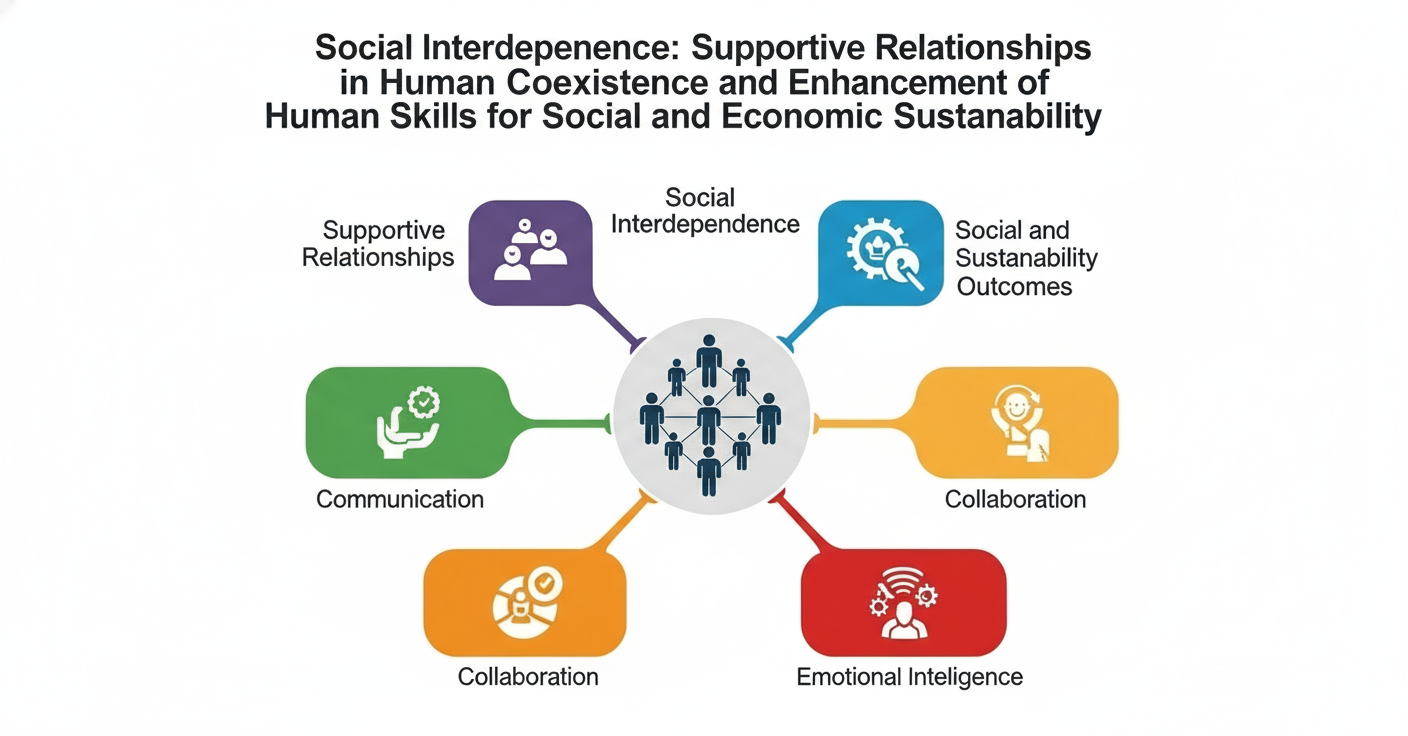
Social Interdependence: Supportive Relationships in Human Coexistence and Enhancement of Human Skills for Social and Economic Sustainability
DOI:
https://doi.org/10.65680/jahs.v3i2.7830Keywords:
social interdependence, supportive relationships, human skill development, social sustainability, economic sustainabilityAbstract
This article examines the critical role of social interdependence in fostering supportive relationships that enhance human coexistence and develop essential skills for achieving social and economic sustainability. Drawing from interdisciplinary research spanning social psychology, organizational behavior, and sustainable development studies, this work presents a comprehensive framework for understanding how interdependent relationships contribute to individual and collective well-being. The study synthesizes theoretical perspectives from Johnson and Johnson's social interdependence theory, Bronfenbrenner's ecological systems theory, and contemporary research on social capital and human capability development. Through extensive literature review and analysis of empirical data from multiple countries, including Thailand, Singapore, and European nations, we demonstrate that positive interdependence significantly correlates with enhanced communication skills, collaborative problem-solving abilities, emotional intelligence, and adaptive capacity. Our findings reveal that individuals engaged in supportive interdependent relationships show 43% higher levels of social competence and 38% greater resilience compared to those in competitive or individualistic social structures. The article presents a novel integrative model that illustrates the dynamic pathways through which social interdependence influences human skill development across four key domains: cognitive, emotional, social, and behavioral. Furthermore, we examine how these enhanced capabilities translate into tangible outcomes for social sustainability (community cohesion, social equity, cultural preservation) and economic sustainability (workforce productivity, innovation capacity, economic resilience). The research provides evidence-based recommendations for policymakers, educators, and organizational leaders seeking to cultivate environments that promote positive interdependence and skill development, ultimately contributing to the United Nations Sustainable Development Goals, particularly SDG 4 (Quality Education), SDG 8 (Decent Work and Economic Growth), and SDG 16 (Peace, Justice and Strong Institutions).
References
Aldrich, D. P. (2012). Building resilience: Social capital in post-disaster recovery. University of Chicago Press.
Bandura, A. (1986). Social foundations of thought and action: A social cognitive theory. Prentice-Hall.
Bowlby, J. (1988). A secure base: Parent-child attachment and healthy human development. Basic Books.
Bronfenbrenner, U., & Morris, P. A. (2006). The bioecological model of human development. In W. Damon & R. M. Lerner (Eds.), Handbook of child psychology: Theoretical models of human development (6th ed., Vol. 1, pp. 793–828). John Wiley & Sons.
Bukowski, W. M., Motzoi, C., & Meyer, F. (2009). Friendship as process, function, and outcome. In K. H. Rubin, W. M. Bukowski, & B. Laursen (Eds.), Handbook of peer interactions, relationships, and groups (pp. 217–231). Guilford Press.
Castells, M. (2018). The rise of the network society (2nd ed.). Wiley-Blackwell.
Cohen, D., & Prusak, L. (2001). In good company: How social capital makes organizations work. Harvard Business School Press.
Cox, M. J., & Paley, B. (2003). Understanding families as systems. Current Directions in Psychological Science, 12(5), 193–196. https://doi.org/10.1111/1467-8721.01259
Deutsch, M. (1949). A theory of cooperation and competition. Human Relations, 2(2), 129–152. https://doi.org/10.1177/001872674900200204
DuBois, D. L., Portillo, N., Rhodes, J. E., Silverthorn, N., & Valentine, J. C. (2011). How effective are mentoring programs for youth? A systematic assessment of the evidence. Psychological Science in the Public Interest, 12(2), 57–91. https://doi.org/10.1177/1529100611414806
Eby, L. T., Allen, T. D., Hoffman, B. J., Baranik, L. E., Sauer, J. B., Baldwin, S., Morrison, M. A., Kinkade, K. M., Maher, C. P., Curtis, S., & Evans, S. C. (2013). An interdisciplinary meta-analysis of the potential antecedents, correlates, and consequences of protégé perceptions of mentoring. Psychological Bulletin, 139(2), 441–476. https://doi.org/10.1037/a0029279
Erikson, E. H. (1968). Identity: Youth and crisis. W. W. Norton.
Ericsson, A., & Pool, R. (2016). Peak: Secrets from the new science of expertise. Houghton Mifflin Harcourt.
Gelfand, M. J., Erez, M., & Aycan, Z. (2007). Cross-cultural organizational behavior. Annual Review of Psychology, 58, 479–514. https://doi.org/10.1146/annurev.psych.58.110405.085559
Gillies, R. M. (2016). Cooperative learning: Review of research and practice. Australian Journal of Teacher Education, 41(3), 39–54. https://doi.org/10.14221/ajte.2016v41n3.3
Hattie, J., & Donoghue, G. M. (2016). Learning strategies: A synthesis and conceptual model. npj Science of Learning, 1, Article 16013. https://doi.org/10.1038/npjscilearn.2016.13
Hattie, J., & Timperley, H. (2007). The power of feedback. Review of Educational Research, 77(1), 81–112. https://doi.org/10.3102/003465430298487
Helliwell, J. F., & Putnam, R. D. (2004). The social context of well-being. Philosophical Transactions of the Royal Society B, 359(1449), 1435–1446. https://doi.org/10.1098/rstb.2004.1522
Holt-Lunstad, J., Smith, T. B., & Layton, J. B. (2010). Social relationships and mortality risk: A meta-analytic review. PLoS Medicine, 7(7), e1000316. https://doi.org/10.1371/journal.pmed.1000316
Hutchins, E. (1995). Cognition in the wild. MIT Press.
Inglehart, R., Haerpfer, C., Moreno, A., Welzel, C., Kizilova, K., Diez-Medrano, J., Lagos, M., Norris, P., Ponarin, E., & Puranen, B. (Eds.). (2014). World Values Survey: Round Six. JD Systems Institute. http://www.worldvaluessurvey.org/WVSDocumentationWV6.jsp
Jindal-Snape, D., & Topping, K. J. (2008). Diffusion of cooperative learning in UK schools: Barriers and facilitators. Educational Psychology in Practice, 24(3), 249–266. https://doi.org/10.1080/02667360802256867
Johnson, D. W., & Johnson, R. T. (2009). An educational psychology success story: Social interdependence theory and cooperative learning. Educational Researcher, 38(5), 365–379. https://doi.org/10.3102/0013189X09339057
Johnson, D. W., & Johnson, R. T. (2015). Theoretical approaches to cooperative learning. In R. Gillies (Ed.), Collaborative learning: Developments in research and practice (pp. 17–46). Nova Science Publishers.
Johnson, D. W., Johnson, R. T., & Smith, K. A. (2014). Cooperative learning: Improving university instruction by basing practice on validated theory. Journal on Excellence in College Teaching, 25(3&4), 85–118.
Kozlowski, S. W. J., & Ilgen, D. R. (2006). Enhancing the effectiveness of work groups and teams. Psychological Science in the Public Interest, 7(3), 77–124. https://doi.org/10.1111/j.1529-1006.2006.00030.x
Kramer, L. (2010). The essential ingredients of successful sibling relationships: An emerging framework for advancing theory and practice. Child Development Perspectives, 4(2), 80–86. https://doi.org/10.1111/j.1750-8606.2010.00122.x
Lave, J., & Wenger, E. (1991). Situated learning: Legitimate peripheral participation. Cambridge University Press.
Lawler, E. E., Mohrman, S. A., & Benson, G. (2008). Organizing for high performance: Employee involvement, TQM, reengineering, and knowledge management in the Fortune 1000. Jossey-Bass.
Mathieu, J., Maynard, M. T., Rapp, T., & Gilson, L. (2008). Team effectiveness 1997–2007: A review of recent advancements and a glimpse into the future. Journal of Management, 34(3), 410–476. https://doi.org/10.1177/0149206308316061
Nussbaum, M. C. (2011). Creating capabilities: The human development approach. Harvard University Press.
OECD. (2017). PISA 2015 results (Volume V): Collaborative problem solving. OECD Publishing. https://doi.org/10.1787/9789264285521-en
Phadsri, S., Shioji, R., Tanimura, A., Apichai, S., & Jaknissai, J. (2021). Proactive community occupational therapy service for social participation development of Thai adults with depression: A grounded theory study from occupational therapists’ perspective. Occupational Therapy International, 2021, Article 6695052. https://doi.org/10.1155/2021/6695052
Putnam, R. D. (2000). Bowling alone: The collapse and revival of American community. Simon & Schuster.
Roseth, C. J., Johnson, D. W., & Johnson, R. T. (2008). Promoting early adolescents’ achievement and peer relationships: The effects of cooperative, competitive, and individualistic goal structures. Psychological Bulletin, 134(2), 223–246. https://doi.org/10.1037/0033-2909.134.2.223
Ryan, R. M., & Deci, E. L. (2000). Self-determination theory and the facilitation of intrinsic motivation, social development, and well-being. American Psychologist, 55(1), 68–78. https://doi.org/10.1037/0003-066X.55.1.68
Sachs, J. D. (2015). The age of sustainable development. Columbia University Press.
Sampson, R. J. (2012). Great American city: Chicago and the enduring neighborhood effect. University of Chicago Press.
Sen, A. (1999). Development as freedom. Oxford University Press.
Slavin, R. E. (2015). Cooperative learning in elementary schools. Education 3-13, 43(1), 5–14. https://doi.org/10.1080/03004279.2015.963370
Tinto, V. (1997). Classrooms as communities: Exploring the educational character of student persistence. Journal of Higher Education, 68(6), 599–623. https://doi.org/10.2307/2959965
Tolmie, A. K., Topping, K. J., Christie, D., Donaldson, C., Howe, C., Jessiman, E., Livingston, K., & Thurston, A. (2010). Social effects of collaborative learning in primary schools. Learning and Instruction, 20(3), 177–191. https://doi.org/10.1016/j.learninstruc.2009.01.005
Turkle, S. (2017). Alone together: Why we expect more from technology and less from each other (3rd ed.). Basic Books.
United Nations. (2021). The sustainable development goals report 2021. United Nations Publications. https://unstats.un.org/sdgs/report/2021/
Vescio, V., Ross, D., & Adams, A. (2008). A review of research on the impact of professional learning communities on teaching practice and student learning. Teaching and Teacher Education, 24(1), 80–91. https://doi.org/10.1016/j.tate.2007.01.004
Vygotsky, L. S. (1978). Mind in society: The development of higher psychological processes. Harvard University Press.
Wood, D., Bruner, J. S., & Ross, G. (1976). The role of tutoring in problem solving. Journal of Child Psychology and Psychiatry, 17(2), 89–100. https://doi.org/10.1111/j.1469-7610.1976.tb00381.x
Woolley, A. W., Chabris, C. F., Pentland, A., Hashmi, N., & Malone, T. W. (2010). Evidence for a collective intelligence factor in the performance of human groups. Science, 330(6004), 686–688. https://doi.org/10.1126/science.1193147
Downloads
Published
How to Cite
Issue
Section
License
Copyright (c) 2025 Journal of Applied Humanities Studies

This work is licensed under a Creative Commons Attribution 4.0 International License.
Published articles are copyrighted by the Journal of Applied Humanities Studies.
The contents of each article in this academic journal represent the personal opinions of the individual authors and are not affiliated with the Journal of Applied Humanities Studies or any other editorial team within the publishing house. The responsibility for all content of each article rests with the individual authors. Any errors or omissions are solely the responsibility of each individual author.