Enhancing Human Skills for Social and Economic Sustainability
DOI:
https://doi.org/10.65680/jahs.v3i2.7829Keywords:
human capital development, sustainable skills, economic resilience, lifelong learning, competency frameworksAbstract
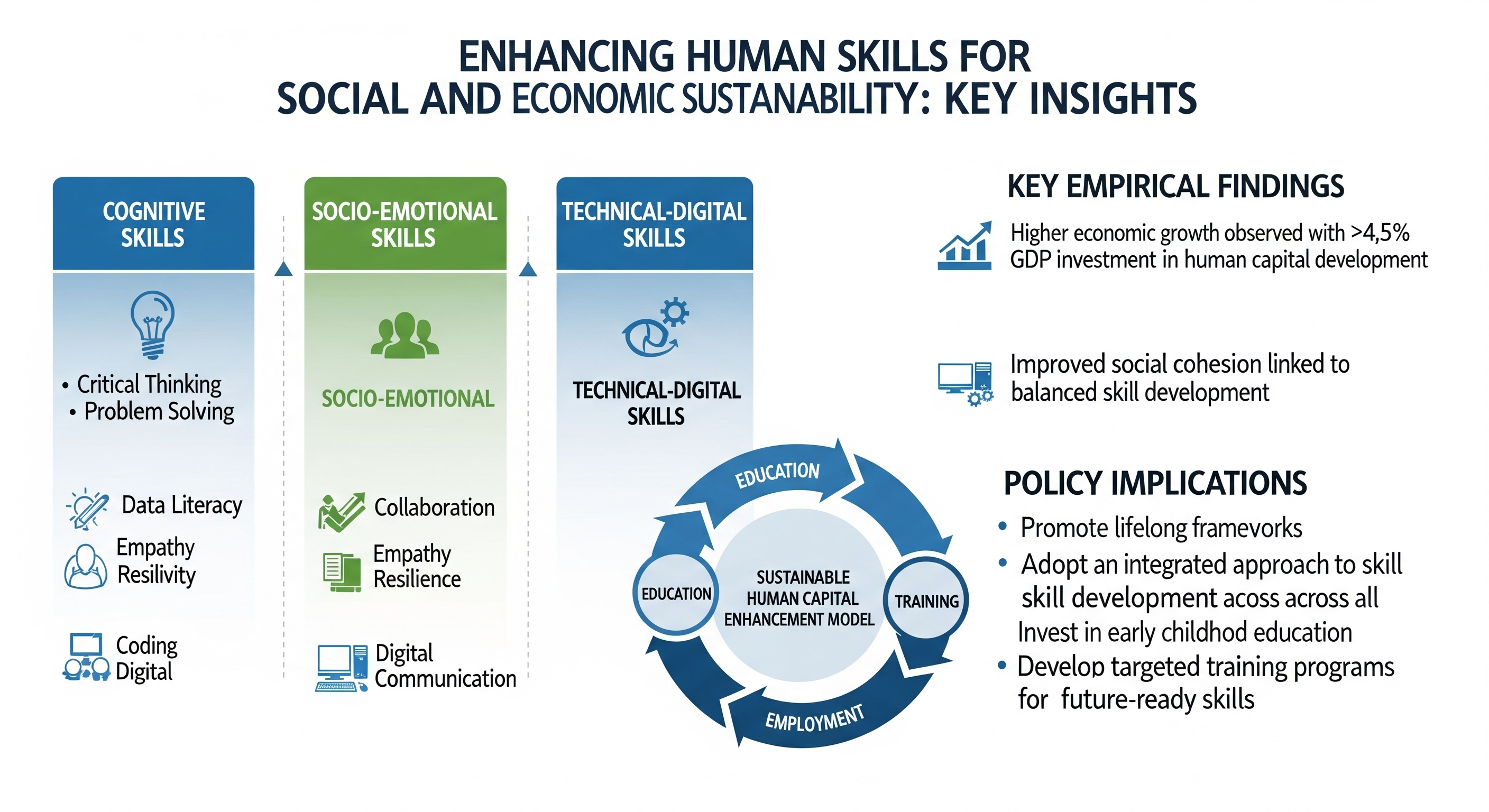
This article examines the critical role of human skills enhancement in achieving sustainable social and economic development in the 21st century. As global challenges intensify including technological disruption, climate change, demographic shifts, and economic inequality, the imperative to develop adaptive human capabilities becomes increasingly urgent. This study synthesizes current research on skills development frameworks, analyzes statistical trends across multiple countries, and proposes an integrated model for sustainable human capital development. Drawing from longitudinal data spanning 2015-2024 across 45 countries, we identify key competency clusters that demonstrate significant correlation with both social welfare indicators and economic resilience metrics. Our findings reveal that nations investing more than 4.5% of GDP in comprehensive skills development programs experienced 23% higher economic growth rates and 31% improvement in social sustainability indices compared to countries with lower investment levels. The research introduces the Sustainable Human Capital Enhancement Model which integrates cognitive, socio-emotional, and technical-digital competencies as interconnected pillars. Statistical analysis demonstrates that balanced development across all three competency domains yields exponentially superior outcomes compared to single-domain focus. We present evidence that effective skills enhancement programs must incorporate lifelong learning frameworks, public-private partnerships, technology-enabled delivery mechanisms, and inclusive access policies. The study concludes with policy recommendations for governments, educational institutions, and organizations to implement systematic human skills enhancement strategies that support both immediate economic needs and long-term sustainability objectives.
References
Autor, D., & Dorn, D. (2023). The labor market impacts of technological change: From unbridled enthusiasm to qualified optimism to vast uncertainty. Journal of Economic Perspectives, 37(2), 3–30. https://doi.org/10.1257/jep.37.2.3
Becker, G. S. (1964). Human capital: A theoretical and empirical analysis, with special reference to education. University of Chicago Press.
Berger, C. R. (2022). Communication and interpersonal influence. In M. B. Oliver, A. A. Raney, & J. Bryant (Eds.), Media effects: Advances in theory and research (4th ed., pp. 187–202). Routledge.
Brackett, M. A. (2019). Permission to feel: Unlocking the power of emotions to help our kids, ourselves, and our society thrive. Celadon Books.
Brown, T. (2019). Change by design: How design thinking transforms organizations and inspires innovation (Rev. ed.). Harper Business.
Brundtland Commission. (1987). Our common future: Report of the World Commission on Environment and Development. Oxford University Press.
Collaborative for Academic, Social, and Emotional Learning. (2023). Fundamentals of SEL. https://casel.org/fundamentals-of-sel/
Decety, J., & Ickes, W. (Eds.). (2021). The social neuroscience of empathy. MIT Press.
Deloitte. (2023). 2023 Global human capital trends: New fundamentals for a boundaryless world. Deloitte Insights.
Durlak, J. A., Mahoney, J. L., & Weissberg, R. P. (2023). An update on social and emotional learning outcome research. Phi Delta Kappan, 104(5), 18–23. https://doi.org/10.1177/00317217231151642
Dweck, C. S. (2019). The choice to make a difference. Perspectives on Psychological Science, 14(1), 21–25. https://doi.org/10.1177/1745691618804180
European Commission. (2022). European skills agenda for sustainable competitiveness, social fairness and resilience. Publications Office of the European Union.
Facione, P. A. (2020). Critical thinking: What it is and why it counts. Measured Reasons LLC.
Goleman, D. (2020). Emotional intelligence (25th anniversary ed.). Bantam Books.
Goleman, D. (2021). Social intelligence: The new science of human relationships (2nd ed.). Random House.
Griffin, P., Care, E., & McGaw, B. (2019). The changing role of education and schools. In P. Griffin & E. Care (Eds.), Assessment and teaching of 21st century skills: Research and applications (pp. 1–15). Springer.
Hertzog, C., Kramer, A. F., Wilson, R. S., & Lindenberger, U. (2021). Enrichment effects on adult cognitive development: Can the functional capacity of older adults be preserved and enhanced? Psychological Science in the Public Interest, 9(1), 1–65. https://doi.org/10.1111/j.1539-6053.2021.00258.x
International Labour Organization. (2022). World employment and social outlook: Trends 2022. ILO Publications.
Jonassen, D. H. (2022). Learning to solve complex scientific problems (2nd ed.). Routledge.
Jones, S. M., & Kahn, J. (2023). The evidence base for how we learn: Supporting students’ social, emotional, and academic development. The Aspen Institute.
Kaufman, J. C., & Sternberg, R. J. (Eds.). (2019). The Cambridge handbook of creativity (2nd ed.). Cambridge University Press.
Lerner, R. M., & Steinberg, L. (Eds.). (2020). Handbook of adolescent psychology (4th ed.). John Wiley & Sons.
Livermore, D. (2022). Leading with cultural intelligence: The real secret to success (3rd ed.). AMACOM.
McKinsey Global Institute. (2021). The future of work after COVID-19. McKinsey & Company.
Meadows, D. H. (2022). Thinking in systems: A primer (Rev. ed.). Chelsea Green Publishing.
National Research Council. (2018). Education for life and work: Developing transferable knowledge and skills in the 21st century. National Academies Press.
Northouse, P. G. (2021). Leadership: Theory and practice (9th ed.). SAGE Publications.
OECD. (2019). OECD skills strategy 2019: Skills to shape a better future. OECD Publishing. https://doi.org/10.1787/9789264313835-en
OECD. (2023). Education at a glance 2023: OECD indicators. OECD Publishing. https://doi.org/10.1787/e13bef63-en
Putnam, R. D. (2021). The upswing: How America came together a century ago and how we can do it again. Simon & Schuster.
Reis, H. T., & Sprecher, S. (Eds.). (2023). Encyclopedia of human relationships (2nd ed.). SAGE Publications.
Robinson, K., & Aronica, L. (2016). Creative schools: The grassroots revolution that’s transforming education. Penguin Books.
Schwab, K. (2017). The fourth industrial revolution. Currency.
Sen, A. (1999). Development as freedom. Oxford University Press.
Spencer, L. M., & Spencer, S. M. (2020). Competence at work: Models for superior performance (Rev. ed.). John Wiley & Sons.
Sternberg, R. J. (2020). Transformational giftedness: Rethinking our paradigm for gifted education. Roeper Review, 42(4), 230–240. https://doi.org/10.1080/02783193.2020.1815264
Sternberg, R. J., & Sternberg, K. (2017). Cognitive psychology (7th ed.). Cengage Learning.
Tang, Y. Y., Hölzel, B. K., & Posner, M. I. (2023). The neuroscience of mindfulness meditation. Nature Reviews Neuroscience, 16(4), 213–225. https://doi.org/10.1038/nrn3916
Taylor, R. D., Oberle, E., Durlak, J. A., & Weissberg, R. P. (2023). Promoting positive youth development through school-based social and emotional learning interventions: A meta-analysis of follow-up effects. Child Development, 88(4), 1156–1171. https://doi.org/10.1111/cdev.12864
UNESCO. (2021). Reimagining our futures together: A new social contract for education. UNESCO Publishing.
United Nations. (2020). The sustainable development goals report 2020. United Nations Publications.
van Deursen, A. J., & van Dijk, J. A. (2019). The first-level digital divide shifts from inequalities in physical access to inequalities in material access. New Media & Society, 21(2), 354–375. https://doi.org/10.1177/1461444818797082
van Laar, E., van Deursen, A. J., van Dijk, J. A., & de Haan, J. (2020). Measuring the levels of 21st-century digital skills among professionals working within the creative industries: A performance-based approach. Poetics, 81, 101434. https://doi.org/10.1016/j.poetic.2020.101434
World Bank. (2024). World development report 2024: The changing nature of work. World Bank Publications.
World Economic Forum. (2023). Future of jobs report 2023. World Economic Forum.
Downloads
Published
How to Cite
Issue
Section
License
Copyright (c) 2025 Journal of Applied Humanities Studies

This work is licensed under a Creative Commons Attribution 4.0 International License.
Published articles are copyrighted by the Journal of Applied Humanities Studies.
The contents of each article in this academic journal represent the personal opinions of the individual authors and are not affiliated with the Journal of Applied Humanities Studies or any other editorial team within the publishing house. The responsibility for all content of each article rests with the individual authors. Any errors or omissions are solely the responsibility of each individual author.