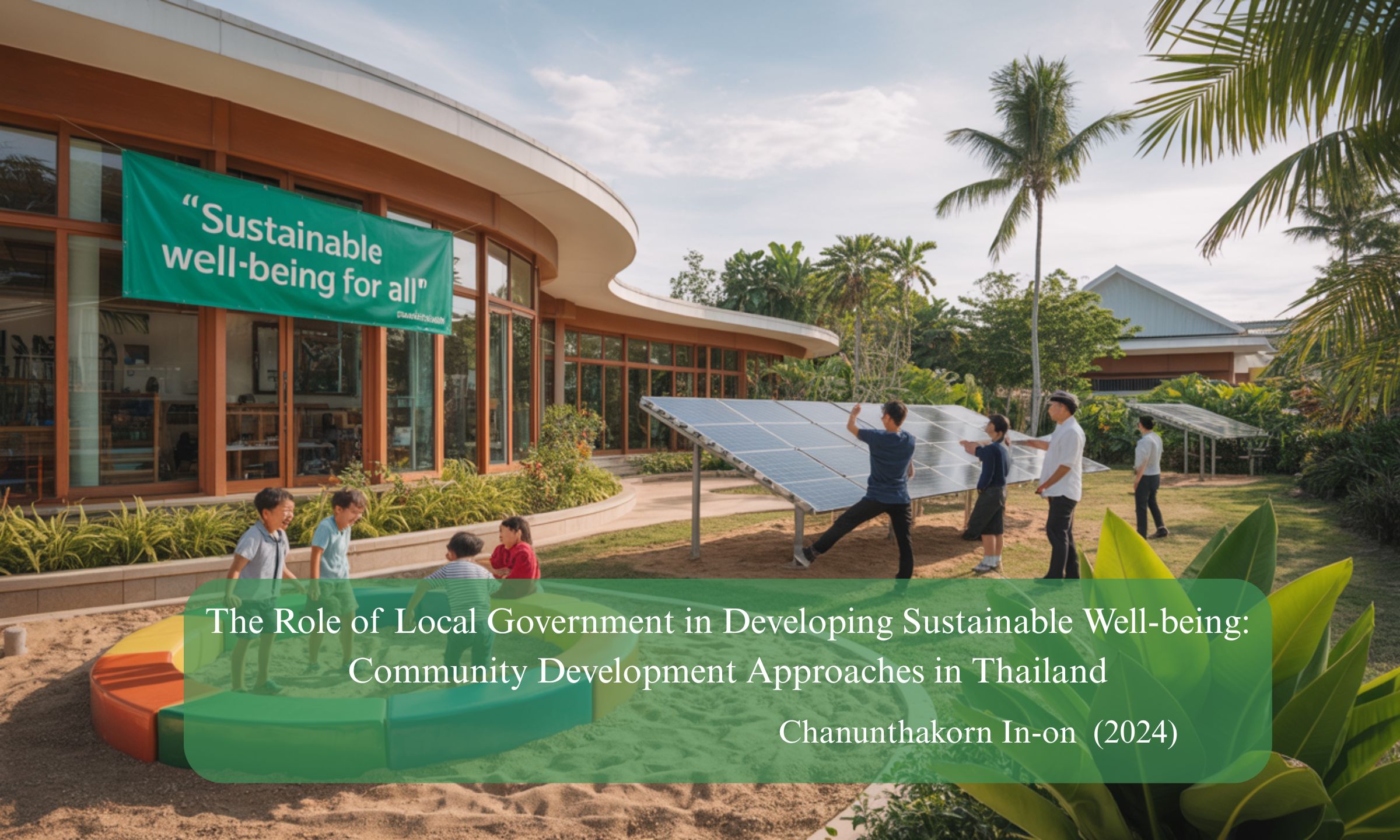
The Role of Local Government in Developing Sustainable Well-being: Community Development Approaches in Thailand
DOI:
https://doi.org/10.65680/jahs.v2i2.7185Keywords:
local governance, well-being, sustainable development, citizen participation, local communityAbstract
This article aims to analyze the role of local government in developing sustainable well-being in Thailand under the framework of sustainable development concepts and the United Nations Sustainable Development Goals (SDGs). The study reveals that local government plays five crucial roles: developing sustainable infrastructure, promoting community economy, managing natural resources and environment, strengthening social and cultural capacity, and promoting citizen participation. The article presents an integrated development approach that connects local governance with sustainable development principles, emphasizing the importance of cooperation among government, private sector, and civil society. The findings demonstrate that effective local governance can serve as a vital mechanism for creating long-term citizen well-being through capacity building of local government organizations, improving legal and policy frameworks, and establishing efficient monitoring and evaluation systems. The article provides policy recommendations for enhancing the role of local governments in sustainable governance. The research contributes to understanding how local governance can effectively drive sustainable development goals at the community level, particularly SDG 11 on sustainable cities and communities, while addressing unique challenges and opportunities within the Thai context.
References
Ahmad, M., Khan, Z., Rahman, Z. U., & Khan, S. (2020). Does financial development asymmetrically affect CO2 emissions in China? An application of the nonlinear autoregressive distributed lag (NARDL) model. Carbon Management, 11(6), 631-647.
Arnstein, S. R. (1969). A ladder of citizen participation. Journal of the American Institute of Planners, 35(4), 216-224.
Boonchoo, P., & Pinyoanunt, P. (2023). Sustainable development and local governance in Thailand: Challenges and opportunities. Asian Journal of Public Administration, 45(2), 123-145.
Charoensin-o-larn, C. (2021). Decentralization and local development in Thailand: Progress and prospects. Journal of Southeast Asian Studies, 52(3), 445-467.
Department of Local Administration. (2024). Statistics of local administrative organizations 2024. Ministry of Interior.
Diener, E., & Seligman, M. E. P. (2004). Beyond money: Toward an economy of well-being. Psychological Science in the Public Interest, 5(1), 1-31.
Ellen MacArthur Foundation. (2019). Completing the picture: How the circular economy tackles climate change. Ellen MacArthur Foundation.
Evans, P., & Campos, J. E. (2013). Constructing good governance: Getting from isomorphism to effectiveness. World Bank Publications.
Gaventa, J. (2006). Finding the spaces for change: A power analysis. IDS Bulletin, 37(6), 23-33.
Hulst, R., & Montfort, A. V. (2007). Inter-municipal cooperation in Europe. Springer Science & Business Media.
Jiraporn Poolsawat. (2022). Challenges of Thai local governance in the digital age. Political Science Journal, 43(1), 78-102.
Millennium Ecosystem Assessment. (2005). Ecosystems and human well-being: Synthesis. Island Press.
Newman, P., Beatley, T., & Boyer, H. (2019). Resilient cities: Overcoming fossil fuel dependence. Island Press.
Nitirat Sitthikjon. (2020). Evolution of decentralization to local levels in Thailand. Chiang Mai University Law Journal, 29(2), 45-67.
OECD. (2019). Making decentralisation work: A handbook for policy-makers. OECD Publishing.
OECD. (2020). Better life index 2020: Measuring well-being. OECD Publishing.
Office of the Decentralization Committee to Local Administrative Organizations. (2022). Annual report 2022. Office of the Prime Minister.
Office of the National Economic and Social Development Council. (2021). The 13th National Economic and Social Development Plan (2023-2027). Office of the National Economic and Social Development Council.
Osborne, D., & Gaebler, T. (1992). Reinventing government: How the entrepreneurial spirit is transforming the public sector. Addison-Wesley.
Peters, B. G. (2018). The politics of bureaucracy: An introduction to comparative public administration. Routledge.
Porter, M. E., & Kramer, M. R. (2019). Creating shared value. In Managing sustainable business (pp. 323-346). Springer.
Putnam, R. D. (2000). Bowling alone: The collapse and revival of American community. Simon & Schuster.
Rhodes, R. A. W. (1997). Understanding governance: Policy networks, governance, reflexivity and accountability. Open University Press.
Shah, A. (2006). Local governance in developing countries. World Bank Publications.
Slack, E. (2019). The property tax in theory and practice. Institute on Municipal Finance and Governance.
Sterling, S. (2011). Transformative learning and sustainability: Sketching the conceptual ground. Learning and Teaching in Higher Education, 5, 17-33.
Stiglitz, J. E., Sen, A., & Fitoussi, J. P. (2009). Report by the commission on the measurement of economic performance and social progress. Commission on the Measurement of Economic Performance and Social Progress.
Surachai Limsagul. (2022). Evaluation of decentralization results in Thailand: Lessons and development approaches. Public Administration Development Journal, 62(3), 123-156.
UNDP. (1997). Governance for sustainable human development. United Nations Development Programme.
UNESCO. (2020). Education for sustainable development: A roadmap. UNESCO Publishing.
United Nations. (2015). Transforming our world: The 2030 agenda for sustainable development. United Nations General Assembly.
United Nations Development Programme. (2020). Human development report 2020: The next frontier human development and the anthropocene. UNDP.
Wichai Chokviwat. (2023). Local governance innovation for sustainable development. Local Government Administration Journal, 36(2), 89-115.
World Commission on Environment and Development. (1987). Our common future. Oxford University Press.
World Health Organization. (2020). Healthy cities: Good health is good politics. WHO Press.
World Water Council. (2018). Water security for peace and development. World Water Council.
Downloads
Published
How to Cite
Issue
Section
License
Copyright (c) 2024 Journal of Applied Humanities Studies

This work is licensed under a Creative Commons Attribution 4.0 International License.
Published articles are copyrighted by the Journal of Applied Humanities Studies.
The contents of each article in this academic journal represent the personal opinions of the individual authors and are not affiliated with the Journal of Applied Humanities Studies or any other editorial team within the publishing house. The responsibility for all content of each article rests with the individual authors. Any errors or omissions are solely the responsibility of each individual author.